
Luxury Sneaker
Store Insurance.
init coverage --vertical=sneaker --inventory=high-value --resale=enabled
A grail-tier sneaker shop is one of the least conventional retail accounts in the property & casualty market. Resale value is the price tag — not the wholesale cost. Inventory is held on consignment as often as it's bought outright. Authentication is the whole product. And the moment counterfeit goods slip past the desk, the store is exposed to federal trademark law and a brand-owner lawsuit that doesn't care whether the store knew. Standard small-business retail policies were not written for any of that.
The brokerage places programs purpose-built for the luxury sneaker, streetwear, and grail vertical — from single-storefront flagship shops to consignment-led multi-location operations to hybrid stores running an in-house drop calendar alongside an online resale arm. The form respects what the inventory actually is, where the counterfeit risk actually lives, and which forms actually respond when a theft, a swap, a fake, or a chargeback storm hits.
Wearing apparel and accessories seizure lines in FY 2023, leading all CBP IPR enforcement categories at 26.2% of total seizures.
CBP · FY 2023 IPR Seizure StatisticsYear-over-year increase in MSRP value of goods seized for IPR violations from FY 2023 to FY 2024, per CBP's published seizure statistics.
CBP · FY 2024 IPR Seizure StatisticsMaximum statutory damages per counterfeit mark per type of goods for willful counterfeit-mark trademark infringement under 15 USC § 1117(c)(2).
15 USC § 1117(c)(2)Counterfeit pairs of Nike sneakers StockX was held liable for selling under March 2025 summary judgment ruling in Southern District of New York; case settled August 2025 with prejudice.
SDNY · Nike v. StockXWhy a sneaker store isn't a shoe store.
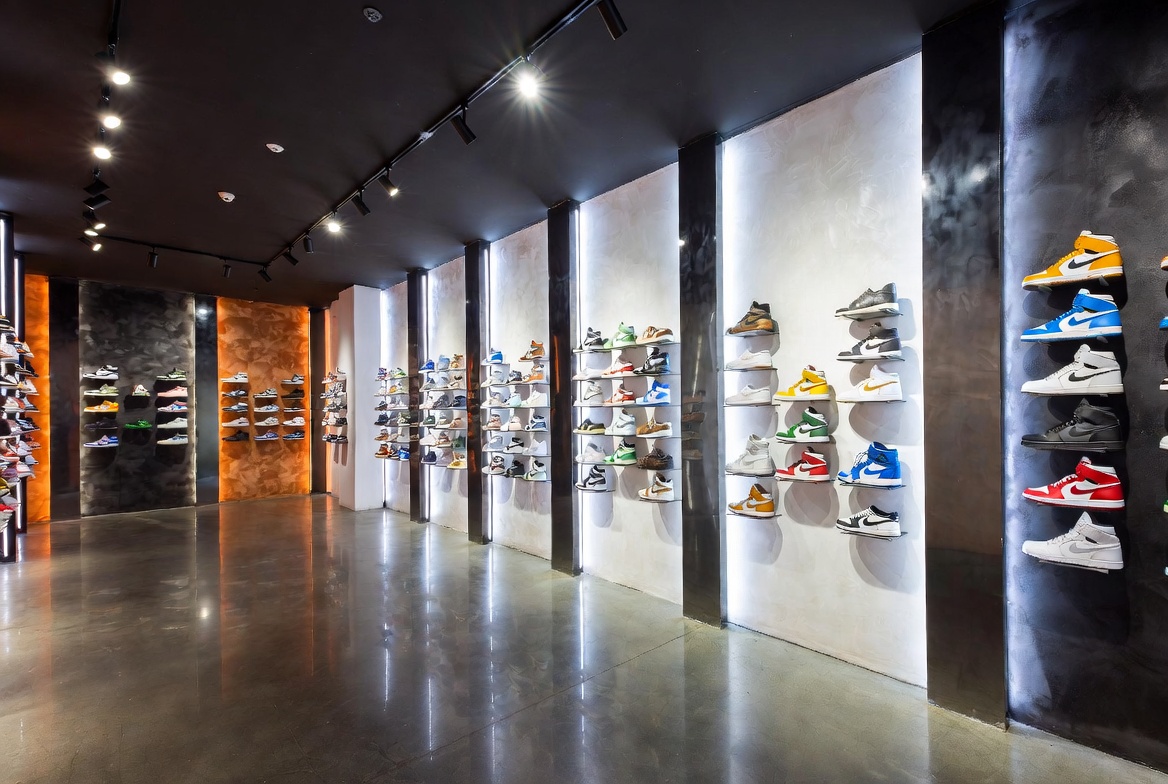
A general-line shoe retailer sells inventory at retail markup over wholesale cost, holds modest replacement-cost value, and rotates seasonally. A luxury sneaker store doesn't operate that way. The flagship product on the wall — a Travis Scott Air Jordan 1 Low, a Yeezy Foam Runner colorway, a Dior x Air Jordan 1 release, a Tiffany x Nike collaboration — sat on a release-day retail price for less than a minute before its real market price was the secondary one. The price the store quotes the customer is the resale price. The price the store paid is rarely the same number.
That gap reshapes the entire insurance question. Replacement-cost valuation on a standard business owners policy values the inventory at "your cost." But the store's customer-facing exposure runs at the resale-market value — the customer who paid $8,400 for a graded grail-tier piece doesn't accept a $200 wholesale replacement when the store loses the shoe. Carriers that understand the vertical write coverage at agreed value or at fair-market replacement; carriers that don't understand it underwrite the account as a general retail risk and leave the store underinsured.
Underneath the visual merchandising, the structure looks much closer to a fine-jewelry retailer or a diamond dealer than to a streetwear chain. That's where the form architecture comes from. The brokerage builds programs around specialty retail JBP-equivalent coverage forms, scaled to peak inventory aggregates and adjusted for the unique counterfeit, swap, and platform-resale exposures that exist nowhere else in the retail book.
Six store types. Six different forms.
"Luxury sneaker store" describes at least six distinct operating models. The cards below map what each one is and the coverage architecture that tends to dominate the rating for that profile.
The Brick-And-Mortar Flagship
Owned inventory, curated buying, in-store authentication. Sales register on retail POS; web presence is marketing-led, not transactional. Conventional retail forms scaled aggressively up on theft, burglary, and BPP limits. CCTV, alarm grade, and after-hours protocols all rated.
The Consignment House
Inventory is mostly held on consignment from individual sellers and resellers. The store doesn't own most of what's on the wall. Bailee & customers' goods is the load-bearing form. UCC Article 9 governs ownership posture and creditor exposure in the event of consignor disputes.
The Hybrid Retail + Resale Platform
Brick-and-mortar plus a full online resale arm — frequently listing on the store's own e-commerce site plus marketplace mirrors. Inventory cycles through both channels. Cyber, chargeback fraud, and counterfeit-sale defense all elevate to first-tier exposures.
The Authentication-As-Service Operation
The store offers paid authentication on units owned by others — sometimes as a standalone service, sometimes alongside its consignment model. Coverage for property of others is non-negotiable. Professional liability (E&O) for the authentication opinion is critical.
The Drop / Pop-Up Activation
Time-bounded retail event — a brand collaboration drop, a tour-merch activation, a SneakerCon booth. Short-term coverage scoped to the event window, with location additional insureds for the host venue and elevated peak inventory limits during the drop.
The Multi-Location Specialty Chain
Three to twenty-plus stores across markets. Schedule of locations on the policy; coordinated burglary and crime-line treatment across stores; head-office cyber and corporate exposures handled as a separate program tier. Excess and umbrella scale aggressively.
The seven-stage path from consignor to sale.
Authentication is the entire product. The sequence below is a generalized model of the verification path most luxury sneaker operations run — and the stages where coverage gaps tend to show up under stress.
auth_pipeline.run()
7 stages · asyncIntake
scan_in()
chain_of_custody
Box Check
label_match
weight_check
Visual Audit
stitching
typography
silhouette
Materials
leather/foam
colorway
texture
Sole & Stamp
sku_match
factory_code
date
Sign-Off
authenticator_id
timestamp
Vault / Floor
tag_apply
storage_route
The authenticator's signed-off opinion at Stage 06 is the moment professional liability (E&O) coverage activates. If a unit later turns out to be counterfeit despite that sign-off — a "miss" in the auth pipeline — the store's E&O responds to the buyer's claim. The bailee or property form responds to the loss of the unit itself. Two separate forms, two separate triggers.
The Lanham Act, codified at 15 USC § 1117, allows trademark owners to elect statutory damages of $1,000 to $200,000 per counterfeit mark per type of goods sold — and up to $2,000,000 per counterfeit mark per type of goods for willful infringement (§ 1117(c)(2)). A single fake pair sold knowingly — or sold under a "guaranteed authentic" representation when reasonable diligence would have caught it — can pierce the E&O policy's intentional acts exclusion and leave the store directly exposed to brand-owner litigation.
Line-by-line. The forms a store actually needs.
The log on the right is the structural backbone — the lines that show up on a clean luxury sneaker store program. Some lines are non-negotiable; others attach based on operating model. The brokerage matches the build to the actual operating profile, not to a generic retail package.
Many of these lines look familiar to retail brokers but are written differently for high-value resale. Bailee on a fashion-boutique form responds at wholesale; bailee on a specialty retail JBP-equivalent form responds at agreed-value resale. The form name matters less than the valuation method written into the actual policy.
Specialty Retail Property
BPP at agreed value or fair-market replacement on owned inventory. Sub-limits for vault stock, floor stock, and after-hours. UL-rated safe expectation scales with peak aggregate.
Bailee & Customers' Goods
Load-bearing for consignment-led stores. Per-consignor schedule, peak aggregate, mysterious disappearance sub-limit. Valuation method agreed in advance.
Commercial General Liability
Premises bodily injury and property damage. Personal & advertising injury — important for any store running social channels or making authentication claims publicly.
Crime / Theft / Robbery
Forcible entry burglary, robbery during operating hours, employee dishonesty. Mysterious disappearance frequency is the underwriter's central concern; documented inventory procedures matter.
Professional Liability (E&O)
Authentication-opinion E&O. Responds to a buyer's claim that the store warranted a unit as authentic when it was not. Critical for any store offering paid authentication.
Cyber & Privacy
Breach response, PCI fines, funds-transfer fraud. Hybrid retail/online operations sit on multiple PII collection points (POS, e-commerce, consignor onboarding).
Workers' Compensation + EL
Statutory for W-2 staff. Authenticators frequently classified as employees regardless of contract structure under state ABC tests.
Inland Marine / Transit
For shipments between locations, drop-off pickups, returns. USPS Registered Mail for high-value individual shipments; carrier care-custody-control language for multi-pair shipments.
Business Income / Extra Expense
Lost revenue and continuing expenses during a covered loss. Period of indemnity should reflect the store's drop calendar, not a generic twelve-month default — peak weeks drive recovery math.
Hired & Non-Owned Auto
If the store transports inventory in personal vehicles, courier pickup, or rented vans during drop events. Cargo coverage layered where appropriate.
Umbrella / Excess
$1M–$5M typical first layer. Major mall and high-end retail center venue contracts frequently require $5M–$10M total liability tower.
Active Shooter / Workplace Violence
An honest line for the vertical. Drop events draw lines, draw crowds, and create elevated workplace-violence exposure that ordinary retail GL doesn't speak to.
Six incident classes. How they actually land on a file.
The patterns below are composite illustrations of the claim types the specialty market actually sees on luxury sneaker store files. They are educational — they do not describe specific clients. Actual coverage depends on the specific policy form, sub-limits, and exclusions in force at the time of loss.
After-Hours Forced-Entry Burglary
Smash-and-grab attack outside operating hours. Multiple grail-tier units removed. Alarm system activated, central-station response logged. Crime / burglary coverage responds, subject to UL safe rating compliance and alarm certification documentation.
Authenticated Unit Later Found To Be Counterfeit
A unit sold to a customer with the store's authentication tag is later resubmitted to a third-party authenticator and identified as counterfeit. Customer demands refund and consequential damages. E&O responds for defense costs and indemnity, subject to intentional-acts exclusion analysis.
Trademark Owner Demand Letter / Lawsuit
A brand owner — Nike, adidas, LVMH-portfolio — sends a cease-and-desist or files suit alleging the store sold counterfeit goods bearing the owner's marks. Lanham Act statutory damages exposure plus injunctive relief and attorney's fees engaged. Defense costs run quickly into six figures.
Sneaker Swap At Authentication Or Try-On
A customer tries on or examines a unit on the floor and substitutes a worn or counterfeit pair, leaving with the store's authentic unit. Frequent. Mysterious disappearance sub-limit; floor procedures and CCTV review are the underwriting variables.
Card-Not-Present Chargeback Avalanche
A pattern of fraudulent online orders using stolen card data, followed by chargebacks once the genuine cardholder identifies the unauthorized transactions. Cyber form's funds-transfer fraud and card-not-present coverage respond depending on facts and processor relationship.
Drop-Day Crowd Incident
Line outside the store on a major release day. Customer injury, property damage to neighboring tenants, dispute with mall security, or unwanted media coverage from a crowd surge. CGL and premises liability respond; venue contracts often require additional insured endorsements for the host property.
Scenarios above are composite illustrations drawn from publicly documented claim categories in the specialty retail class. Actual coverage outcomes are determined by the specific policy forms, endorsements, sub-limits, deductibles, and exclusions in force at the time of loss. Nothing on this page is a coverage opinion or a guarantee of payment under any specific policy.
Pages that sit alongside a sneaker store file.
// retail · resale · authentication · jewelry-adjacent
// fashion industry cluster
// core coverage lines
Questions sneaker operators ask first.
Will a standard small-business retail policy cover our shop?
What's "agreed value" and why does it matter for our inventory?
If we authenticate a unit and it later turns out to be fake, are we covered?
What is the Lanham Act and how does it affect us?
15 USC § 1114) creates civil liability for trademark infringement; Section 35 (15 USC § 1117) sets damages — including the option for the trademark owner to elect statutory damages of $1,000 to $200,000 per counterfeit mark per type of goods, rising to $2,000,000 per counterfeit mark per type of goods for willful counterfeiting. For a luxury sneaker store, the Lanham Act is the legal framework under which a brand like Nike, adidas, or LVMH brings suit if counterfeit goods bearing the brand's marks are sold. The Nike v. StockX litigation — counterfeiting summary judgment in March 2025, settled in August 2025 — is the most-cited recent application in the resale vertical.What protects us if a represented seller's inventory is seized in their bankruptcy?
UCC § 9-515 every five years, generally protects the consignor's interest. If the consignor failed to perfect, the inventory may be subject to the consignor's creditors and the store may face disruption while the dispute resolves. The store's policy doesn't change the legal outcome — but business income coverage responds to the operational disruption, and a clear consignment agreement template is the upstream protection.How does cyber coverage actually work for us if Shopify or another platform hosts the storefront?
What kind of physical security do underwriters expect?
How are our authenticators classified — employees or contractors?
Does our policy cover drop events at our store or at a third-party venue?
What if our store has been declined or non-renewed by a previous carrier?
Are our customers' shoes covered while we have them for trade-in evaluation?
How long does a luxury sneaker store submission take?
Start the luxury sneaker store submission.
Use the intake portal to begin the submission, or schedule a discovery call to walk through the inventory model, peak aggregate, authentication workflow, and drop calendar before any paperwork moves. Clean submissions move from intake to first carrier indication within five to ten business days.