
Jewelry & Watch Rental Insurance
A fine jewelry store is built on the premise of keeping inventory locked down. A jewelry or watch rental business is built on the exact opposite premise: taking your most valuable assets and shipping them out to strangers across the country. In the insurance world, this represents an extreme concentration of transit risk, bailee exposure, and the industry’s most devastating pitfall: Voluntary Parting.
Standard property and Jewelers Block policies categorically exclude losses where you voluntarily hand an item over to someone who then steals it—which is exactly what happens in a fraudulent rental transaction or synthetic identity scam. At Kelly Insurance Group, we architect specialized inland marine and rental floaters that directly address voluntary parting, secure transit exposures via designated carriers, and protect the bailee liability of peer-to-peer consignment models.
Coverage Footprint Of A Rental Operation
The Gap Between "Theft" and "Fraud" in Rentals
For a rental company, the most devastating insurance discovery often happens after the worst-case scenario: a customer rents a $40,000 Patek Philippe or a diamond collar, the return date passes, the credit card on file bounces, and the customer vanishes. You file a claim for theft, only to receive a denial letter citing the "Voluntary Parting Exclusion."
In the eyes of standard insurance contracts, theft is someone breaking into your vault. Fraud is you willingly boxing up the asset and handing it to a criminal because they tricked you with a fake identity or stolen credit card. A standard Jewelers Block or Commercial Property policy explicitly strips out coverage for voluntary parting. If your business model is renting hard luxury goods, standard policies leave you exposed on every single transaction.
Kelly Insurance Group builds programs specifically for rental, subscription, and peer-to-peer consignment models. We integrate rigorous underwriting requirements—like mandatory biometric ID verification and specific shipping protocols—to secure the coverage that responds when a renter turns into a thief, when FedEx loses a package, or when a piece is returned damaged beyond repair.
Find Your Operating Segment
Click the segment that matches your operation. While this page focuses on Rental and Consignment operations, our coverage hub addresses the entire luxury and fashion supply chain.
Fashion & Jewelry Operating Segments
// SELECT A SEGMENT FOR DETAILRental, Resale & Consignment
Operations holding and renting goods belonging to the house or to third-party consignors. Bailee exposure is the load-bearing line, alongside the massive threat of voluntary parting (fraudulent rentals) and physical damage during the rental period.
The Legal Framework of Luxury Rentals
Renting out high-value jewelry and timepieces operates in a complex intersection of secured transactions, consumer protection, and data security. Your underwriting eligibility hinges heavily on how your platform handles these compliance layers.
Uniform Commercial Code (Consignment)
UCC Article 9If you operate a peer-to-peer model where owners consign their watches to you for rental, UCC Article 9 dictates how security interests are perfected. Without proper filings, a consignor's watch could be seized by the rental company's creditors in a bankruptcy.
Payment Card Industry Data Security Standard
PCI-DSSRental platforms frequently hold large authorizations or security deposits on client credit cards. Strict PCI compliance is required to store this data. A breach exposing client financials triggers massive regulatory fines and chargeback cascades.
State Rental and Lease Statutes
State-by-State Consumer LawConsumer protection laws dictate what constitutes "wear and tear" versus "damage," and tightly regulate how and when you can seize a security deposit for a scratched watch crystal or missing diamond.
FTC Identity Theft Rules
16 CFR Part 681 (Red Flags Rule)Companies acting as creditors (extending terms or holding deposits) must implement written Identity Theft Prevention Programs to detect "red flags" of synthetic or stolen identity usage during customer onboarding.
How A Rental Platform Insurance Program Is Built
A jewelry and watch rental platform requires a fundamentally different architecture than a static retail store. Coverage must follow the asset out the door, across state lines, into the customer's hands, and back—closing the gaps where standard property forms fail.

The Core: Rental Floater
Inland Marine & Voluntary PartingThe specialized form designed for goods expected to leave your custody. It must explicitly include Voluntary Parting coverage to respond to fraudulent rentals and conversion by the renter.
Transit & Bailee Lines
Shipping & Peer-to-PeerOutbound and return shipping present massive choke points for theft. High-limit transit coverage is required, alongside Bailee's Customer forms if you are renting out watches that belong to other investors.
Authentication & Operations
E&O and PropertyIf you authenticate watches (verifying a Rolex isn't a "super-clone"), E&O coverage defends against claims of misrepresentation. Commercial Property covers your vault and operations center.
Digital Platform Risk
Cyber & CrimeRental platforms hold massive ID verification files (passports, driver's licenses) and credit card holds. Cyber liability and Employee Dishonesty (internal theft of inventory or data) are mandatory.
What Makes Luxury Rental Underwriting Difficult
Underwriting a rental platform isn't about inspecting your physical safe; it's about auditing your digital processes. Carriers look at how you verify a customer's identity and how you handle the logistics of shipping a $20,000 asset in a cardboard box.
The Identity Verification Warranty
Just as a retail store has a "safe warranty," a rental platform has an ID verification warranty. To secure Voluntary Parting coverage, the underwriter will mandate specific procedures: biometric ID matching, third-party fraud scoring (e.g., Jumio, Stripe Identity), and matching the shipping address to the credit card billing address. If you bypass these steps to close a rental quickly and the asset is stolen, the claim is void.
- Mandatory biometric ID verification steps
- Address mismatch flags and manual review
- Strict adherence to underwriting protocol warranties
The Return-Fraud Threat (Super-Clones)
A sophisticated fraud vector involves a customer renting a genuine luxury timepiece (like an Audemars Piguet or Rolex), and returning an identical, high-grade "super-clone" counterfeit in its place. The company doesn't realize the switch until the watch goes to the bench for inspection. Policies must be structured to treat this conversion as a covered loss under the voluntary parting or entrustment provisions.
- Micro-engraving and serial number tracking
- Bench inspection protocols upon return
- Conversion and entrustment coverage triggers
Outbound & Inbound Transit
Transit is the most vulnerable point in the rental lifecycle. Porch pirates, intercepted reroutes (where a fraudster requests FedEx hold the package at a different location), and lost returns are constant threats. Standard carrier liability from UPS or FedEx caps at minimal amounts (often $1,000 for jewelry). High-limit, standalone transit policies or specialized courier services (like ParcelPro) are required to bridge the gap.
- Signature-required, no-reroute shipping rules
- Standalone Inland Marine transit floaters
- Return-shipping label control
Wear and Tear vs. Physical Damage
A renter returns a diamond necklace with a missing stone, or a watch with a shattered sapphire crystal. Is it standard wear and tear (excluded) or sudden physical damage (covered)? Rental contracts must clearly define customer liability, and the insurance policy must provide "all-risk" physical damage coverage for goods in use to protect the asset's value when customer deposits fall short.
- "All-risk" physical damage floaters
- Subrogation against the renter's deposit/card
- Clear definitions of excluded wear-and-tear
Generic Jewelers Block vs. Rental-Specific Floater
Many rental operators mistakenly purchase a standard Jewelers Block, assuming it covers all jewelry business models. It does not. The exclusions in a standard block will bankrupt a rental operation after a single sophisticated fraud event.
Generic Jewelers Block — What Fails
- Explicitly excludes "Voluntary Parting" and conversion.
- Excludes physical damage that occurs while the item is in use by a customer.
- Drastically limits transit coverage for packages sent to residential addresses.
- Often requires goods to be in a UL-rated safe overnight, which is impossible during a rental term.
- Lacks bailee coverage tailored for peer-to-peer consignment models.
Built-For-Rental Program — What Responds
- Includes Voluntary Parting coverage (subject to ID verification warranties).
- "All-risk" physical damage coverage follows the asset while in the renter's possession.
- Specialized transit limits for outbound and return shipping to residential addresses.
- Off-premises limits designed around the volume of inventory out on rental simultaneously.
- Full Bailee's Customer coverage protecting investors/consignors who supply the watches.
Securing Voluntary Parting coverage is difficult and requires presenting a flawless operational narrative to underwriters. We must prove your fraud-prevention technology stack (biometrics, 3D Secure payments, address verification) is robust enough to mitigate the extreme risks of the asset class.
Where The Transit Exposure Lives
The backbone of a jewelry rental business is logistics. From the vault, into the transport case, through the courier network, and to the client's door. Every handoff is a potential point of failure. Standard courier liability is deeply inadequate for luxury goods; an entire pelican case of rented timepieces will yield a fraction of its value if lost by a major carrier without third-party insurance.
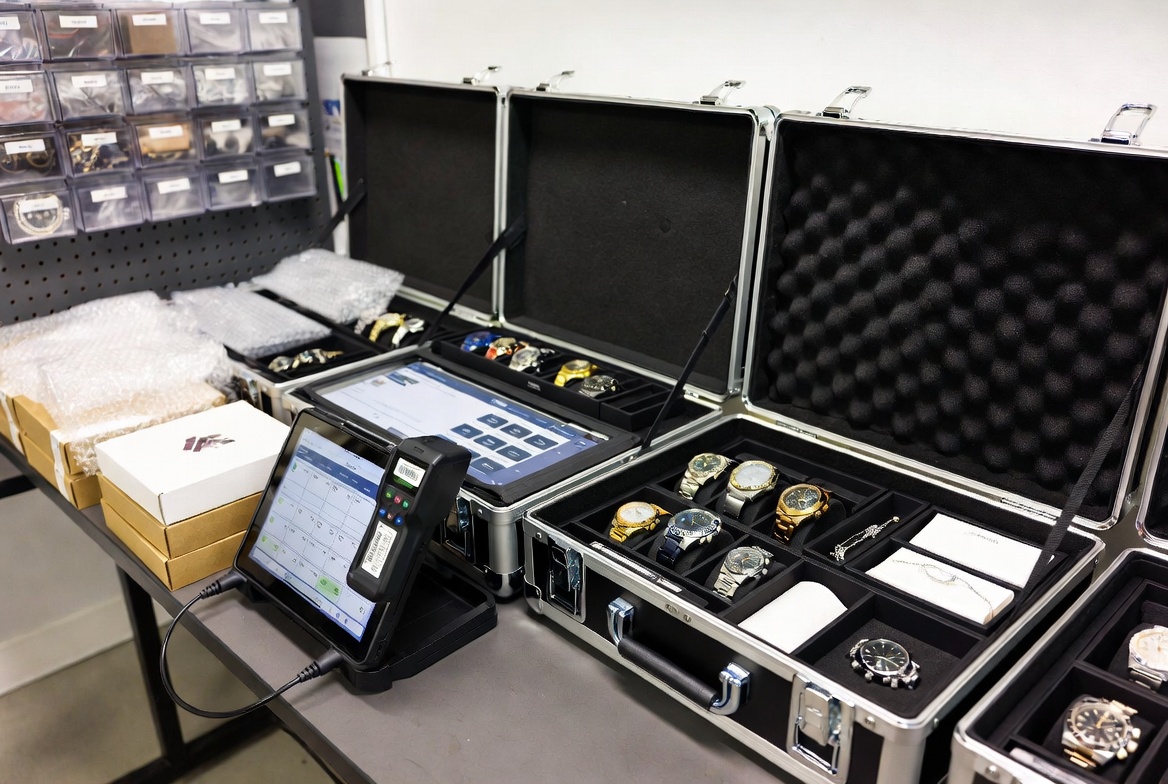
Our brokerage utilizes specialized Inland Marine Transit policies to cover these gaps. We work with operators using secure transport cases and advanced inventory management stations to ensure every piece is authenticated, logged, photographed for condition, and shipped under strict "Direct Signature Required / No Hold at Location" rules—the exact protocols required to keep transit coverage intact.
The 29 Specialty Spokes Under This Hub
Each page below addresses a specific operating segment within the fashion, jewelry, and luxury supply chain. Explore related programs to build out your full risk management profile.
Fine Jewelry, Watches & Hard Goods
Fashion Retail & High-Value Inventory
Design, Production & Manufacturing
Fashion Events & Styling
Underwriting the Rental Platform
The brokerage is a fourth-generation Pittsburgh specialty house with deep experience placing high-value risk that breaks standard ISO molds. Renting luxury goods is considered a hard-to-place class. Our job is to build a narrative around your technology, logistics, and fraud prevention that proves to underwriters your risk is managed and profitable. Our company history is on the history page and current markets are at the carriers page.
For jewelry and watch rental businesses, the standard engagement looks like this: a deep-dive discovery call focusing exclusively on your ID verification stack, your payment processing/chargeback history, and your shipping protocols. We then build an underwriting submission tailored to specialized inland marine markets and E&S syndicates that write voluntary parting coverages.
There is no obligation to engage at any step. The intake forms portal at insurance-intake-forms is the cleanest way to start. Direct line: (412) 212-2800. Bookings via book an appointment.
Jewelry & Watch Rental Insurance FAQ
What is Voluntary Parting, and why does it matter?
How do underwriters evaluate a rental platform for fraud coverage?
What if a customer damages a rented watch or jewelry piece?
Are we protected if a package is lost in transit to the customer?
If we operate a peer-to-peer model and rent out watches owned by other people, how are they covered?
What happens if a customer returns a counterfeit "super-clone" instead of our genuine watch?
Why do we need Cyber Liability insurance?
Secure Your Rental Inventory
Use the intake forms portal to start the submission process, or book a call to discuss your verification stack and transit logistics. Securing voluntary parting coverage requires a meticulous presentation to the market.