Apparel & Garment Manufacturer Insurance
Cut-and-sew shops, contract garment makers, private-label producers, performance-wear factories, denim mills, knitwear houses and contract apparel manufacturers operate inside a regulated product class with overlapping federal exposure: textile flammability, fiber-content labeling, children's product testing, lead and phthalate limits in components, country-of-origin certification, and worker classification under the Fair Labor Standards Act. A standard manufacturer's BOP rarely speaks the right language for any of it.
We place specialty programs that pair products-completed operations liability with the recall, intellectual-property infringement, ocean cargo, contingent business income and stock-throughput exposure that real apparel manufacturing actually generates. The brokerage has been quoting hard-to-place manufacturing risks since the trade reorganized under NAFTA — long before fast fashion turned a sourcing question into a federal-court question.
Apparel Manufacturer Risk Loading
Who We Insure Inside The Apparel Class
The apparel manufacturer class spans single-stitch loft contractors in Manhattan's Garment District, vertically integrated denim mills in Los Angeles, athleisure cut-and-sew plants in North Carolina, performance-wear engineers in the Pacific Northwest, and private-label production houses sourcing finished cut-makes-trim from overseas factories. Each model triggers different coverage parts. The list below is partial — call the desk if a class isn't named.
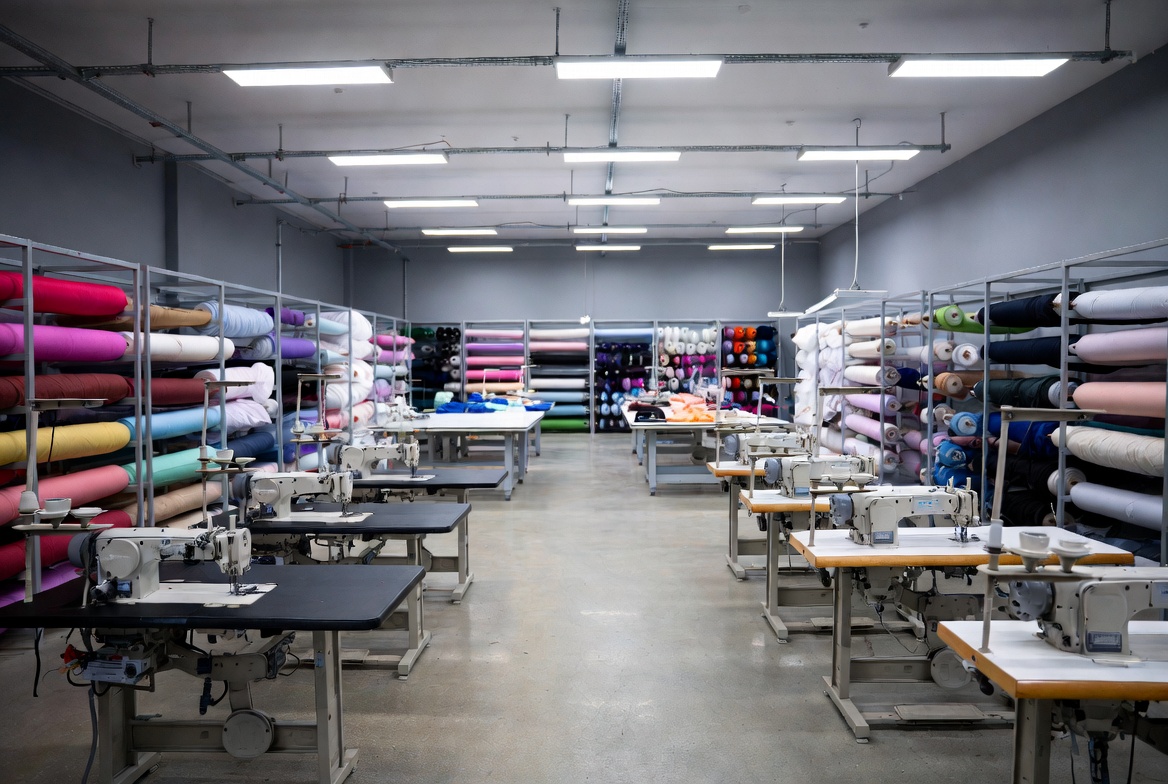
Manufacturing Operations
- ▸ Cut-and-sew contract manufacturers
- ▸ Private-label garment producers
- ▸ Knit goods & sweater knitting mills
- ▸ Denim & jeanswear factories
- ▸ Activewear & performance-wear production
- ▸ Children's apparel (CPSIA-regulated)
- ▸ Intimate apparel & lingerie manufacturers
- ▸ Uniform & workwear contractors
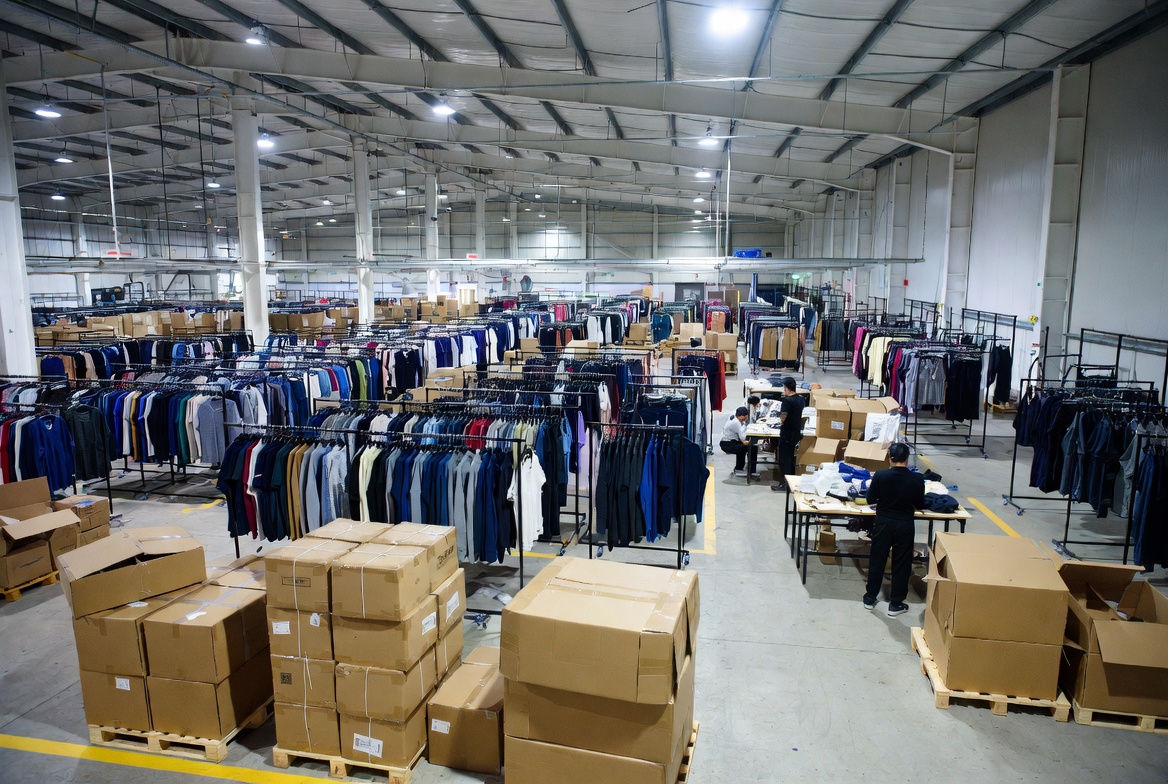
Adjacent & Specialty Operations
- ▸ Embroidery, screen-print & sublimation finishers
- ▸ Wash houses, dyers & garment finishers
- ▸ Pattern grading & sample room operations
- ▸ Apparel importers with US warehousing
- ▸ DTC brands with contracted production
- ▸ Reshoring micro-factories & on-demand production
- ▸ Sustainable / recycled-fiber manufacturers
- ▸ Hard-to-place accounts with prior loss history
The Coverage Stack For Apparel Manufacturers
An apparel manufacturer's policy doesn't live inside one form. It's a stack — general liability sits next to products-completed operations sits next to inland marine sits next to ocean cargo sits next to recall. Click each tab to see what belongs where, and which lines are core vs. specialty.
The Federal Framework Your Underwriter Reads First
Apparel manufacturing is a federally regulated product class. Every quote we submit has to address how the operation handles the statutes below — not the marketing pitch, but the testing, labeling, certification and documentation chain that determines whether a claim is defensible.
Clothing Textiles Flammability
Standard for the Flammability of Clothing Textiles. Establishes a 3-class burn-rate test for any fabric intended for use in wearing apparel and prohibits the sale of garments using Class 3 (rapid and intense burning) textiles. Adopted under the Flammable Fabrics Act.
Children's Sleepwear Flammability
CPSC's Standard for the Flammability of Children's Sleepwear requires that any garment sized 0–14 intended primarily for sleeping or sleep-related activities pass Fabric Production Unit and Garment Production Unit testing — or qualify as a labeled tight-fitting garment under §1615.1(o) / §1616.2(m).
CPSIA Lead Content Limit
Total lead content in children's product substrates capped at 100 ppm since August 14, 2011. Lead in surface coatings on children's products is capped at 90 ppm under 16 CFR 1303. Applies to zippers, snaps, rivets, painted appliqués and embellishments.
Phthalates Prohibition
Children's toys and child care articles cannot contain more than 0.1% of DEHP, DBP, BBP, DINP, DIBP, DPENP, DHEXP or DCHP in accessible plasticized components. Relevant to plastisol screen-print inks, PVC trims, vinyl-coated rainwear and printed appliqués.
Textile Fiber Products Identification Act
Requires fiber content by generic name and percentage by weight, the manufacturer or RN, and country of origin on a permanent label. Misbranding is a deceptive practice under Section 5 of the FTC Act; recalls and consent orders follow.
Care Labeling Rule
FTC rule requires manufacturers and importers to attach a permanent care label disclosing regular care instructions — washing, drying, ironing, bleaching, dry cleaning — in plain English. The instructions must protect the garment from harm if reasonably followed.
Country Of Origin Marking
U.S. Customs requires every imported article to be marked legibly and indelibly with its country of origin. CBP penalties for false marking on apparel include seizure, marking duties of 10% ad valorem, and Section 1592 fraud assessments.
Fair Labor Standards Act
Sets federal minimum wage, overtime, and recordkeeping standards. The apparel manufacturing sector has historically been a DOL Wage and Hour Division enforcement priority — joint-employer findings against brands sourcing from non-compliant contractors are a documented EPLI loss driver.
OSHA General Industry
Machine guarding on cutters and pressers, ergonomic exposure at sewing stations, fire egress on densely racked goods, hazard communication for solvents in finishing operations. Citations carry per-violation penalties that adjust annually for inflation.
Apparel Manufacturer Risk Profiler
Select the garment category that represents your largest production volume. The profiler returns the federal regulations your underwriter will flag, the typical coverage extensions that loss-control wants to see, and the documentation usually requested at quote stage.
Select Production Category
// RUNTIME · CATEGORY → REGULATORY OVERLAYWhere Coverage Has To Follow The Goods
Apparel goods cross multiple insurable jurisdictions before they reach a customer. The chain below maps the typical lifecycle and identifies the policy or coverage extension that should be in force at each step. Gaps between these segments are where the worst uncovered losses come from.
Raw Fiber & Trim
Greige goods, yarn, trim, hardware ordered from mills and trim houses. Title and risk often pass at supplier loading dock.
Cargo · Contingent BIOcean Transit
Containerized over water from sourcing region. Incoterms (FOB, CIF, DDP) determine which party bears casualty risk on the water.
Ocean MarinePort & Customs
CBP entry, country-of-origin marking, Section 321 / formal entry. Delays expose to spoilage on time-sensitive seasonal goods.
Cargo · Trade CreditCut-Make-Trim
Bolts staged, marked, cut, bundled, sewn, pressed, QC'd. Concentration of values at the factory peaks here.
Property · Goods In ProcessFinishing & Embellishment
Dye, wash, distress, print, embroider — often at a third-party finisher. Coverage transitions to bailee or off-premises form.
Pollution · BaileeFinished Goods Warehouse
Pack-out, ticketing, distribution staging. Highest cumulative inventory value on the books.
Property · Stock ThroughputWholesale & DTC Ship-Out
Buyer purchase orders, e-commerce fulfillment, drop-ship. Product liability fully engaged from delivery onward.
Products Liability · RecallHow These Claims Actually Show Up
The losses below are composite, generalized examples of claim types we see in the apparel manufacturer book. They are illustrative — they do not describe specific clients or claim files. They are included to show the coverage logic that has to be in place before the claim event.
Drawstring Strangulation Claim
A children's hoodie produced under a private-label agreement is alleged to have caused a strangulation injury when the upper drawstring caught on playground equipment. CPSC guidance on drawstrings in children's upper outerwear (per the agency's substantial product hazard determination) is invoked, and the brand pursues the contract manufacturer for breach of warranty.
Triggers: Products Liability · IP Defense · RecallFailed Flammability Retest
A children's sleepwear SKU passes initial GPU testing, but a retailer's independent third-party retest shows char length exceeding the §1615 standard. The brand initiates a voluntary corrective action. Notification, return logistics, destruction certificates and refund processing produce direct first-party costs well into six figures.
Triggers: Product Recall · Crisis ResponsePrint Copyright Cease & Desist
An independent artist alleges that a floral print used in a capsule collection is substantially similar to a work registered with the U.S. Copyright Office. Counsel is retained to evaluate access and substantial similarity. Discovery, mediation and any settlement run through the IP coverage form, not the personal & advertising injury sub-limit.
Triggers: IP InfringementSprinkler Discharge In Finished Goods
An accidental sprinkler activation in a finished-goods staging area damages a full season's worth of cashmere knitwear awaiting ticketing. Salvage value is minimal; the loss involves stock at peak inventory value during pre-shipment. Without stock throughput or proper goods-in-process valuation, BPP responds at cost — not at the sales-price value the brand expected.
Triggers: Property · BI · Stock ThroughputPiece-Rate Wage Claim
Former operators bring a collective action alleging piece-rate wages, when calculated against actual hours, fell below the federal minimum wage and that overtime was uncompensated. The DOL Wage and Hour Division opens a parallel investigation. Defense costs and any settlement run through EPLI; CGL does not respond to wage-and-hour exposures.
Triggers: EPLI · Wage & Hour EndorsementContainer Loss At Sea
A container of fall outerwear is lost overboard during a transpacific crossing. General Average is declared. Without specific ocean marine cargo coverage in force, the importer is forced to post a salvage bond and absorb both the value of lost goods and a proportional GA contribution before any release of remaining cargo.
Triggers: Ocean Marine · GA ContributionThese are illustrative loss patterns drawn from common manufacturer-class exposures. Actual coverage outcomes are determined by the specific policy forms, endorsements, sub-limits, deductibles and exclusions in force at the time of loss. Coverage discussions on this page are general; nothing here is a coverage opinion or a guarantee of payment under any specific policy.
Inventory Valuation Worksheet
An apparel manufacturer's largest insurable property exposure is rarely the building — it's the floating value of fiber, trim, work-in-process and finished goods spread across the supply chain. This worksheet helps frame the conversation. It does not produce a quote or a binding insurance value.
BOP vs. Specialty Apparel Manufacturer Program
The packaged Business Owners Policy that works for most retail and service businesses is not designed for apparel manufacturers. Below is a side-by-side of where coverage typically diverges.
| Coverage Element | Standard BOP | Specialty Apparel Manufacturer Program |
|---|---|---|
| Products-Completed Operations | Often shared sub-limit with GL aggregate | Standalone aggregate; products-specific defense erosion |
| Recall & Withdrawal Costs | Typically excluded | First-party recall and third-party recall liability available |
| Intellectual Property | Limited "personal & advertising injury"; print/design claims often excluded | Standalone IP infringement form covering copyright, trademark, trade dress, design patent |
| Ocean Marine Cargo | Not part of a BOP | Open cargo certificate, warehouse-to-warehouse, optional difference-in-conditions |
| Goods In Process Valuation | BPP at actual cash value of raw materials only | Goods-in-process at selling price less unincurred expenses (ISO CP 99 30 or manuscript) |
| Contingent Business Income | Generally not included | Named-dependent-property endorsement covering key suppliers and finishers |
| Stock Throughput | Not available | Single all-risks form following goods from sourcing through final delivery |
| Pollution Liability | Standard ISO pollution exclusion applies | Pollution legal liability available for dye, wash and finishing operations |
| Employment Practices Liability | Often a standalone purchase, low sub-limits | Wage-and-hour endorsement and joint-employer defense costs negotiable |
| Cyber & Privacy | Optional rider, breach response only | Full cyber form including business interruption for ERP outages |
What Kelly Insurance Group Brings To An Apparel Submission
Apparel manufacturing is what the carriers call a "controlled class." Admitted markets have narrow appetites — they decline complex international supply chains, decline accounts with prior product withdrawals, and decline manufacturers using independent contractor sewing operators or piece-rate stitch operations. That is precisely where this brokerage works. We are placed in front of Lloyd's syndicates and U.S. excess-and-surplus underwriters who write specialty apparel programs, and we know how to structure a submission so that the broker remembering the file in twelve months is still you, not us.
The brokerage's history is documented at our company history page and on the about page — Franklin B. Kelly's agency wrote the same kind of manufacturing risk that lower Pittsburgh and Millvale industry generated through the mid-20th century, and the firm has been a hard-to-place specialist ever since. The full carrier roster is at the carriers page.
Submissions come through the intake forms portal; appointments through book an appointment; or call/text (412) 212-2800 for a same-day conversation.
Fashion Industry & Connected Coverage Pages
The apparel manufacturer is the production node of a larger fashion industry coverage cluster. The pages below address adjacent specialty exposures.
Fashion Cluster Pages
Supporting Coverage From The Broader KIG Library
Apparel & Garment Manufacturer Insurance FAQ
Does a standard manufacturer's BOP cover an apparel cut-and-sew operation?
What's the difference between products liability and product recall coverage?
If I'm just a brand and a contract factory does the sewing, do I still need products liability?
What does the CPSIA actually require of a children's apparel manufacturer?
What is a Children's Product Certificate (CPC), and who is responsible for issuing one?
Are 100% cotton infant garments exempt from children's sleepwear flammability testing?
What does an ocean cargo policy actually cover that a property policy doesn't?
Why do retailers and big-box buyers require their vendors to carry specific limits?
Does intellectual property infringement coverage protect against trademark and copyright claims on prints and embellishment?
How does insurance handle a joint-employer wage-and-hour claim?
What documentation does an apparel manufacturer underwriting submission require?
What if my account has been declined or non-renewed?
Start An Apparel Manufacturer Submission
Use the intake forms portal to start your submission, or book a call to talk through the program before paperwork. Most apparel manufacturer accounts move from intake to indication within 2–5 business days.
Open Intake Forms Portal