
Tree Cutting Insurance.
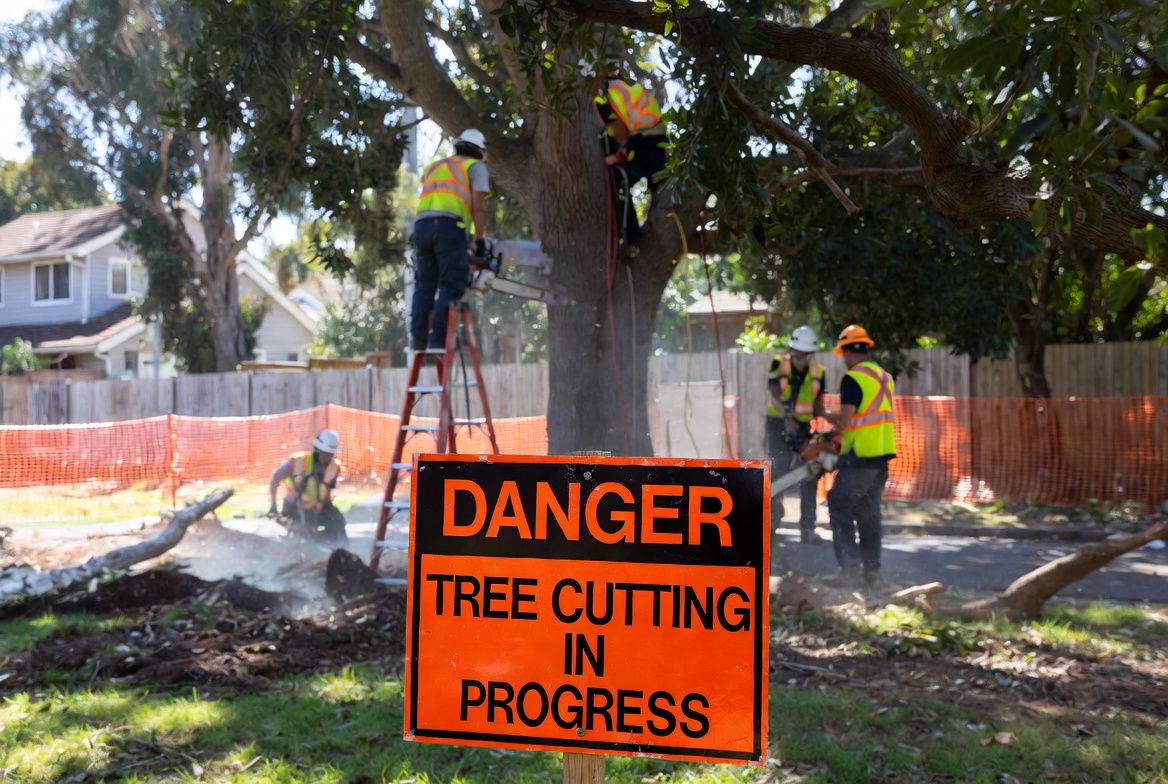
When your sign is in the yard and your saw is running, the duty of care has already started — and so has the coverage exposure. The right policy is built around the moment a chainsaw, a drop zone, and a third party share the same property.
The Operation Your Policy Has to Anticipate
Tree cutting is the broad operational term that covers any work where a chainsaw, pole saw, or felling cut is being made on a tree — whether the goal is a full removal, a sectional takedown, a major reduction, a hazard cut, or a single piece coming down. It is the operation under which most other tree work sits.
From an insurance perspective, "cutting" matters because the saw is what triggers most of the high-severity exposures. Strikes from falling pieces, kickback injuries, miscut directional fells, struck-by debris, vehicle damage, and bystander injury all originate at the saw. The policy needs to be built around that fact.
- Directional felling — bringing a whole tree down with a calculated face/back cut
- Sectional takedown — cutting a tree apart from the top, piece by piece
- Reduction cuts — heavy pruning that approaches removal-grade severity
- Hazard cuts — removing identified defective leaders or branches
- Storm-damage cutting — emergency response to wind, ice, or snow loss
- Stump cuts & ground-level finishing — trim-back to grade after the lift
- Brush, limb, and clearing cuts — supporting other trade contractors on site
- Land-clearing cutting — selective or full clearance work for development
The Four Zones of an Active Cutting Operation
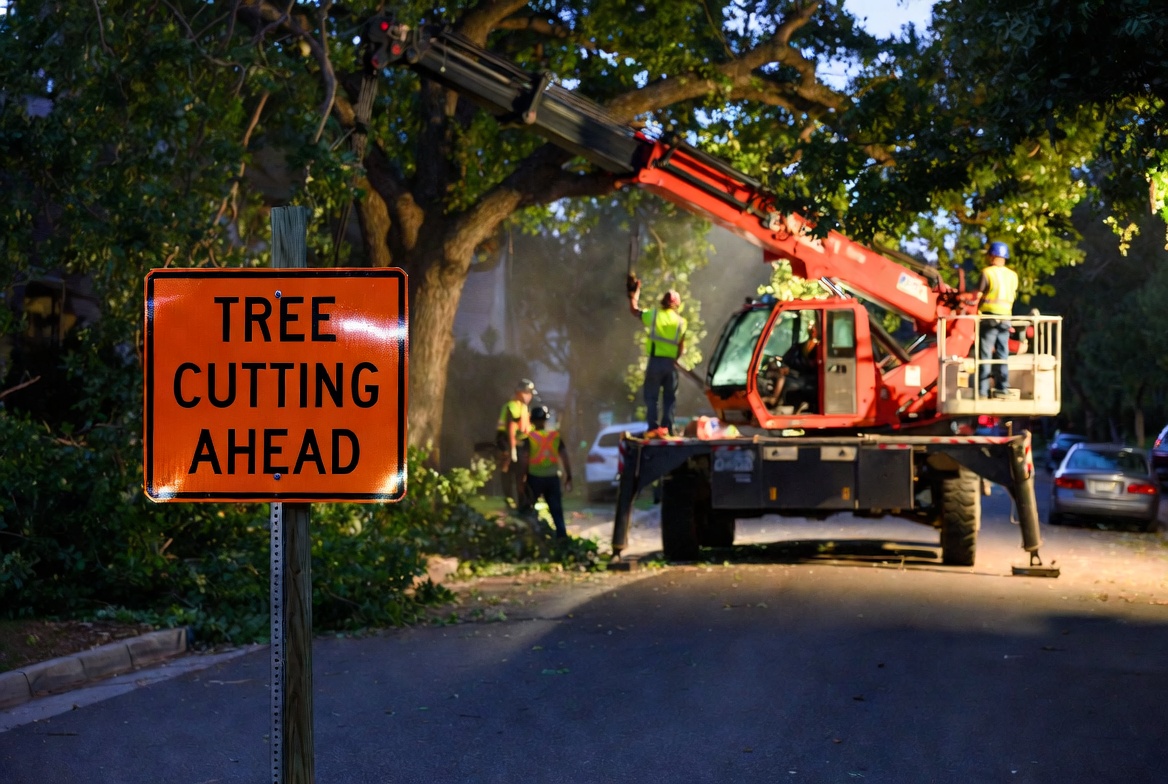
The Cut Zone
Where the saw is running and the cut is being made. Highest-severity zone. Crew-only access. Marked by signage and crew positioning.
The Drop Zone
Where the cut piece will land. Defined before the cut, kept clear of crew, customers, vehicles, and structures.
The Drag-Out Path
The route from drop zone to chip truck or trailer. Active during cleanup. Frequent damage-claim zone — landscaping, hardscape, irrigation.
The Public Edge
The boundary between the work site and pedestrians, traffic, neighbors. Where signage, cones, lookouts, and traffic control live.
When the sign goes up, the duty of care starts.
When the saw runs, the policy is doing its work.
Tree cutting carries a legal duty to protect the people, property, and traffic in proximity to the operation. That duty doesn't begin when something goes wrong — it begins the moment the sign goes up and the saw fires. The General Liability policy, the auto policy, the workers comp, and the umbrella all share the burden of that duty when something does happen.
The Notice & Signage Underwriters Look For
Carriers that quote tree cutting accounts pay close attention to job-site control discipline. Crews that consistently set up their sites with proper signage, traffic control, and bystander management are easier to place — and renew at lower-friction terms — than crews that don't.
-
Posted Warning Signage
"Tree work in progress" / "Danger: cutting in progress" signage at every entry to the work zone.
-
Cones & Barricades
Physical perimeter around drop zones and drag-out paths. Clear separation of public traffic from active work.
-
Traffic Control Plan
For roadside or right-of-way work — flaggers, cones, advance warning signs, lane closure protocol if required.
-
Customer Notification
Customer is told when crews will be on site, what to expect, and where not to walk during active cutting.
-
Neighbor Notification
For tight residential work, advance notice to neighbors whose property could be affected by drop zones, drag-out, or noise.
-
Crew Communication
Defined signals between climber/operator and ground crew. Designated lookouts watching the public edge.
What Each Policy Does When Cutting Goes Wrong
Pays for
Third-party bodily injury and property damage caused by the cutting operation — bystanders, neighbors, customer property, vehicles.
Triggers
Falling pieces hitting structures or vehicles. Bystander injury. Neighbor damage. Completed-ops claims surfacing later.
Pays for
Employee injuries during cutting work — chainsaw kickback, struck-by, falls, equipment-related injuries.
Triggers
Any work-related injury to an employee. Statutory in most states once any non-owner employee is on payroll.
Pays for
Liability and physical damage tied to the trucks getting crews and equipment to and from the cutting site.
Triggers
Accidents in transit. Bucket truck collisions. Trailer detachments. Loading/unloading auto-related incidents.
Pays for
Damage to your saws, climbing systems, rigging hardware, chippers, and other mobile equipment used in cutting work.
Triggers
Theft, fire, in-transit damage, falling-object damage to staged equipment, accidental gear damage.
Pays for
Amounts above your underlying GL or auto limits when a single cutting incident produces a claim that exhausts primary.
Triggers
Severe property damage. Multiple-victim injury. High-limit contract requirements from HOAs, municipalities, and utilities.
Build the Right Cutting Program
Tell us how often the saw runs, how close the targets are, what kind of cutting your crews actually do, and where the work is taking you. We build the program around the operation — not around an average tree-service template.
Start the Intake Form →Search the Kelly Insurance Group Site
Other Tree Service Coverages We Place
By Operation Type
Cost, Quotes & Buyer Resources
Hard-to-Place & Problem Risk Pages
Other KIG Resources
Tree Cutting Insurance Questions Answered
What's the difference between cutting, trimming, and removal?
Cutting is the broad operational term for any work involving a saw cut on a tree. Trimming is a subset focused on pruning live and dead branches without taking the tree down. Removal is the complete dismantling of the tree. Most tree contractors do all three, and the program needs to anticipate the highest-severity work performed. See our Trimming page and Removal page.
Is signage actually a coverage issue?
Signage isn't a coverage trigger by itself, but it's a credibility signal underwriters use when grading job-site control. Documented site-control practices — signage, cones, traffic control, lookouts — make placements easier. They also make defending a claim easier when one happens, since they demonstrate the duty of care was met.
Does General Liability cover damage from a misdirected fell?
Yes, generally — third-party bodily injury and property damage from a covered occurrence during cutting operations is the core of what GL pays for. Damage to the tree being cut is excluded (the owner consented), and damage to property in your care/custody/control is excluded (addressed by Rigger's Liability or Inland Marine). See our Tree Service GL page.
What about chainsaw kickback injuries to my crew?
Employee injuries from chainsaw kickback are Workers Compensation claims — covered under the WC policy, not GL. Carriers look at PPE compliance (saw chaps, helmets, eye protection) when underwriting cutting-heavy accounts. See our Arborist Workers Comp page.
Does the policy cover cutting near power lines?
Cutting in proximity to energized utility lines is a specific underwriting question, not an automatic inclusion. Utility line clearance work typically requires a separate class code and specific endorsement. See our Utility Line Clearance page.
What about cutting damage that surfaces days or weeks later?
Completed operations coverage under the GL is what responds. A hanger that drops a week later, a structural failure traced back to a bad cut, a delayed property damage claim — these are completed-ops triggers, and the policy needs to include the coverage with appropriate aggregate limits.
I had a cutting-related claim — can I still get coverage?
Yes. Specialty markets place tree service accounts with prior claims regularly. Send loss runs, post-loss safety improvements, signage and site-control documentation, and operations details. See our Tree Service With Claims page.
Where do I start?
Start with the intake form. It captures cutting volume, equipment, signage and site-control practices, customer mix, and any prior claims. Or reach out via the contact page or (412) 212-2800.
Your Cutting Program, Built Right.
Tell us how often the saw runs, what kind of cutting you do, where the targets are, and how you control the site. We build the program around the operation — and the duty of care that comes with it.
Start the Intake Form → Contact Kelly Insurance Group →