High-Risk Tree Removal Insurance.
If your current carrier has non-renewed you, quoted you at a multiple of last year, or imposed conditions that don't match the work you actually do — the conversation has shifted from tree service insurance to specialty placement. Different markets, different documentation, different price discovery.
If Any of These Apply — You're in Specialty Territory
"High-risk" is not a marketing phrase — it's an underwriting category. It means a tree service operation has one or more characteristics that move it out of standard tree service GL programs and into specialty markets that price and structure the work differently.
Most operations don't realize they've crossed the line until renewal hits, the carrier non-renews, or the quote comes back at a multiple. The card to the right is the kind of file that triggers that conversation.
Why Standard Markets Walk Away
It's tempting to read a non-renewal notice as personal or arbitrary. It almost never is. Standard tree service GL programs are sized for a specific risk profile, and accounts that drift outside that profile get filtered out at renewal. The three reasons below cover most of the cases.
Severity Profile Mismatch
The standard market priced the account based on baseline residential trim work. The operation has grown — bigger trees, higher targets, more crane work, urban density — and the loss potential is now larger than the program was sized for. The carrier didn't say no to your business. They said no to the new risk profile.
Loss History Outside Tolerance
Standard tree service programs work on actuarial expectations of how often claims happen and how big they are. An account that produces frequency or severity above the carrier's tolerance gets non-renewed. One serious claim doesn't cause this. A pattern of claims, or one very large claim, often does.
Operational Complexity
Subcontractor surge, multi-state operations, energized line proximity, large MSAs — these are operational complexities most standard tree programs aren't built to underwrite. Specialty markets are built for it. Standard markets exit when the operation reaches that complexity.
Where High-Risk Accounts Actually Get Placed
Tree service insurance isn't a single market — it's a tiered ecosystem of standard admitted carriers, specialty admitted carriers, and excess & surplus lines markets. High-risk accounts move down the tiers as the risk profile grows.
Filed-rate carriers writing standard tree service programs. Lowest cost when the risk profile fits. Tightest underwriting filters when it doesn't.
- Predictable residential and small commercial volume
- Limited subcontractor reliance
- No prior major claim activity
- Single-state or limited regional operating territory
- No crane operations, no line clearance
- Workers Compensation in place for all required states
Specialty tree service programs from admitted carriers familiar with the operations. Built for legitimate operating complexity that standard markets aren't sized for.
- Crane-assisted removal as a regular practice
- Larger residential and commercial accounts
- Multi-state operating territory with structure
- Subcontractor use with documented vetting
- Some prior claim activity, properly mitigated
- Defined operational discipline and ANSI Z133 documentation
Non-admitted excess & surplus lines carriers writing the hardest risk profiles. Manuscript forms, individual underwriting, broader appetite for complexity — at higher pricing and with stricter conditions.
- Multiple prior claims or one severe loss
- Recent non-renewal or cancellation
- Heavy line clearance or utility work
- Multi-state storm response and FEMA debris contracts
- Crane-dominant operations and tight urban work
- Operations in transition or rebuilding after a loss
The High-Risk Submission Process
File Build
Loss runs, declarations, contracts, operations narrative, claims context. The submission is the file.
Market Plan
Identify the right specialty markets for the specific risk profile. Not every market for every account.
Submission
The file is sent to selected markets with positioning that anticipates underwriter questions.
Underwriting Q&A
Specialty underwriters ask follow-up questions. Detailed answers are the difference between offers and declines.
Quote & Bind
Compare offered terms, conditions, exclusions, and price across markets. Place the program that fits.
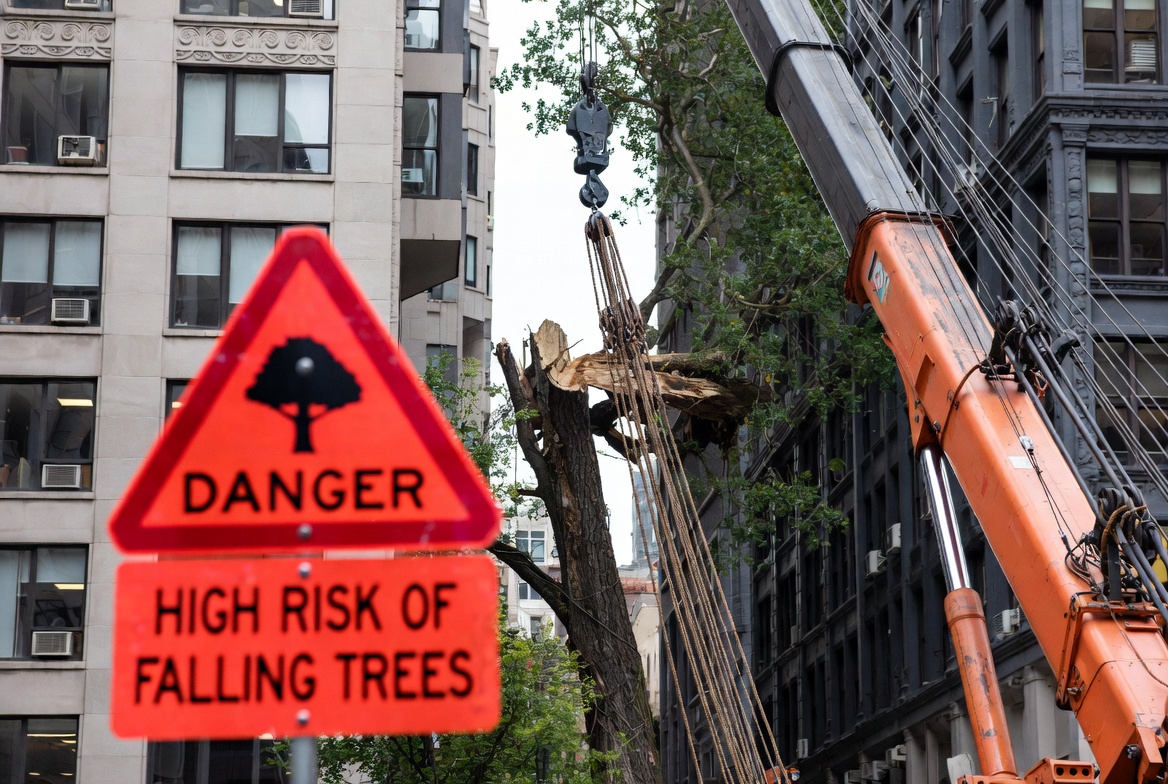
Crane in the Street. Rigging Set. Targets Everywhere.
This is the operation that makes a standard underwriter's pen hover. Crane in the street, rigging set on a target tree, pedestrians within shouting distance, vehicles parked, and a building wall ten feet from the drop zone. It's the work that pays the bills — and the work that has to be specifically underwritten, not assumed into a generic tree policy.
What Goes Into a Real High-Risk Submission
Specialty placement is documentation-heavy. The submission is what underwriters underwrite — not the relationship, not the broker's pitch. Below is what a high-risk tree removal account typically has to put together to get serious quotes from specialty markets.
Loss Runs (3–5 years)
Claim history from current and prior carriers, by line of coverage, with paid, reserved, and incurred amounts.
Current Policy Declarations
GL, Auto, WC, Inland Marine, Umbrella declarations and any specific endorsements driving exclusions.
Operations Narrative
Written description of operations — work types, crew structure, equipment list, customer mix, geography.
Subcontractor Practices
How 1099 climbers, sub crews, and sub crane vendors are vetted, contracted, and documented.
Safety & ANSI Z133 Program
Written safety program, training records, incident review process, ANSI Z133 reference documentation.
Equipment Schedule
List of bucket trucks, chip trucks, cranes, climbing systems, rigging hardware with values and ages.
Contract Requirements
Copies of the master service agreements driving the limit demands — utility, municipal, HOA, large commercial.
Post-Loss Mitigation
For accounts with prior claims — what changed after the loss. Process changes, training, equipment, supervision.
A non-renewal isn't the end.
It's the market telling you which conversation to have next.
Specialty placement is that conversation.
If your account has moved out of the standard market — through claim activity, operational growth, or a non-renewal letter — the work isn't finding a sympathetic carrier. It's building the file that lets specialty markets price the actual risk and put offers on the table. We do that work.
Build the High-Risk Submission
Send loss runs, current declarations, an operations narrative, and any non-renewal correspondence. We build the specialty submission file and place it with the markets that actually write the work — at terms that match the operation.
Start the Intake Form →Search the Kelly Insurance Group Site
Other Tree Service Coverages We Place
By Operation Type
Cost, Quotes & Buyer Resources
Hard-to-Place & Problem Risk Pages
Other KIG Resources
High-Risk Tree Removal Questions Answered
What does "high-risk" actually mean in tree service insurance?
It's an underwriting category, not a marketing label. An account becomes "high-risk" when it has characteristics that move it outside the standard tree service program — claim activity, operational complexity, geographic spread, equipment-driven severity, or a recent non-renewal. The work then gets placed through specialty admitted carriers or excess & surplus lines markets.
My carrier just non-renewed me. What happens next?
The first step is documentation — loss runs, current declarations, the non-renewal correspondence, and an operations narrative. From there, the file gets positioned for the specialty markets that actually write hard accounts. See our After Cancellation or Non-Renewal page.
Is high-risk coverage just more expensive standard coverage?
Generally yes, with caveats. Specialty markets price the extra exposure they're taking on, so premium typically runs higher than what a standard carrier would charge. But the program is also structured around the actual operation — meaningful endorsements, manuscript forms, broader appetite — that standard carriers wouldn't offer at any price. The price difference reflects the work the standard market wouldn't write.
What's the difference between admitted and surplus lines?
Admitted carriers are licensed by the state, file rates with the state insurance department, and are backed by state guaranty funds. Surplus lines (excess & surplus, or E&S) carriers are not admitted in the state, can write manuscript forms with broader appetite, but aren't backed by state guaranty funds. High-risk tree removal accounts often place in E&S because the appetite there is broader than admitted markets.
How long does specialty placement take?
Longer than standard placement. Specialty markets ask more questions, want more documentation, and take more time to underwrite. A clean high-risk file with all documentation in order typically moves faster than a fragmented one — which is why the file build is the first step, not the last.
Can I get coverage if I had multiple claims?
Yes — specialty markets place accounts with multiple claims regularly. The conversation shifts to severity, mitigation, and pattern: what happened, what changed, what's different now. See our Tree Service With Claims page.
What if I'm running without Workers Compensation?
Operating without statutory Workers Comp where it's required creates problems beyond just placement difficulty — it's a regulatory issue. Specialty markets will work with accounts that are bringing WC into compliance, but the program needs the WC piece to be on the table. See our Without Workers Compensation page.
Where do I start?
Start with the intake form. It gathers the loss runs, current declarations, operations narrative, and contract requirements that go into building a real high-risk submission. Or reach out via the contact page or (412) 212-2800.
Your Specialty Submission, Built Right.
Send loss runs, current declarations, contracts driving your limits, and any non-renewal correspondence. We build the submission file specialty markets actually want to see — and we place it with the markets that write the work.
Start the Intake Form → Contact Kelly Insurance Group →