
Commercial Tree Contractor Insurance.
The customer is a facilities director, a property management firm, or a corporate procurement team. The work is recurring, the contracts are formal, the insurance demands are written into the agreement — and the program has to satisfy them before the first crew sets foot on the property.
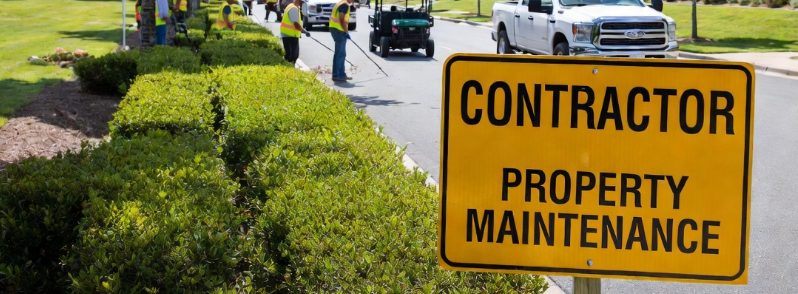
Corporate campus tree maintenance — proper signage, vendor uniforms, posted work area. The visual language commercial customers expect on their property.
Institutional Buyers Buy Differently
Residential customers buy on price, availability, and trust. Commercial customers buy on contract terms, predictability, and risk transfer. The decision-maker isn't the homeowner — it's a facilities director, a property management company, or a corporate procurement team who is responsible for risk on a portfolio of properties.
That changes everything about how the work has to be sold, delivered, and insured. Vendor approval processes, insurance certificate requirements, additional insured status, hold-harmless agreements, indemnification language, and recurring service calendars all become part of the conversation. The program has to satisfy the contract before the work begins — not be retrofitted after the fact.
The Commercial Property Types That Drive the Work
Corporate Campuses
Multi-building corporate headquarters and office campuses. Manicured landscape standards, brand-image expectations, executive proximity.
Office Parks & Business Centers
Multi-tenant commercial real estate. Property management firm as decision-maker. Predictable maintenance schedules.
Healthcare & Hospitals
Hospital campuses, medical office buildings, surgery centers. 24/7 patient access requirements, infection control, helipad clearance.
Retail & Shopping Centers
Strip malls, regional retail, mixed-use centers. High pedestrian traffic, parking lot operations, business-hour scheduling constraints.
Industrial & Logistics
Warehouses, distribution centers, manufacturing sites. Equipment proximity, security protocols, escort requirements.
K–12 & Higher Education
School districts, college and university campuses. Background check requirements, restricted hours during academic calendar, child-safety protocols.
Hospitality & Resorts
Hotels, resorts, conference centers. Guest experience standards, event-driven scheduling, brand-image expectations matching the property class.
Senior Living & Assisted Care
Independent living, assisted living, memory care, skilled nursing. Resident safety, minimal disruption, accessibility considerations.
Financial & Government
Bank branches, credit unions, government offices, courthouses. Security clearance, after-hours service requirements, controlled access.
The Annual Contract Rhythm
Commercial tree contractor work is fundamentally recurring. Most master service agreements specify a service calendar — what gets done when, in what order, across the year. Coverage has to anticipate the entire calendar, not just summer-peak volume.
Signage, Uniforms, & Site Discipline
Commercial customers — especially corporate campuses, healthcare, and retail — pay attention to how the contractor presents on their property. Posted signage, branded vehicles, uniformed crews, and visible site control are part of the deliverable, not a nice-to-have.
This visual language has insurance implications, too. Documented site-control practices, posted hazard signage, traffic management protocols, and uniformed identification all become credibility signals at submission and at claim time. Carriers grade commercial accounts in part on what the work actually looks like on the property.
What a Commercial Insurance Exhibit Typically Looks Like
Master service agreements include an insurance exhibit — a section, usually one to three pages, listing the specific coverages, limits, and contract language the vendor must carry. Below is a representative format. The actual numbers, parties, and conditions vary by customer, but the structure is consistent.
EXHIBIT C — Insurance Requirements (Vendor)
// REPRESENTATIVE FORMATWhat Facilities & Procurement Teams Actually Look For
Beyond the insurance exhibit, vendor approval at commercial accounts often runs through a separate procurement review. The list to the right is what most facilities directors and property management firms expect to see before a contractor gets approved as an active vendor.
The good news: none of these are exotic. They're standard commercial-vendor disciplines that mostly come down to documentation that already exists — gathered, current, and ready to deliver on request.
-
Current Certificate of Insurance
COI on the customer's preferred format with all required endorsements properly indicated.
-
Additional Insured Endorsements
Specific endorsement forms naming the customer, parent, affiliates, and property manager as required.
-
W-9 & EIN Documentation
Tax documentation for vendor onboarding into the customer's accounts payable system.
-
State Licensing & Registration
Business license, contractor registration, pesticide applicator licensing where applicable.
-
Safety Program Documentation
Written safety program, ANSI Z133 compliance, training records, incident review process.
-
Subcontractor Vetting Process
Documented subcontractor onboarding — COIs, hold-harmless agreements, additional insured requirements applied to subs.
-
Background-Check & Drug-Test Protocols
For schools, healthcare, and certain financial institutions — documented worker screening protocols.
-
References from Comparable Accounts
Other commercial customers willing to speak to performance, reliability, and claim history.
Residential customers buy on price & trust.
Commercial customers buy on contract terms.
The program has to satisfy the contract — before the work starts.
If your tree service has won — or is bidding on — a commercial contract, the program built around residential trim work almost certainly won't pass procurement review. We rebuild it around the customer mix, the contract structure, and the institutional buyer that's actually signing.
Build the Right Commercial Program
Send your customer mix, current contracts, insurance exhibits driving your limits, certificate requirements, and existing program declarations. We rebuild it for the institutional accounts you actually serve.
Start the Intake Form →Search the Kelly Insurance Group Site
Other Tree Service Coverages We Place
By Operation Type
Cost, Quotes & Buyer Resources
Hard-to-Place & Problem Risk Pages
Other KIG Resources
Commercial Tree Contractor Insurance Questions Answered
How is commercial tree contractor insurance different from residential?
The work types overlap — trimming, removal, hazard pruning — but the customer is different. Commercial customers buy on contract terms, recurring service calendars, and specific insurance demands written into the agreement. The program has to satisfy the contract before the work starts. See our Residential Tree Service page.
What's the difference between an MSA and a one-off contract?
A Master Service Agreement (MSA) is a multi-year framework that governs ongoing work between vendor and customer. Individual jobs are issued under the MSA via work orders or task orders. The insurance requirements live in the MSA's insurance exhibit and apply to every job done under the agreement.
How are limit requirements typically structured in commercial contracts?
Most commercial contracts specify minimum per-occurrence and aggregate GL limits, an Auto limit, Workers Comp at statutory levels, and a stacked total reached through Umbrella or Excess. Higher-value properties and larger institutional customers demand higher stacked totals. See our Excess Liability page.
What is "primary & non-contributory"?
Primary means the contractor's policy pays first, before any policy held by the customer. Non-contributory means the contractor's carrier doesn't try to share the loss with the customer's carrier. It's a common contract requirement and requires specific policy endorsement to deliver. See our Primary/Non-Contributory page.
What about background checks for school or healthcare work?
K–12 school districts, certain healthcare facilities, financial institutions, and government sites often require documented background-check programs for any vendor with property access. The check requirements get folded into the vendor approval process, often before insurance is reviewed. Contractors serving these classes typically maintain a written screening protocol.
Does pollution liability come into play on commercial accounts?
Often yes — especially when the scope includes pesticide or herbicide application, fuel handling, or vegetation management chemicals. Many commercial MSAs specifically require Contractors Pollution Liability. See our Pollution Liability page.
How do certificate-of-insurance requirements work in practice?
Customers typically require the COI to be delivered before the first work date, in their specified format, with all named additional insureds and required endorsements properly noted. Renewal COIs are required prior to expiration. Some commercial customers use third-party certificate management platforms that the contractor's broker uploads into directly. See our Tree Service Certificate of Insurance page.
Where do I start?
Start with the intake form. It captures customer mix, contract structure, certificate requirements, and existing program declarations. Or reach out via the contact page or (412) 212-2800.
Your Commercial Program, Built Right.
Send your customer mix, contracts driving your limits, certificate requirements, vendor approval expectations, and current program declarations. We build it for the institutional accounts you serve — and the contracts that govern them.
Start the Intake Form → Contact Kelly Insurance Group →