Utility Line Clearance Tree Service Insurance.
Line clearance is not "tree work near power lines." It is its own regulated specialty — governed by federal OSHA standards, ANSI Z133, utility master service agreements, and a qualification framework most general tree insurers do not write to.
Specialty Risk Profile
A Specialty That Sits Between Tree Care & Electrical Work
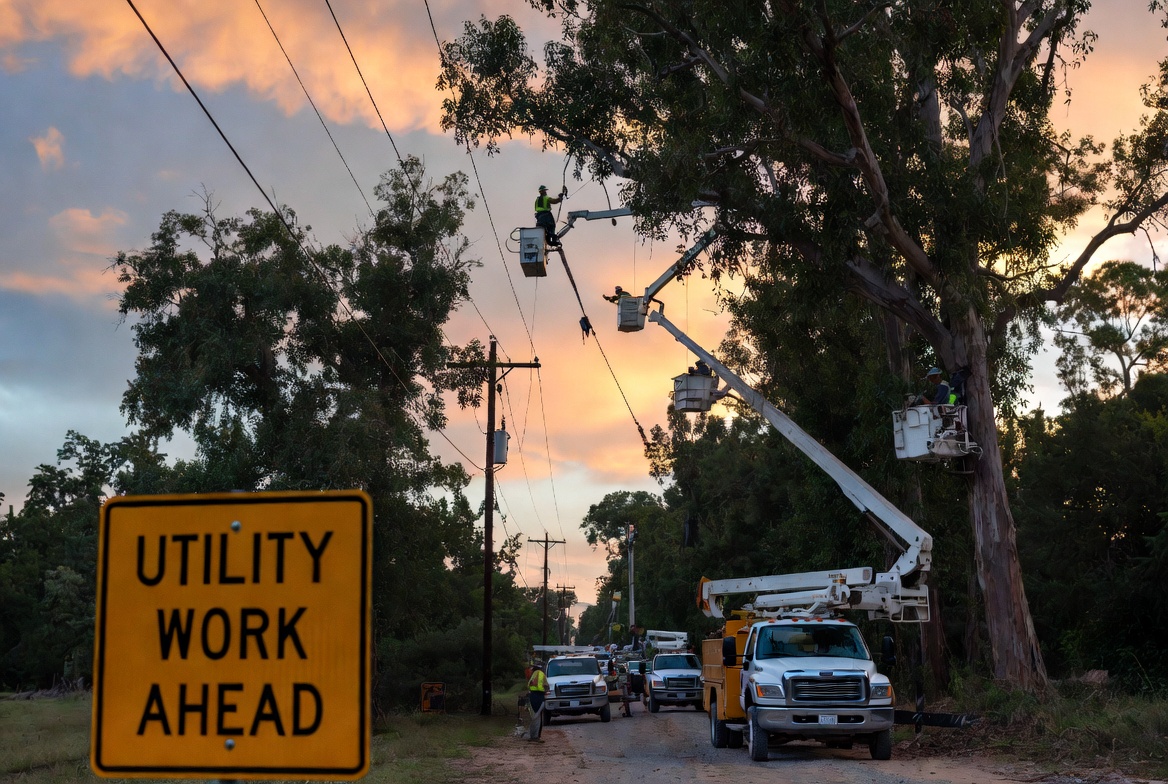
Utility line clearance is the tree work performed in the right-of-way of energized electrical utility lines, communications lines, and rail corridors. It is the work that keeps the lights on after wind events, prevents tree-caused outages, and clears vegetation away from infrastructure on a planned cycle for the utility owner.
From a regulatory standpoint, line clearance is governed by OSHA 29 CFR 1910.269 for electric power generation, transmission, and distribution work. The regulation defines minimum approach distances from energized conductors, qualification requirements for workers, and the conditions under which different categories of personnel can operate within specified distances of live lines. ANSI Z133 provides the consensus tree-care standard that complements those regulatory requirements.
From an insurance standpoint, it sits in a different bucket than residential tree work. Most standard tree service GL forms either exclude or sub-limit work in proximity to energized lines. The carriers that write the work are specialty markets that understand the regulatory framework, the qualification structure, and the contract demands utilities place on the contractors they hire.
The Distance Bands That Govern The Work
Every line clearance operation is shaped by Minimum Approach Distance (MAD) — the regulatory floor for how close a worker, tool, or piece of equipment may come to an energized conductor. The exact distance scales with voltage, and the distance increases as the voltage climbs.
The diagram on the right is a simplified visual representation. The voltage bands shown are illustrative reference categories used by carriers and contractors when describing the kind of work an account performs — actual MAD values come from the published OSHA tables and any utility-specific work rules that go beyond them.
Voltage Categories & MAD Reference
// SIMPLIFIEDWho Can Work Where, By Qualification
OSHA 1910.269 defines who is allowed to perform what kind of work in proximity to energized lines. This is not a marketing distinction — it is a regulatory classification that determines what a given worker may legally do, what training they must hold, and what coverage applies to their work.
Line Clearance Tree Trimmer
The core regulated category. Trained and qualified under OSHA 1910.269 to work within specified minimum approach distances of energized conductors. Typically the workers performing the actual line clearance cuts.
- Trained to OSHA 1910.269 qualifications
- Permitted to work within reduced MAD per voltage
- Documented training, evaluation, and recertification
- The category most utility MSAs require for the actual work
Trainee Status
Workers in active training to become qualified line clearance arborists. Permitted to work in proximity to energized lines under direct on-site supervision of a fully qualified arborist, within defined limitations.
- Direct on-site supervision required at all times
- Reduced authority under MAD versus fully qualified workers
- Defined training program with documented progression
- Specific duration limits per the regulation
Outside the Permitted Distance
Workers without line clearance qualification — including standard tree workers, ground crew, and apprentices — are not permitted to approach energized lines within the qualified-worker MAD. They must remain outside the larger non-qualified approach distance.
- Greater required distance from energized conductors
- Cannot perform the actual line clearance cuts
- Useful for ground support outside the work zone
- Risk of regulation violation if positioning is mismanaged
Multi-Crew, Multi-Truck, Multi-Day Corridor Work
Line clearance is rarely a single-truck residential job. It is corridor work — multiple crews and bucket trucks staged along a power right-of-way, often across miles of cycle clearance for a utility owner. That fact alone changes the program.
Multi-vehicle deployment increases auto liability exposure across the operation. Multiple crews working independently within the same MSA increase the supervisory and qualification burden. Cycle-based contracts mean the work continues for weeks or months, and each day is an opportunity for a new claim. The program has to be sized for the operation that's actually running — not for a residential trim shop.
What a Utility Master Service Agreement Typically Demands
Where the Standard Tree Program Stops Working
Most standard tree service General Liability forms are sized for residential and small commercial work, not for energized utility line clearance. The three areas below are where the cracks most commonly show up when an account moves from standard tree work into utility line clearance.
Energized-Line Exclusions
Many standard tree GL forms either exclude work in proximity to energized lines or sub-limit it. A tree service that took on utility work without rebuilding the program may have the exposure but no coverage.
What to look for: the policy specifically anticipates utility line clearance and removes any energized-line exclusion that would otherwise apply.
Limit Adequacy
Residential tree GL limits are often well below the limits utility MSAs require. Stacked umbrella and excess become the standard tools for reaching contract-specified totals.
What to look for: the program's total stacked limit meets or exceeds the highest single MSA the contractor operates under, with margin for error.
Subcontractor & Trainee Surge
Cycle clearance work creates pressure to hire fast. Trainee status, subcontractor crews, and unfamiliar 1099 climbers all create coverage and qualification questions that have to be answered before they reach the work site.
What to look for: documented subcontractor vetting, qualification verification, COIs, additional insured documentation. Built-in process, not a scramble.
This is regulated work. The carrier has to write to the regulation.
The contract has its own demands. The program has to satisfy the contract.
If your operation has won — or is bidding on — a utility line clearance contract, the residential tree program almost certainly won't carry it. We rebuild the program around the regulatory framework, the MSA's specific requirements, and the operation's actual qualification structure.
Build the Right Line Clearance Program
Tell us about the utility MSAs you operate under, the voltage classes you work, your qualification structure, your subcontractor practices, and your existing program. We rebuild it for the regulated specialty it actually is.
Start the Intake Form →Search the Kelly Insurance Group Site
Other Tree Service Coverages We Place
By Operation Type
Cost, Quotes & Buyer Resources
Hard-to-Place & Problem Risk Pages
Other KIG Resources
Utility Line Clearance Questions Answered
What's the difference between line clearance and "tree work near power lines"?
Line clearance is a regulated specialty performed by qualified line clearance arborists under OSHA 1910.269, typically under contract to a utility owner. "Tree work near power lines" usually describes incidental proximity exposure on a residential job — and it's often excluded or sub-limited on standard tree GL forms. Utility line clearance work has to be specifically anticipated by the policy.
Does my standard tree service GL cover line clearance?
Most standard tree service GL forms either exclude or sub-limit work in proximity to energized lines. Specialty markets that write line clearance underwrite it differently — they expect a specific operations description, qualification documentation, and contract requirements as part of submission. Always confirm before binding.
What is OSHA 1910.269 and why does it matter?
OSHA 29 CFR 1910.269 is the federal regulation governing electric power generation, transmission, and distribution work — including the line clearance tree work performed in utility rights-of-way. It defines minimum approach distances, qualification requirements, and conditions under which different categories of personnel can operate. The carriers writing line clearance underwrite to this regulation.
What's a "qualified line clearance arborist"?
A worker trained and qualified under OSHA 1910.269 to work within reduced minimum approach distances of energized conductors. The qualification involves documented training, evaluation, and recertification. It's the core regulated category for the actual line clearance work — and most utility MSAs require it.
Does pollution liability come into play on line clearance work?
Often yes. Vegetation management contracts frequently include herbicide and growth regulator applications alongside the cutting work. Pesticide-applicator licensing, written application records, and Contractors Pollution Liability all become relevant. See our Pollution Liability page.
What about subcontractors and trainees during cycle clearance?
Cycle clearance creates pressure to hire fast. Carriers want to see written subcontractor vetting protocols, qualification verification for trainees, COIs, and additional insured documentation — all before crews reach the work site. Ad hoc 1099 hiring during peak demand is one of the highest-friction practices for line clearance placements.
I had a line clearance claim — can I still get coverage?
Yes. Specialty markets that write line clearance regularly handle accounts with prior claims. Send loss runs, post-loss safety improvements, qualification program documentation, and current MSA exhibits. See our Tree Service With Claims page and High-Risk Arborist page.
Where do I start?
Start with the intake form. It captures MSA structure, voltage class, qualification structure, and subcontractor practices. Or reach out via the contact page or (412) 212-2800.
Your Line Clearance Program, Built Right.
Tell us the utilities you work for, the voltage classes you operate in, your qualification structure, your existing program, and the contracts driving the limits. We rebuild the program for the regulated specialty it actually is — not a generic tree policy.
Start the Intake Form → Contact Kelly Insurance Group →