Forestry Contractor Insurance.
Forestry contracting is its own specialty — skidders, feller-bunchers, processors, log loaders, log trucks, and crews working timber sales in remote terrain. Different equipment, different regulations, different markets than residential or commercial tree services.
Heavy Industrial Specialty
Logging Is Not Tree Service With a Bigger Saw
Forestry contracting — also called logging contracting or timber harvesting contracting — is the industrial-scale harvesting, processing, and hauling of standing timber for sale to mills, paper plants, biomass facilities, or downstream wood products manufacturers. It happens on private forest land, timber company tracts, and public land harvested under federal, state, or tribal timber sale contracts.
From a regulatory standpoint, logging is governed by OSHA 29 CFR 1910.266 — the Logging Operations standard — covering the use of chainsaws, mobile equipment, log handling, and the practices that go with felling and yarding timber. Log trucks operate under FMCSA hours-of-service rules and DOT requirements. Public-land work is governed by the agency's timber sale contract terms.
From an insurance standpoint, forestry contracting is a different bucket from tree service. Different class codes, different workers comp rates, different specialty markets, different equipment forms. The standard tree service program does not write logging — and logging programs aren't sized for tree service work. Operations that sit across both worlds need their program built deliberately.
The Heavy Equipment That Defines the Operation
Feller-Buncher
Self-propelled tracked or wheeled machine that fells and accumulates standing trees with a hydraulic shear or saw head.
Skidder
Wheeled or tracked machine that drags felled trees from the cut site to the landing for processing.
Harvester / Processor
Cuts, delimbs, and bucks trees to length at the stump or landing — the cut-to-length workhorse.
Log Loader
Knuckle-boom loader, typically truck-mounted or self-propelled, that loads cut logs onto trucks at the landing.
Log Truck (Self-Loader)
Heavy truck with integrated knuckle-boom for loading and hauling logs from landing to mill or yard.
Log Truck (Mule Train)
Conventional log truck without onboard loader — loads at the landing using separate equipment, hauls to destination.
Bulldozer / Skid-Steer
Used for road work, landing prep, slash piling, fire breaks, and erosion control on the harvest site.
Chainsaw & Hand Tools
Felling, limbing, and bucking saws used by sawyers — the original tool of the trade, still core to most operations.
The Four Customer Tiers That Drive Forestry Work
Forestry contractors don't all serve the same market. Some run almost exclusively private-land harvest. Others live on federal and state timber sales. The customer mix determines the contract structure, the insurance demands, and the regulatory framework.
Individual owners of forested land selling standing timber. Smallest scale, simplest contracts, most relational sales process. The contractor often handles cruising, marketing the wood, and the harvest.
- Direct contract or stumpage purchase
- Variable scale — single woodlot to small tracts
- Lower contract demands, higher relationship-driven
- State Forest Practices Act compliance still applies
Large industrial timber owners — vertically integrated forest products companies and Timber Investment Management Organizations. Procurement-driven contracts, formal vendor approval, ongoing harvest schedules.
- Formal cut-and-haul contracts
- Specific insurance exhibits in the agreement
- Annual or multi-year harvest plans
- Vendor approval, COI compliance, additional insured demands
Public-land timber sale contracts — U.S. Forest Service, Bureau of Land Management, state forestry departments, tribal lands. Bid-based, contract-heavy, environmentally regulated, with specific insurance and bonding requirements.
- Bid-based purchase of standing timber
- Specific contract terms, layout, and operating restrictions
- Performance bonds and operating bonds typically required
- Bonded payment performance and reclamation obligations
Conservation-focused work — fuel reduction, wildfire mitigation, post-fire salvage, ecological thinning, watershed restoration. Often funded by federal stewardship authority, state programs, or conservation organizations.
- Fuel break creation and forest health thinning
- Post-fire salvage of fire-affected timber
- Stewardship contracts under federal authority
- Insurance demands often parallel federal timber sale contracts
The Exposure Tree Services Don't Have
Logging operations work in dry timber, often in remote backcountry, often during fire season. The combination of chainsaws, hot exhaust, hydraulic equipment, and dry fuels creates a wildfire-ignition exposure that simply does not exist on a residential trimming job. The program has to anticipate it.
Equipment-Caused Ignition
Chainsaw exhaust, dragging chains, hot manifolds, equipment fires, and metal-on-rock sparking — all common ignition sources during operations in dry conditions.
Industrial Fire Precaution Levels
Many states (especially in the West) impose Industrial Fire Precaution Level (IFPL) restrictions during fire season — limiting operating hours, requiring fire watches, mandating equipment guards, and at extreme levels shutting operations down entirely.
Wildfire Liability Exposure
If an operation is alleged to have started a wildfire, the resulting claims can be among the largest losses in the contracting world — property damage to thousands of acres, structures, infrastructure, and suppression cost recovery.
Skidders, Signs, & Active Harvest Sites
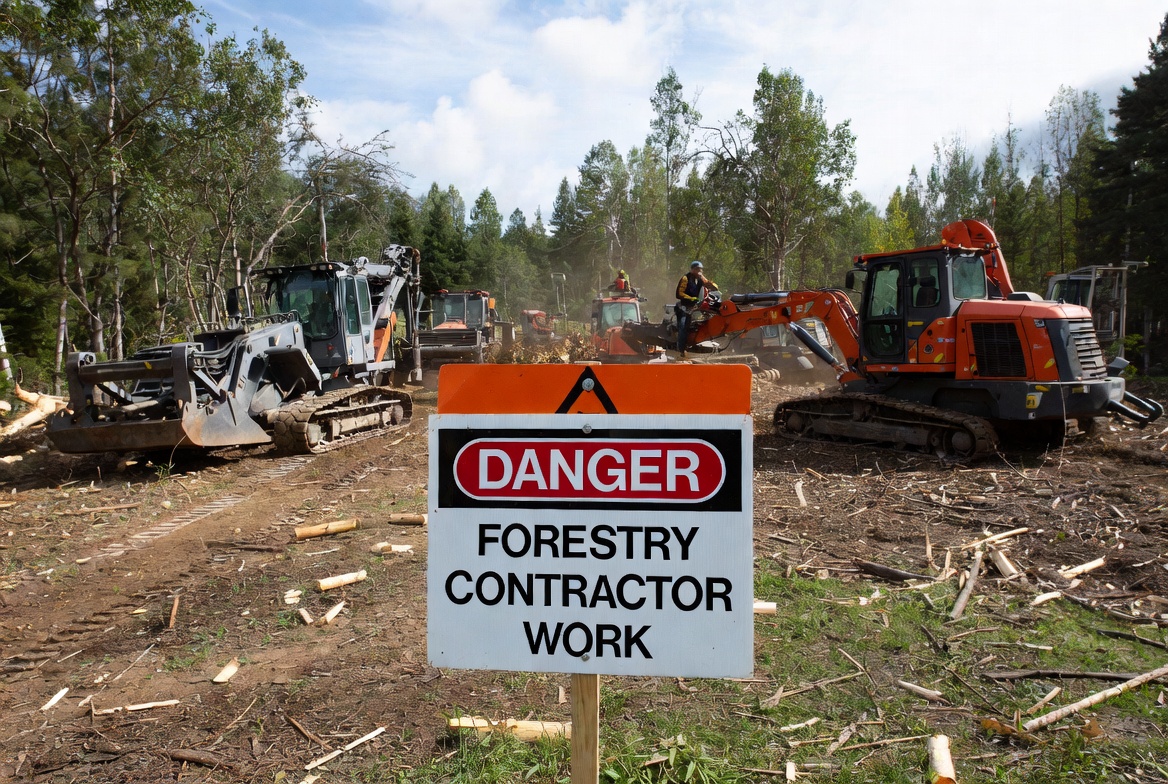
An active harvest site is heavy industry happening in the woods. Multiple machines moving simultaneously, log trucks staging at the landing, skidders dragging hitches in, fellers laying down trees ahead of them. Posted signage warns the public off the access road. Crew radios crackle with positions and pace.
This visual matters at submission time. Specialty logging underwriters expect to see operational discipline — posted signage, traffic control on access roads, defined landing layouts, fire watch documentation, and equipment maintenance records. The site itself is part of the application.
What Goes Into a Forestry Contractor Program
Pays For
Third-party bodily injury and property damage caused by harvest operations — to landowners, neighbors, public-road users, adjacent property.
Triggers
Errant felled timber. Equipment off-tract incursion. Damage to fencing, structures, vehicles. Public-road incidents during haul.
Pays For
Employee injuries on harvest sites — sawyer injuries, equipment-operator injuries, struck-by, fall injuries, log-handling injuries.
Triggers
Logging is among the highest-rated WC class codes. Statutory in every state. Specialty WC markets often required.
Pays For
Wildfire ignition claims, fuel and hydraulic spills, suppression cost recovery, and third-party liability for fire-related damages.
Triggers
Equipment-caused ignition. Operational fire incidents. Pollution from fuel storage, equipment leaks, or chemical handling.
Pays For
Liability and physical damage on log trucks, support vehicles, and trailers used to haul timber from landing to destination.
Triggers
Highway accidents during haul. Load-securement incidents. Trailer detachments. Loading-zone auto incidents at the landing.
Pays For
Damage to skidders, feller-bunchers, harvesters, log loaders, dozers, and chainsaws — physical damage on the harvest site or in transit.
Triggers
Equipment fires. Theft from remote sites. Rollovers, collisions, fluid contamination. Vandalism.
Pays For
Damage to timber being harvested but not yet hauled — purchased standing timber, felled but unhauled timber at the landing.
Triggers
Fire damage to felled timber. Theft of decked logs. Storm damage to harvested wood awaiting transport.
Pays For
Performance bonds, operating bonds, and reclamation bonds typically required on federal, state, and tribal timber sale contracts.
Triggers
Required by the public-land contract terms. Demonstrates financial responsibility for performance, payment, and post-harvest restoration.
Logging is heavy industry in the woods.
Tree service insurance won't carry it. Logging insurance won't just appear.
It gets deliberately built.
If your operation runs skidders, fellers, processors, log loaders, or log trucks — the program has to be sized around heavy industrial logging exposure. Specialty markets, real underwriting, real submissions. We do the work.
Build the Right Forestry Program
Send us your equipment list, customer mix, the contracts driving your bonding and limit demands, your loss runs, and your existing program. We build the forestry contractor program around the operation that's actually running.
Start the Intake Form →Search the Kelly Insurance Group Site
Other Tree Service Coverages We Place
By Operation Type
Cost, Quotes & Buyer Resources
Hard-to-Place & Problem Risk Pages
Other KIG Resources
Forestry Contractor Insurance Questions Answered
How is forestry contractor insurance different from tree service insurance?
Tree service insurance is built around residential and commercial tree care work — bucket trucks, climbing, trimming, removal in populated areas. Forestry contractor insurance is built around industrial timber harvesting — skidders, feller-bunchers, processors, log trucks, remote terrain, and timber sale contracts. Different class codes, different markets, different forms.
What's OSHA 1910.266 and why does it matter?
OSHA 29 CFR 1910.266 is the federal regulation governing logging operations — covering manual felling, mobile equipment, log handling, and the practices that go with timber harvesting. Specialty logging markets underwrite to this regulation. Documented compliance, training records, and safety programs that reference 1910.266 are credibility signals.
Do I need surety bonds to log on public land?
Yes — federal, state, and tribal timber sale contracts typically require performance bonds, operating bonds, and reclamation bonds. The bonding requirements are written into the timber sale contract terms. See our Surety Bonds page.
What about wildfire liability?
Wildfire claims arising from logging operations are among the most severe losses in the contracting world. Specialty pollution and fire liability coverage, equipment fire suppression protocols, fire watch programs, and IFPL compliance all factor into the program. Operations in fire-prone regions need this specifically anticipated.
How do log truck operations factor in?
Log trucks are a meaningful share of forestry contractor exposure. Heavy haul, load securement, off-road and on-road conditions, FMCSA hours-of-service rules — all create distinct commercial auto exposure that has to be sized into the program. See our Specialty Truck Insurance page.
What if I'm a tree service that occasionally does logging work?
Cross-discipline operations are one of the trickiest placements. The program has to anticipate both the tree service exposure and the logging exposure — and standard markets often won't write the combination. Specialty markets that understand both sides handle these placements deliberately.
What about federal stewardship contracts and post-fire salvage?
Stewardship contracts under federal authority and post-fire salvage operations have their own contract language, environmental requirements, and insurance demands. They often parallel federal timber sale contracts in coverage and bonding requirements but include specific stewardship-related provisions.
Where do I start?
Start with the intake form. It captures equipment, customer mix, contract structure, bonding requirements, and existing program declarations. Or reach out via the contact page or (412) 212-2800.
Your Forestry Program, Built Right.
Send us the equipment, the customer mix, the contracts driving your bonding and limit demands, and your existing program. We build it for the heavy industrial logging operation that's actually running — not a tree service program with the wrong class codes.
Start the Intake Form → Contact Kelly Insurance Group →