ACTION OVER INSURANCE COVERAGE, THIRD-PARTY-OVER CLAIMS AND CONTRACTOR LIABILITY EXCLUSIONS
Action over coverage becomes critical when a worker injury claim moves beyond workers compensation and creates liability pressure against another project party. Kelly Insurance Group helps contractors, owners, developers, construction managers, retail brokers, wholesale brokers and attorneys review action over insurance, third-party-over exposure, action over exclusions, Labor Law coverage, additional insured tenders, contractual indemnity, umbrella limits and excess liability wording.
BUILT FOR HARD CONSTRUCTION LIABILITY QUESTIONS
This hub is for people trying to understand where the coverage problem actually sits: the injured worker, the direct employer, the owner, the general contractor, the subcontract agreement, the additional insured endorsement, the GL exclusion or the excess layer.
- Action over insurance coverage
- Third party action over claims
- Action over exclusion review
- New York Labor Law 240 and 241 exposure
- Subcontractor employee injury exclusions
- Umbrella and excess follow-form review
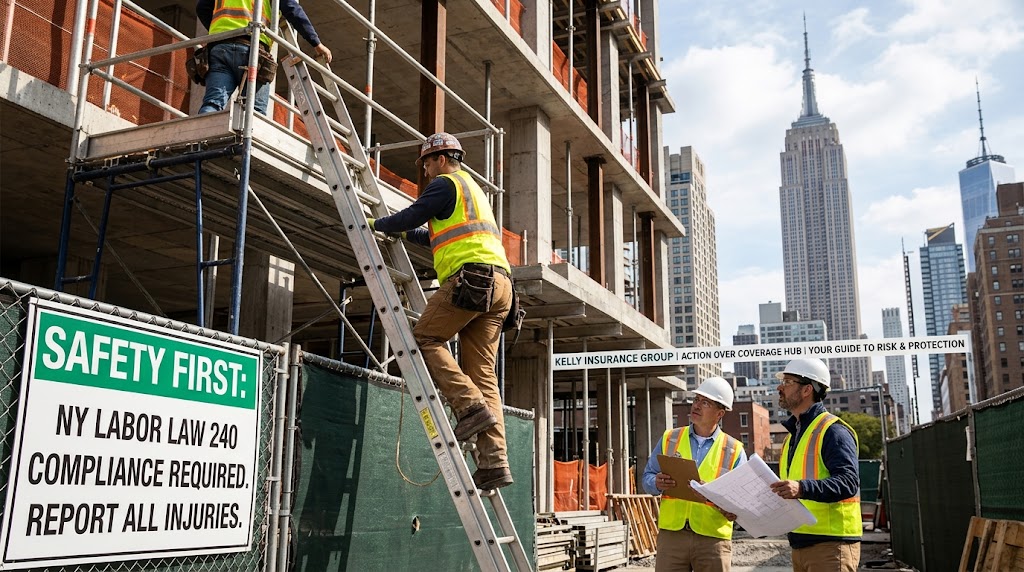 Action over exposure starts on the jobsite, but the real problem often appears inside the contract and policy wording.
WHAT IS ACTION OVER COVERAGE?
Action over coverage is marketplace language used when an injured worker receives workers compensation benefits from the direct employer but then pursues another party, such as a property owner, general contractor, construction manager or project developer. That third party may then tender the claim back to the injured worker’s employer through contractual indemnity, hold harmless language or additional insured requirements.
The problem is simple: a contractor can have a general liability policy and still have a major coverage gap if the policy includes an action over exclusion, third party action over exclusion, employee injury exclusion, subcontractor employee exclusion or restrictive employer’s liability wording.
CLICK THE BREAK POINT TO SEE WHERE ACTION OVER CLAIMS GET DANGEROUS
Action over risk is rarely a single-document problem. The claim can break at several points: the contract, the certificate, the GL endorsement, the workers compensation/employers liability layer or the umbrella and excess tower.
ACTION OVER COVERAGE FAULT LINE
Click a layer to see where an action over claim can create a coverage dispute, tender problem or contract mismatch.
WHO SHOULD CARE ABOUT ACTION OVER INSURANCE?
GENERAL CONTRACTORS
GCs can be pulled into worker injury claims even when the injured worker is employed by a subcontractor. Contract transfer and additional insured wording become central.
SUBCONTRACTORS
Subcontractors may be required to defend, indemnify and insure upstream parties. A policy with an action over exclusion may fail the real contract requirement.
PROJECT OWNERS
Owners and developers often expect downstream insurance to protect them. That expectation can collapse if the subcontractor’s policy contains restrictive wording.
CONSTRUCTION MANAGERS
CMs may face jobsite safety allegations, additional insured tenders and contractual risk-transfer demands tied to subcontractor employee injuries.
ATTORNEYS
Counsel may need to identify whether the tender path, policy wording, additional insured status and indemnity language actually create a defense or indemnity obligation.
RETAIL & WHOLESALE BROKERS
Brokers may need a market strategy for hard-to-place contractor accounts, New York Labor Law exposure, action over exclusions and excess liability restrictions.
COMMON ACTION OVER COVERAGE PROBLEMS
The certificate can look fine while the policy wording quietly blocks the claim everyone expected the insurance to handle. That is why endorsements and exclusions must be reviewed before relying on the certificate.
ACTION OVER EXCLUSION
May restrict or remove coverage when an employee injury claim is tendered back through a third-party lawsuit, contract or additional insured demand.
THIRD PARTY ACTION OVER EXCLUSION
Targets the upstream claim pathway where an injured employee sues a third party and that party seeks protection from the employer’s insurance program.
INJURY TO SUBCONTRACTOR EMPLOYEE
Can create a serious gap when a project involves multiple trades, subcontractors, labor crews and upstream certificate requirements.
EMPLOYER’S LIABILITY LIMITATION
Workers compensation and employers liability should be reviewed with the GL program, especially where contracts demand action over support.
ADDITIONAL INSURED MISMATCH
A certificate may say additional insured, but the actual endorsement determines who is protected and how far that protection reaches.
EXCESS FOLLOW-FORM PROBLEM
A higher limit does not repair a bad underlying form if the umbrella or excess policy follows the same exclusion or adds its own restriction.
ACTION OVER COVERAGE AND NEW YORK LABOR LAW EXPOSURE
New York construction accounts often create the sharpest action over coverage questions because Labor Law 240 and Labor Law 241 can drive severe worker-injury claims, upstream tenders and heavy contract requirements. A contractor doing work in New York should not assume a standard GL policy, generic certificate or ordinary umbrella limit is enough.
LABOR LAW 240
Often connected with Scaffold Law, ladders, scaffolds, hoists, falling objects, elevation devices and gravity-related construction injury claims.
LABOR LAW 241
Often connected with construction, excavation, demolition, Industrial Code allegations, jobsite safety conditions and broader worksite compliance issues.
THE FASTEST ACTION OVER REVIEW STARTS WITH THE REAL DOCUMENTS
A certificate is not enough. Send the policies, endorsements, contracts and project details so the actual coverage structure can be reviewed.
KEEP GOING THROUGH THE ACTION OVER COVERAGE CLUSTER
CURRENT CUSTOMERS MAY RECEIVE ACCESS TO OUR CUSTOM CLIENT PORTAL.
Most Kelly Insurance Group customers are given access to a custom client portal where policy documents can be accessed and certificates of insurance can be generated. That matters when project owners, general contractors, construction managers, developers or municipalities need proof of coverage quickly.
ACTION OVER INSURANCE QUESTIONS
WHAT IS AN ACTION OVER CLAIM?
An action over claim commonly refers to a situation where an injured worker receives workers compensation benefits from the direct employer but brings a claim against another party, such as a property owner, general contractor or construction manager.
WHAT IS A THIRD-PARTY-OVER ACTION?
A third-party-over action involves an injured employee, after collecting workers compensation benefits from the employer, suing a third party for contributing to the injury.
WHAT IS AN ACTION OVER EXCLUSION?
An action over exclusion is policy wording that may restrict or eliminate coverage for certain employee injury claims that move upstream through tender, indemnity or additional insured demands.
DOES GENERAL LIABILITY AUTOMATICALLY COVER ACTION OVER CLAIMS?
No. The policy must be reviewed for exclusions, endorsements, employer’s liability wording, subcontractor employee injury exclusions, additional insured language and excess liability restrictions.
WHAT SHOULD I SEND FOR REVIEW?
Send the GL policy, endorsements, excess policy, contract, certificate requirement, subcontractor agreements, workers compensation information, project scope and loss history.
SEND THE ACTION OVER COVERAGE DETAILS.
Use this form if you need help reviewing action over insurance, third party action over exposure, action over exclusions, New York Labor Law coverage, contractor GL wording, additional insured requirements, umbrella limits, excess liability or project contract requirements.