Emergency Tree Service Insurance.
When the call comes in at 2 a.m. and a tree is on a house, the policy that covered yesterday's planned trim job has a much harder day ahead. Emergency response is a different operation — and the program needs to anticipate that before the phone rings.
What an Emergency Call Actually Looks Like
The Phone Rings at 2:14 AM
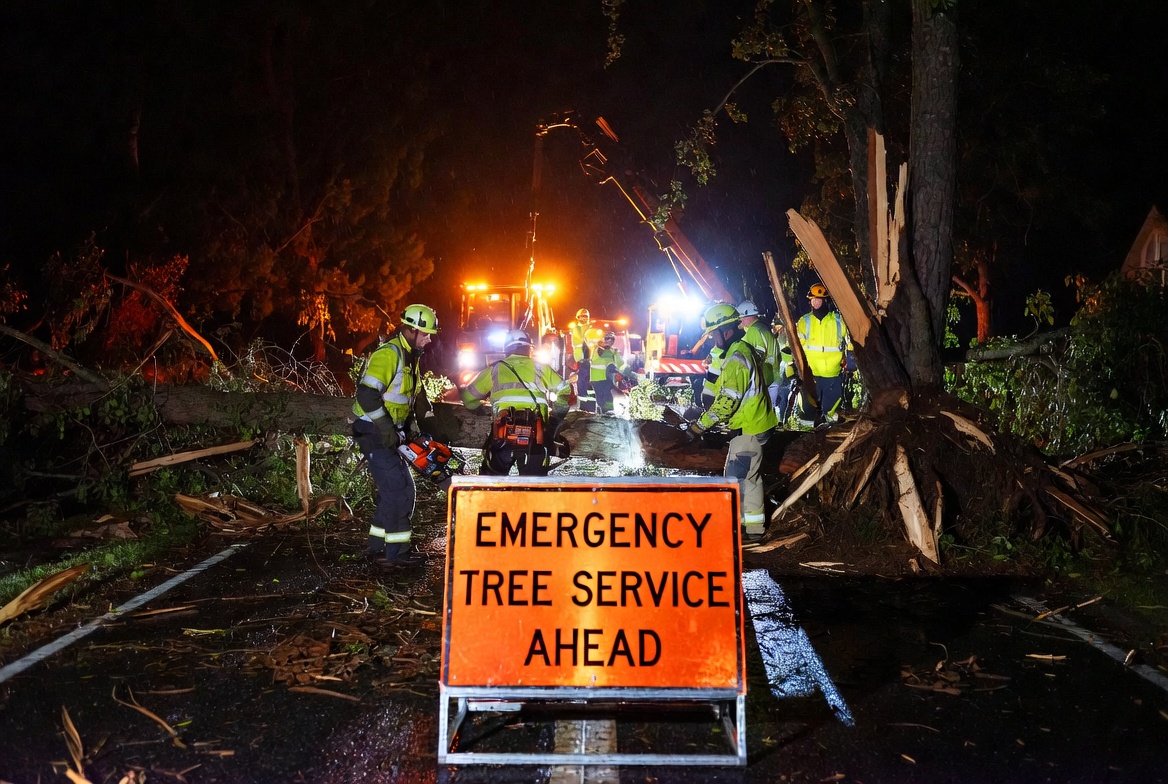
A wind event drops a 70-foot oak through the second story of a residential home. The customer's homeowners insurance carrier or a 24/7 dispatcher routes the call to your emergency line. The customer is awake, scared, and needs someone on site before sunrise.
Coverage implications: The clock on duty of care just started. The policy's 24-hour operating provisions, after-hours coverage, and operating territory all become live considerations.
Crews Roll Out
The lead is dispatched. Bucket truck and chip truck on the road. Maybe a crane on standby. Possibly a sub being called in because everyone is already deployed. Drivers are tired, weather is bad, visibility is reduced.
Coverage implications: Commercial Auto liability is fully active. Hired & Non-Owned Auto becomes relevant if a personal vehicle is being used. Workers Compensation responds to in-transit injury.
Higher accident severity in storm-condition drivingCrews Arrive — and the Site Is a Mess
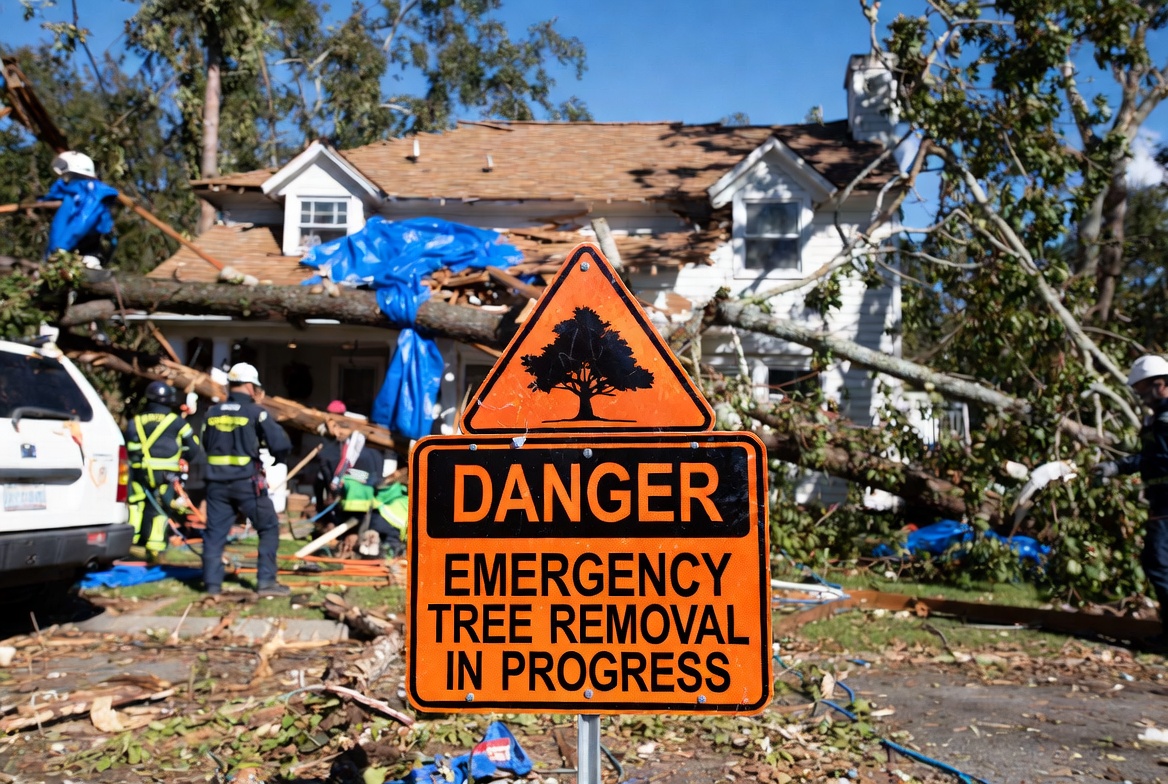
Power lines may be down or compromised. Structural integrity of the house is unknown. Adjacent trees have storm damage and may be next. Customer property is everywhere — patio furniture, fencing, vehicles in the path. Setting up a clean drop zone is harder than on a planned job.
Coverage implications: General Liability is fully engaged. Pollution Liability matters if there are fuel leaks from damaged vehicles or the chainsaws being staged. Utility line proximity is a specific underwriting question on most tree GL forms.
Energized lines = different operation, possibly different coverageThe Cuts Begin Under Difficult Conditions
Saws fire. Pieces start coming off in the dark, often by headlamp. The tree is partially supported by the structure it fell on, which means cuts behave unpredictably. Compression and tension forces are difficult to read. Rigging plans change cut by cut.
Coverage implications: Rigging operations are active. Damage to the structure that's already damaged is its own complicated claim conversation. Any property in your care during a hoist is a Rigger's Liability question.
Sun Up — Operation Continues, Crews Are Tired
Crews that mobilized at 2 a.m. are now eight hours into the work, having had no sleep, no real meals, and elevated stress. Fatigue is real. Mistakes get more likely as the day progresses. New emergency calls keep stacking up on the dispatch board.
Coverage implications: Workers Compensation severity climbs with fatigue. Carriers look at how operations manage hours during storm response — written fatigue management protocols are a credibility signal.
Fatigue-driven claims are an emergency-response signatureOne Job Done — Backlog Building
The first emergency is wrapped, the customer is taken care of, and the crew is exhausted. Three more emergency calls came in during the job. The cycle starts over. Some operations stay in this mode for three days, five days, two weeks after a major event.
Coverage implications: Multi-day, multi-state, multi-job storm response is a different exposure profile from a single emergency. Mutual aid agreements, FEMA debris work, and contracted utility response all surface here.
Operations should be priced for storm tempo, not just baseline volumeThe Claim Patterns You Don't See on Planned Work
Emergency tree work produces a different set of claim patterns than planned residential or commercial trimming. The pace, the conditions, the unfamiliar properties, the fatigue, and the proximity to active hazards — they all combine to surface losses that simply don't happen on a scheduled Tuesday morning trim.
Carriers underwriting tree services with meaningful emergency volume look at this carefully. "We do storm work" is one underwriting question. "We do storm work as our primary revenue stream" is a completely different conversation — and the program has to be priced and structured around the answer.
Operations that have grown into emergency response without updating their insurance program are the most common gap we see. The policy was sized around the original residential trimming business; the work has shifted; the policy has not. The first major emergency claim is when that gap shows up.
Mutual Aid, FEMA Work & Multi-State Deployment
Major weather events trigger mutual aid networks, contracted utility response crews, and FEMA debris monitoring contracts. Tree services that participate in these are operating across state lines, often under tight contractual requirements, with insurance demands that exceed what a residential operation typically carries.
Each of the items below carries specific coverage implications — additional insureds, primary & non-contributory language, waiver of subrogation, certificate requirements, and underlying limits. Storm-chaser operations that don't anticipate these end up either declining the work or accepting the risk uninsured.
- Mutual aid agreements: contracted standby with utilities or municipalities for emergency response
- FEMA-related debris contracts: federal funding requirements, monitoring overhead, specific compliance documentation
- Out-of-state operating territory: auto coverage territory, GL territory, workers comp licensing across jurisdictions
- Master service agreements: high-limit insurance demands, additional insured status, primary & non-contributory clauses
- Subcontractor surge: bringing in unfamiliar 1099 climbers and ground crews to keep up with demand
- Equipment in unfamiliar territory: Inland Marine extending coverage to gear deployed across state lines
What an Emergency-Ready Program Actually Includes
The right program for an emergency tree service is built before the next storm rolls in. By the time the wind picks up and the first call comes in, the placement decisions have already been made — and either the program is sized for the work or it isn't.
The card to the right is what carriers look for on a tree service that does meaningful emergency volume. None of these are exotic — they're standard placement disciplines that simply have to be in place before the operation needs them.
Program Readiness Items
24-Hour Operating CoverageConfirm the GL and Auto policies have no after-hours restriction.
Multi-State TerritoryAuto and GL territories cover the states you respond into.
Subcontractor Vetting Process1099 sub COIs and additional insured docs ready to deploy fast.
Mutual Aid Contract ComplianceAI, primary & non-contributory, waiver of subrogation pre-set.
Stacked Liability LimitsUmbrella and excess sized for storm-condition severity events.
Fatigue Management ProtocolDocumented hours discipline during extended response operations.
The phone rings at 2 a.m.The job won't wait.
The duty of care doesn't either.
The program has to be ready before the storm — not after.
If your tree service has grown into emergency response — or storm work has become a meaningful share of revenue — the program built around your original baseline won't carry the weight. We rebuild it for the way the work actually arrives.
Build the Right Emergency Program
Tell us how often the calls come in after hours, where you respond, what mutual aid or storm contracts you carry, and how your subcontractor pipeline works during peak deployment. We build the program for the way emergency work actually runs.
Start the Intake Form →Search the Kelly Insurance Group Site
Other Tree Service Coverages We Place
By Operation Type
Cost, Quotes & Buyer Resources
Hard-to-Place & Problem Risk Pages
Other KIG Resources
Emergency Tree Service Insurance Questions Answered
Is emergency tree work different from regular tree work for insurance?
From a coverage form standpoint it's largely the same policies — GL, Auto, WC, IM, Umbrella. From an underwriting standpoint it's a different conversation. Storm-condition operations, after-hours work, multi-state deployment, fatigue exposure, and energized hazards all change how carriers grade an account that does meaningful emergency volume.
Do I need a separate policy for emergency work?
Generally no — emergency work is folded into the standard tree service program. The point isn't a separate policy; it's making sure the existing program is sized, structured, and underwritten with the emergency work in mind. A program built around residential trimming volume won't carry the load for storm-response operations.
Does my GL cover work near downed power lines?
Energized utility line proximity is a specific underwriting question. Many tree GL forms exclude or sub-limit work in proximity to live utility lines. Operations that respond to storm damage near utility infrastructure should confirm the policy specifically anticipates the exposure. See our Utility Line Clearance page.
What about out-of-state storm response?
Auto coverage territory, GL territory, and workers comp licensing all have to support the states you respond into. Many policies are limited to specific operating territory by default — out-of-state storm chasing without checking the territory creates real coverage gaps. See our Hired & Non-Owned Auto page.
What's the deal with FEMA and mutual aid contracts?
FEMA-related debris contracts and utility mutual aid agreements come with specific insurance requirements: high underlying limits, additional insured status for the contracting party, primary & non-contributory language, waiver of subrogation, and certificate compliance. Operations that participate in these need a program built specifically to satisfy the contract requirements. See our Excess Liability page.
How do you handle subcontractor surge during peak storm response?
This is one of the harder operational disciplines on emergency response. Carriers want to see written subcontractor vetting protocols — COIs collected before work begins, additional insured documentation, hold-harmless agreements. Operations that bring in unfamiliar 1099s during peak demand without that discipline end up with audit pickups and coverage gaps.
I had a storm-related claim — can I still get coverage?
Yes. Specialty markets place tree service accounts with prior storm-related claims regularly. Send loss runs, post-loss safety improvements, and operational changes since the loss. See our Tree Service With Claims page and After Cancellation page.
Where do I start?
Start with the intake form. It captures emergency response volume, operating territory, mutual aid or storm contracts, and subcontractor practices. Or reach out via the contact page or (412) 212-2800.
Your Emergency Program, Built Right.
Tell us when the calls come in, where you respond, what contracts and mutual aid agreements you carry, and how your team scales during peak deployment. We build the program for the work that arrives at 2 a.m. — not the work you scheduled last week.
Start the Intake Form → Contact Kelly Insurance Group →