
STUNT AND PYROTECHNICS
FILM INSURANCE FOR HIGH-RISK PRODUCTIONS
Coverage for the productions other brokers decline. Stunt sequences, pyrotechnics, weapons, fire effects, fight scenes, vehicle action, and special effects placed through specialty markets that actually want this risk class — when the credentials, planning, and crew justify it.
- STUNTS & FIGHT CHOREOGRAPHY
- PYROTECHNICS & FIRE EFFECTS
- WEAPONS & FIREARMS ON SET
- VEHICLE ACTION & CAR STUNTS
- HIGH FALLS & WIREWORK
- EXPLOSIVE SPECIAL EFFECTS
- HAZARDOUS LOCATION FILMING
- DECLINED OR HARD-TO-PLACE RISKS
STANDARD CARRIERS DON'T WRITE THIS. SPECIALTY ONES DO.
Stunts, pyro, weapons, and fire effects are routinely declined by generalist film carriers. Specialty markets place this business every day — when the production is structured to be insurable.
Stunt and pyrotechnics film insurance is its own underwriting discipline. Standard film production package policies typically exclude or significantly limit coverage for high-risk activities. To get bound coverage that actually responds when something goes wrong on a stunt or pyro day, the production needs to be placed with specialty carriers who underwrite this class of risk regularly.
Those carriers want to see specifics: who's coordinating the stunts, what credentials the pyrotechnicians hold, how the weapons are being handled, what the fight choreography plan looks like, where the safety perimeters are. The more detail the production provides, the better the placement — and the better the premium. Insufficient detail typically means declination.
We work with productions across every budget tier on this — from low-budget indie features incorporating limited stunts through studio-tier action productions with full SFX departments. Including projects that have already been declined by other brokers.

WHAT "STUNT & PYRO" ACTUALLY COVERS
"Stunt and pyrotechnics" is shorthand for a wide range of high-risk production activities. Each category has its own underwriting expectations and required credentials.
CHOREOGRAPHED STUNTS
Performed stunts including falls, ratchet pulls, wirework, body-impact gags, and choreographed action sequences. Credentialed stunt coordinator typically required.
STUNT COORDINATOR-LEDFIGHT CHOREOGRAPHY
Hand-to-hand combat, weapons fight choreography, edged weapon scenes, and physical altercations. Fight coordinator credentials and rehearsal documentation expected.
FIGHT COORDINATORPYROTECHNICS
Controlled explosive effects, squibs, mortars, flash pots, and pyrotechnic gags. Licensed pyrotechnician and proper permits required by every carrier.
LICENSED OPERATORFIRE EFFECTS
Burning sets, fire stunts, flame effects, gas-fed fire, and full-body burns. Specialty fire coordinator and detailed safety plan are standard requirements.
FIRE COORDINATORWEAPONS & FIREARMS
Prop firearms, blank rounds, edged weapons, and weapons handling on set. Credentialed weapons handler / armorer required by carriers and increasingly by law.
ARMORER REQUIREDVEHICLE ACTION
Car chases, vehicle rollovers, vehicle stunts, ramps and jumps, motorcycle stunts, and picture car action. Stunt drivers and coordinated vehicle plans expected.
STUNT DRIVERSHIGH FALLS & WIREWORK
Air rams, high-fall rigs, wirework gags, descender systems, and flying performer rigs. Rigging credentials and engineered safety plans required.
RIGGING-INTENSIVEEXPLOSIVE SFX
Larger-scale special effects involving controlled detonations, explosive squibs, building demos for camera, and engineered explosive gags.
SFX COORDINATORHAZARDOUS LOCATIONS
Filming in inherently hazardous environments — heights, water, confined spaces, industrial sites — with corresponding safety planning requirements.
LOCATION-DRIVENHOW HIGH-RISK COVERAGE ACTUALLY GETS BOUND
Specialty carriers don't bind stunt and pyro coverage from a one-line request. Here are the elements underwriters typically require to evaluate and price the risk.
STUNT COORDINATOR CREDENTIALS
Coordinator name, prior credits, experience with the specific stunt category, and resume documentation submitted with the application.
PYROTECHNICIAN LICENSING
State and federal licensing for the licensed pyrotechnician supervising any pyro work — including ATF and applicable state fire marshal credentials.
SCENE BREAKDOWNS
Specific scene-by-scene breakdown of every stunt, fight, pyro, weapon, or hazardous activity in the script — with detail on action and safety.
WEAPONS HANDLER / ARMORER
Credentialed weapons handler responsible for all firearms, prop weapons, and blank rounds on set — increasingly required by both carriers and law.
SAFETY PLAN & PERIMETER
Documented safety plans covering rehearsal protocols, perimeters, fire suppression, medic on standby, and crew safety briefings.
PERMITS & LOCAL APPROVALS
Documentation of fire marshal sign-off, ATF permits where applicable, and local jurisdiction approvals for the specific stunt or pyro activity.
REHEARSAL DOCUMENTATION
Records of stunt rehearsals, walk-throughs, dry runs, and choreography sessions completed before camera-ready execution.
ON-SET MEDICAL & FIRE
Set medic and on-standby fire safety personnel where the activity warrants — typically required for any pyro, fire effect, or significant stunt.
WHEN OTHER BROKERS HAVE SAID NO
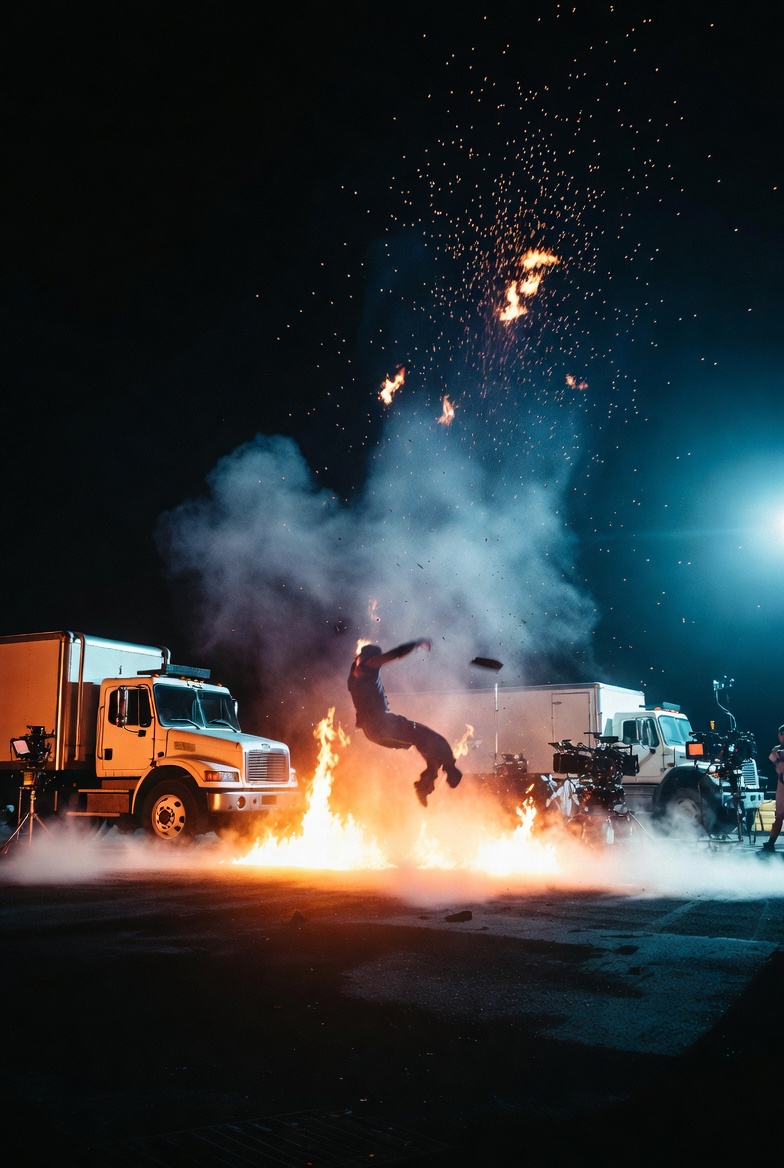
WE WORK THE MARKETS THAT WRITE WHAT GENERALISTS DECLINE
Productions land at our door already declined. Generalist agencies don't have the carrier appetite or specialty market access to place high-risk film business — so they decline, undercover, or quote at numbers that effectively price the project out.
That doesn't mean the production isn't insurable. It usually means the broker didn't have the right markets. We routinely place coverage that other brokers have walked away from — for productions with stunts, pyro, weapons, fire effects, complex SFX, foreign filming, and combinations of all of the above.
-
PREVIOUSLY DECLINED PROJECTS Productions turned down by another broker or carrier — often placeable with the right specialty market.
-
FIRST-TIME ACTION PRODUCERS Producers tackling stunts or pyro for the first time. Coverage placed when the credentialed crew supports it.
-
COMBINED HAZARD CLASSES Productions involving multiple high-risk categories — stunts plus pyro plus weapons in the same project.
-
FOREIGN-LOCATION ACTION Action productions shooting outside the United States with corresponding territorial and credential complexities.
-
NON-UNION ACTION PRODUCTIONS Action productions outside SAG-AFTRA, DGA, or IATSE jurisdiction — coverage that doesn't depend on union framework.
COVERAGE COMPONENTS FOR HIGH-RISK PRODUCTION
Stunt and pyro coverage is layered into the broader production insurance program. Here are the components that come up most often when high-risk activity is in the script.
PRODUCTION GENERAL LIABILITY
Third-party bodily injury and property damage — extended to cover the heightened exposure from stunt and pyro activity.
STUNT PERFORMER COVERAGE
Coverage extensions covering stunt performers, fight performers, and stunt doubles working on the production.
PYRO LIABILITY
Liability coverage specifically tied to controlled pyrotechnic effects, gas-fed fire, and explosive gags supervised by licensed operators.
WEAPONS HANDLING
Liability tied to weapons on set — prop firearms, blank rounds, edged weapons — under a credentialed armorer's supervision.
VEHICLE STUNT COVERAGE
Coverage extensions for picture car stunts, choreographed vehicle action, rolls, jumps, and chase sequences.
FIRE EFFECTS COVERAGE
Liability for burning sets, full-body burns, fire stunts, and gas-fed flame effects executed under qualified supervision.
WORKERS COMPENSATION
Statutory coverage for stunt performers, SFX crew, and pyrotechnicians — coordinated with the rest of the production. See film production workers comp.
EQUIPMENT COVERAGE
Production equipment in proximity to stunts and pyro — coordinated with broader film equipment insurance.
UMBRELLA / EXCESS
Higher excess limits often required by locations, distributors, or financiers when stunts or pyro are in the script.
WHAT TO HAVE READY WHEN YOU CALL
A faster submission is a better submission. The more of the following the production has documented up front, the faster underwriters can quote — and the more competitive the placement.
SCRIPT WITH SCENES MARKED
Working draft of the script with stunt, pyro, fight, and weapon scenes flagged for underwriter review.
STUNT BREAKDOWN
Scene-by-scene breakdown of every stunt and high-risk activity with action description, performer, and safety approach.
COORDINATOR RESUMES
Resumes and prior credits for the stunt coordinator, fight coordinator, pyrotechnician, and weapons handler.
SAFETY PLAN
Documented safety plan covering perimeters, fire safety, on-standby medical, and crew briefing protocols.
SHOOT SCHEDULE
Shooting schedule identifying which days carry stunt, pyro, fight, or weapons activity — including prep and rehearsal.
LOCATION DETAILS
Locations where high-risk activity will occur, including any soundstage, studio, or specialty stunt facility involvement.
PERMIT STATUS
Status of fire marshal sign-off, ATF approvals, and local jurisdiction permits required for the activity.
PRIOR DECLINATIONS
If the project has been declined elsewhere — what was said and why. Helps us go directly to the right specialty market.
QUESTIONS ACTION PRODUCERS ASK
CAN YOU GET INSURANCE FOR A FILM WITH STUNTS?
WHY DOES STUNT INSURANCE COST MORE?
WHAT IS A STUNT COORDINATOR AND WHY DO CARRIERS REQUIRE ONE?
DO I NEED A LICENSED PYROTECHNICIAN FOR PYRO EFFECTS?
WHAT IF MY PROJECT WAS ALREADY DECLINED BY ANOTHER BROKER?
DOES MY PRODUCTION POLICY ALREADY COVER STUNTS?
HOW DO WEAPONS ON SET GET INSURED?
CAN YOU INSURE A LOW-BUDGET PRODUCTION WITH STUNTS?
YOUR ACTION SHOOT IS REAL. YOUR INSURANCE NEEDS TO BE TOO.
Stunts, pyro, weapons, fire effects, vehicle action — placed through specialty markets that actually want this risk class when the production is structured to be insurable. Including projects that have already been declined by other brokers.
THE COMPLETE FEATURE FILM INSURANCE LIBRARY
FEATURE FILM INSURANCE
The complete overview of feature film coverage — every spoke, every policy type, every budget tier.