Drone Light Show Insurance
A drone light show is not a single risk — it is aviation, entertainment, and special event rolled into one operation flying at night, often over crowds, often near pyrotechnics, almost always under an FAA waiver. Standard drone insurance does not cover it. Standard event insurance does not cover it. The placement requires aviation-form coverage, specialty markets, and a broker who understands what an underwriter actually wants to see.
What A Drone Light Show Operator Actually Insures
A drone light show fleet is a coordinated swarm of LED-equipped multirotor aircraft flying choreographed paths at night. The technology has scaled from novelty to centerpiece — Olympic ceremonies, Super Bowl halftimes, Burning Man, Coachella, Disney parks, Fourth of July civic events that used to be fireworks. As fireworks bans spread and audience expectations rise, the operator base is growing faster than the carrier base willing to insure it. That gap is where a specialty broker matters.
The risk profile is genuinely unusual. A 500-drone fleet flying 200 feet above a stadium crowd is operating under an aviation regulatory framework, with aircraft hardware on inland transit between shows, with software that can fail catastrophically (a December 2024 holiday show in Florida ended with multiple drones falling from the sky and a reported spectator injury — the kind of incident the entire industry now references), with workers comp exposure across pilots, observers, and ground crew, with potential pyrotechnic effects bolted to the airframe, and with venue contracts demanding $5 million to $25 million aviation liability limits before the show is allowed to set up.
No single carrier covers all of that off the shelf. Building the right placement requires layering coverage forms — aviation liability for third-party bodily injury and property damage, hull for the fleet itself, inland marine for ground equipment, workers comp for crew, hired and non-owned auto for the trucks moving the fleet, event cancellation for weather and waiver-pull risk, errors and omissions for the show design, and umbrella excess sitting above all of it.
The Coverage Stack — 10 Lines Of Insurance
A complete drone light show operator program almost always combines the following coverages. The first three are non-negotiable for any contracted show. The remainder fill in based on operator size, scope, fleet, and tour pattern.
Aviation Liability
Third-party bodily injury and property damage caused by the drone fleet in flight. Aviation form, not commercial general liability — standard CGL contains an aircraft exclusion. Limits typically $1M, $2M, $5M, $10M, or $25M per occurrence. Venue tier drives the limit demanded.
Hull / Physical Damage
Damage to the drone fleet itself. In-flight, in-transit, in-storage. Per-drone or fleet aggregate. Custom show drones (Verge Aero, EFM, Pixis builds) typically run $1,500–$5,000 per unit, so a 500-drone fleet is a meaningful TIV before the GCS, base stations, and transport gear are added.
Commercial General Liability
Premises and operations liability that does not involve the aircraft itself — slip and fall in the launch zone, spectator tripping over a transport case, ground crew incidents that are not employee-comp. Sits alongside aviation liability, not in place of it.
Ground Equipment
Ground control stations, RTK base stations, charging racks, tablets, laptops, comms headsets, transport cases, generators. High-mobility coverage that follows the gear from warehouse to truck to venue to hotel.
Workers Compensation
Pilots, visual observers, ground crew. Required by state, with monopolistic-state issues for touring operators (North Dakota, Ohio, Washington, Wyoming). Class code interpretation varies — the placement matters.
Hired & Non-Owned Auto
Touring operators move fleets in rental box trucks (Penske, Ryder, U-Haul) or use employee personal vehicles for venue runs. HNOA is the bridge between an unowned vehicle and the operator's liability. Lithium-ion battery transport rules apply.
Event Cancellation
Weather (wind over 20–26 mph, rain, low visibility under 3 SM, low ceiling under 500 ft), regulatory cancellation (waiver suspended, TFR issued, NOTAM conflict), equipment failure preventing performance. Covers deposits, lost revenue, and rebooking costs.
Errors & Omissions
Show design, animation, programming. If the contracted show fails to deliver as designed — wrong logo, missed cue, intellectual property dispute over the visual content — E&O picks up. Often overlooked until a client withholds final payment.
Cyber Liability
Telemetry data, GCS network, customer event files, sponsor logo files, payment data. A compromised RTK link or hacked GCS is both a safety issue and a data event. Cyber sits next to operations because the two are now intertwined.
Commercial Umbrella
Sits above the aviation liability and CGL. Most major venue and stadium contracts require $10M+ combined limits, which usually means primary aviation plus an aviation-following umbrella or excess tower. Not all umbrellas follow form over aviation — placement matters.
Why Standard Drone Insurance Does Not Work For Light Shows
App-based and direct-to-consumer drone insurance platforms underwrite a single Part 107 pilot flying one aircraft for real estate, inspection, mapping, or short-form video. The product is fast, cheap, and well-suited for that risk. It is not built for a swarm. As fleet count rises, the underwriting requirements shift from a checkbox quote to a detailed application reviewed by an aviation underwriter. Most direct platforms either decline entirely above a certain fleet threshold, or they accept the risk but with limits, exclusions, and terms that fall short of what venues actually require.
| Requirement | App-Based / Direct Platform | Specialty Broker Placement |
|---|---|---|
| Fleet over 250 drones | Often declined | Routine |
| Hybrid pyrotechnic effects | Almost never | Specialty market available |
| $25M aviation liability | Capped well below | Layered tower placement |
| Operator with prior claim | Often non-renewed | Re-quoted with loss control |
| Indoor arena (no GPS) | Excluded or surcharged | Underwritten on positioning tech |
| BVLOS / over Cat 4 people | Outside platform scope | Aviation form with waiver review |
| Custom additional insured language | Templated only | Negotiated to contract |
| Aviation-following umbrella above $10M | Not offered | Layered through specialty markets |
The aircraft exclusion in standard commercial general liability is the single most important sentence on this page. CGL forms exclude bodily injury or property damage arising out of the ownership, operation, or use of any aircraft — and the FAA classifies a drone as an aircraft. A general liability policy with an unmodified aircraft exclusion does not pick up a drone-caused injury, even if the policy is in force at the time. Aviation-form coverage is the only form built to respond. Brokers who do not place aviation regularly miss this every time.
Quote A Show Or A Season
Whether you are flying a single 100-drone wedding show or anchoring a 50-show national tour, KIG places drone light show coverage through specialty aviation markets. Bring your fleet count, show calendar, waiver status, and any prior loss runs — we will tell you what the placement looks like.
The FAA Waiver Stack — What Underwriters Want To See
Aviation underwriters will not bind a drone light show without confirmation that the operator holds the waivers their show pattern requires. Some are universal to multi-aircraft operations. Others depend on whether the show flies over people, into controlled airspace, beyond visual line of sight, or above 400 feet. Each waiver is filed through DroneZone and typically takes 30 to 90 days for FAA review.
A single remote pilot in command operating more than one drone simultaneously. The foundational drone show waiver. Required for any swarm operation, no exceptions.
RequiredNight operations. Since the 2021 final rule, basic night flying is allowed without a waiver if the aircraft has anti-collision lighting visible for three statute miles — but show ops still file in combination with 107.35.
ConditionalCategories 1 through 4. Drones meeting Cat 1–3 weight and injury-threshold criteria can fly over people without a waiver. Heavier show drones often fall into Cat 4, which still requires a waiver.
If Over CrowdsStandard operating ceiling is 400 feet AGL. Some show formats — particularly stadium-anchor shows visible from a distance — request altitude waivers. Approval is rarer and the process longer.
If Above 400 ftShows in Class B, C, D, or surface-area E airspace require authorization. LAANC handles many real-time approvals; complex venues near major airports often require direct ATC coordination and a TFR.
If In Controlled AirspaceMost show drones remain within VLOS by virtue of their size, illumination, and flight envelope. BVLOS waivers are extremely rare and the FAA has issued very few; underwriting on a BVLOS-claimed show is a separate conversation.
If BVLOSThree statute miles minimum visibility, 500 feet below clouds, 2,000 feet horizontal from clouds. The most common reason a show is grounded mid-evening is a sudden ceiling drop — and the most common event-cancellation claim trigger.
Operating LimitAll drones operating in U.S. airspace must broadcast Remote ID. Show fleet manufacturers typically build compliant aircraft; some operators hold authorization or exemption from the Part 89 broadcast requirement during shows. Carriers ask about this.
RequiredUnderwriters routinely request copies of active waivers as part of the application package, alongside Part 107 certificates for each remote pilot in command, recurrent training records, multi-sUAS simulator hours (typically 30 minutes within the prior 60 days), pre-flight checklist documentation, and the operator's written safety SOPs. The more of this an applicant brings to the table, the better the placement options become. The less, the harder the placement.
Venue Tier Limit Requirements
Limit requirements scale with the venue. A community park show might be satisfied by $1M aviation liability. A major league stadium will not move forward without $10M minimum, and the highest tier (theme parks, major league championship games, brand activations at flagship venues) routinely demands $25M or more, with named additional insureds across the league, the team, the venue operator, the broadcaster, and the concessionaire. The tower is built up from a primary aviation policy plus an aviation-following umbrella or excess layer.
A real-world reference point: at least one U.S. drone show operator publicly states they carry $5M aviation liability as their floor — well above the FAA-minimum and adequate for most mid-tier venues but below what an NFL stadium typically requires. Venue contracts will specify exact additional insured language, primary and non-contributory wording, waiver of subrogation, and same-day COI delivery. A broker who cannot turn around a custom COI in hours, not days, is not the right placement.
The Specialty Aviation Markets That Write Drone Shows
There are a handful of A-rated specialty aviation insurers that actively quote drone light show risks. Beyond that, the surplus lines market and certain Lloyd's syndicates pick up the harder placements — large fleets, hybrid pyrotechnic operations, post-claim renewals, BVLOS operators, and Cat 4 over-people shows. The specific carrier on a given placement depends on operator size, loss history, fleet composition, and waiver scope.
No carrier on this list publishes a rate sheet for drone light shows. Every quote is bespoke, built from a detailed application that captures the fleet, the show calendar, the venues, the waivers, the team, the SOPs, and the prior loss experience. The application process is the single biggest difference between app-based drone insurance and aviation-form drone show insurance — and it is also why a broker who already has the relationships gets quotes back in days rather than weeks.
Real Claim Patterns That Drive Underwriting
Underwriters do not price drone light shows on theory. They price on documented claim patterns from this industry and adjacent ones. The patterns below are not hypothetical — each represents a category of loss that has occurred and that carriers now build into their pricing models.
A Swarm Over A Populated City Is Not One Aircraft — It Is Hundreds, In Formation, At Night.
Every additional drone, every additional spectator, every additional foot of altitude over a populated area changes the underwriting math. The claim patterns below are built from the way real shows actually fail.
Drone Falls On Spectator
A holiday-themed drone show in central Florida, December 2024, ended with multiple drones descending from formation into the spectator area. A spectator was reportedly injured. Aviation liability is the responding form — bodily injury, medical, potential bodily injury claim against the operator and additional insured contractors.
Aviation Liability + ExcessRTK Base Failure / Cascade Loss
The RTK ground reference station loses signal mid-show. Drones holding precise position via the corrected GPS feed lose the correction simultaneously. Without redundancy, the swarm enters fail-safe and descends. A 250-drone fleet at $2,500 per unit is a $625,000 hull event before any third-party damage is assessed.
Hull / Physical DamageMid-Flight Battery Fire
A lithium-ion cell fails in flight. The drone descends burning. Risk profile depends on what is below — a parked vehicle, a building roof, dry vegetation, or empty asphalt all trigger different liability and property exposures. In storage, the same failure mode is a CGL or property event.
Aviation + PropertyEquipment Theft From Hotel Lot
A touring operator parks a rental box truck containing 300 drones, two GCS rigs, and four RTK base stations at a hotel between shows. The truck is broken into. Inland marine responds — if the policy was written with off-premises and overnight transit terms that match the operator's actual road pattern.
Inland Marine + HNOAShow Cancelled — Ceiling Drop
A waterfront show is set up, drones are positioned, the audience is seated. At T-minus 30 minutes, the cloud ceiling drops below 500 feet AGL. The pilot in command grounds the show under 107.51(d). The deposit, the rebooking cost, and the deployment cost are all on the operator unless event cancellation responds.
Event CancellationCOI Misrepresentation Lawsuit
A major venue alleges in court that the drone show vendor's certificate of liability insurance was inaccurate and that the venue relied on that representation in signing the contract. Even with the actual show going off without injury, the COI itself becomes the litigation. E&O and the underlying policy both come into play.
E&O + AviationHave A Show Booked? Get Your COI Underway
Most venue contracts demand same-day COI delivery with custom additional insured language. KIG's specialty aviation desk can turn placement around quickly when the underwriting package is ready. Bring us the contract and we will tell you exactly what limits, endorsements, and AI language the placement needs.
Drone Light Show Insurance — Frequently Asked Questions
What An Underwriter Will Ask You For
A clean drone light show submission package keeps the placement moving. The list below is what aviation underwriters in this niche routinely request. Not every line is required for every applicant, but every line is fair game.
Operators who walk in with the entire package assembled get quoted in days. Operators who answer questions one at a time over weeks get quoted slowly, often at higher premiums, and sometimes not at all. The submission package is the single most controllable factor in a drone show insurance placement.
The Industry, At Scale
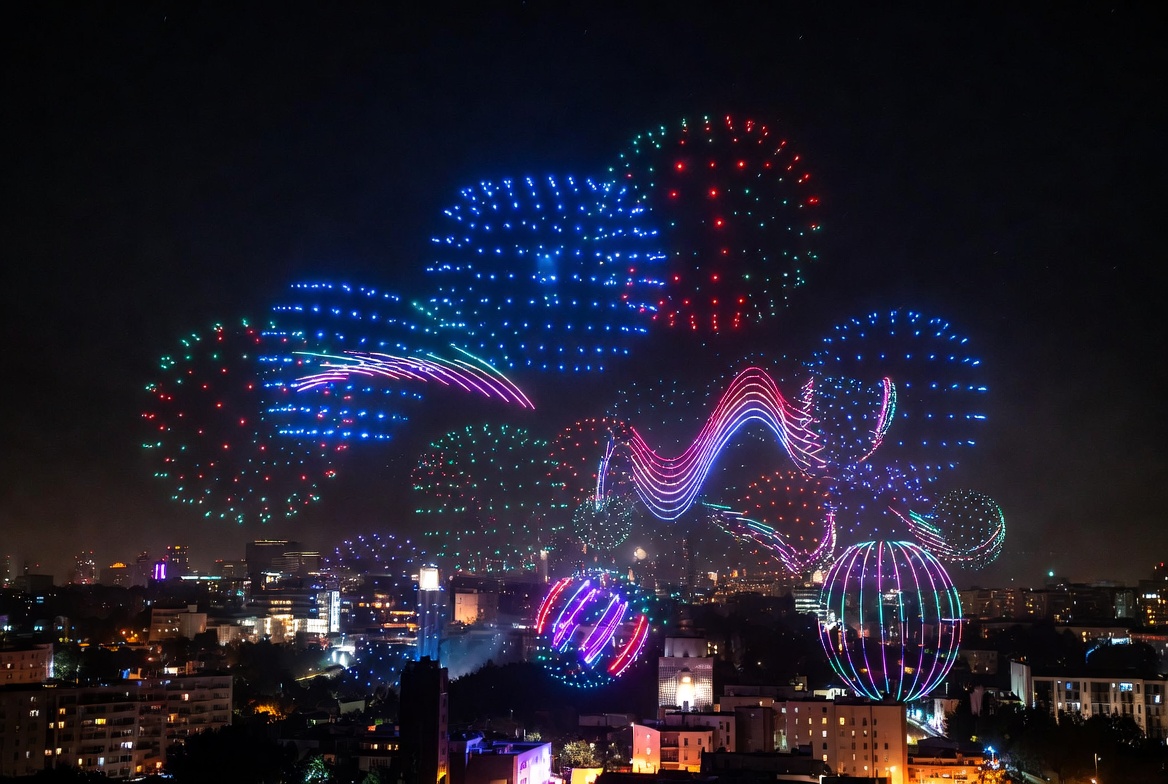
A modern drone light show is the convergence of three separate engineering disciplines — aviation, software, and live entertainment — flying overhead in formation, in real time, in public. The image below shows the visual scale that has made drone shows the fastest-growing replacement for traditional fireworks at civic, corporate, and broadcast events. Every drone in that frame is a Part 107-registered aircraft. Every formation is an FAA-waiver operation. Every show is an insurance placement.
Explore The Drone Light Show Insurance Cluster
Related KIG Coverage Programs
Drone light shows sit at the intersection of aviation, special event, and entertainment. The KIG programs below frequently coordinate with drone show placements — venue contracts, festival anchor shows, pyrotechnic-adjacent risk, and umbrella towers.