Structural Steel Welder Insurance
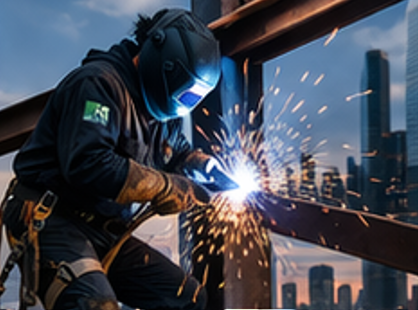
For welders and crews doing elevated structural work — beams, columns, connections, platforms, stairs, and any field welding that becomes a permanent part of a building frame or industrial structure. This coverage conversation is different from mobile welding, shop fabrication, or light repair work, and this page treats it that way.
Structural Steel Welder Insurance
The weld you make today on a structural connection can generate a liability claim five years from now. The contract you sign today can require coverage language that your current policy may not carry. Structural steel welding has a risk profile that demands more from an insurance program — and this page explains exactly what that means and why it matters for your crew.
Complete the Structural Steel Welder Insurance Intake Form
Structural steel welding is a higher-hazard class and not every carrier writes it. The intake form collects the information underwriters actually need — your crew size, the breakdown of structural versus other welding work, typical project types, contract requirements you encounter, and current coverage details. Getting that information organized upfront is what allows us to approach the right markets and structure the right program the first time.
Why Structural Steel Welding Has Its Own Insurance Conversation
The distinction between structural steel welding and other forms of welding work isn't just about scale — it's about the nature of what the weld does. A shop fabricator welds a decorative gate; if it fails, someone might get hurt. A structural steel welder makes connections that hold up floors, support roofs, and anchor staircases in occupied buildings. The consequence profile is categorically different, and the insurance market treats it that way.
Most commercial insurance carriers classify trades by the nature of their work and the severity of potential losses. Structural steel welding consistently falls into a higher-hazard category for two reasons: the elevated work environment itself, and the long-tail nature of structural liability. Unlike a repair weld that a customer can immediately inspect and test, a structural connection becomes embedded in a building — hidden behind walls, encased in fireproofing, or buried under concrete — and any deficiency in that weld may not manifest for years.
That long-tail exposure is why completed operations coverage is so central to structural steel welder insurance. And it's why the conversation around coverage limits, policy endorsements, and carrier selection is more detailed for this class of work than it is for mobile repair welding or light fabrication.
Who This Page Is Written For
Structural Steel Welding Crews
Teams that field-weld connections on commercial, industrial, or institutional structures — beams to columns, column base plates, moment connections, braced frames, stair stringers and platforms, and any other weld that becomes part of the permanent building frame.
Erection and Field Welding Contractors
Contractors who specialize in final field welding after steel erection — correcting fit-up issues, completing connections, adding reinforcement, or welding components the ironworkers leave for specialty crews.
Industrial and Heavy Commercial Welders
Welders working in refineries, manufacturing facilities, power generation, and heavy industrial settings where the structural context and contract demands are similar to commercial construction even if the work is classified differently.
What This Page Does Not Cover
Mobile Repair and Field Service Welding
Truck-based welders doing farm, ranch, and light commercial repair work have a different exposure profile — primarily commercial auto, tools in transit, and on-site liability at varying locations. That conversation is on the mobile welder insurance page.
Shop Fabrication and Fixed-Location Operations
Fabrication shops have property, business income, and customer-premises exposure that structural field welders don't face in the same way. That coverage structure is addressed on the welding shop insurance page.
Independent Welding Contractors — Light Operations
Self-employed welders doing light commercial and residential work with standard liability requirements are addressed on the independent welding contractor insurance page.
What a Structural Steel Welder's Insurance Program Typically Includes
The coverage program for a structural steel welding operation isn't a single policy — it's a set of complementary coverage parts, each addressing a different dimension of the risk. Here's what each part does and why structural work makes each one more important than it would be for lighter welding operations.
Commercial General Liability
The foundation. Covers third-party bodily injury and property damage arising from structural welding operations on-site. On a structural steel project, this includes claims from subcontractors or other trades working near your crew, damage to adjacent completed work from welding heat or sparks, and injury to anyone on the project site attributable to your operations. The limits must meet whatever the contract specifies — and on structural work, those specifications are often higher than standard.
Completed Operations — The Critical Layer
Responds to liability claims arising after the project is finished and your crew has left the site. For structural steel welders, this is arguably the most important coverage component in the program. A connection weld that passes inspection today can develop a failure condition over time — from fatigue cycling, from a defect that inspection didn't catch, from something that wasn't visible until the building was loaded. Completed operations coverage is what responds to that category of claim. It needs to be confirmed present, with limits adequate for structural work, not assumed.
Commercial Umbrella / Excess Liability
Sits above the primary CGL and provides additional limits once primary coverage is exhausted. On structural steel projects, umbrella coverage is frequently required by contract rather than optional. General contractors working on commercial construction typically specify total liability limits — primary plus umbrella combined — that reflect the size and risk profile of the project. A $1M primary policy with a $4M umbrella satisfies a $5M total limit requirement; the primary alone does not. See our commercial umbrella page for how layering works.
Additional Insured Status — Primary & Non-Contributory
Commercial construction subcontracts routinely require structural welding contractors to add the GC, project owner, and sometimes the owner's lender as additional insureds — with primary and non-contributory language. This means your policy must respond first before any other available coverage, and must not seek contribution from the additional insured's own policy. This requires a specific endorsement, confirmed on the certificate. It cannot be added after a loss is reported.
Waiver of Subrogation
Required on most commercial structural steel subcontracts. A waiver of subrogation prevents your insurance carrier from pursuing the GC or project owner after paying a claim on your behalf. From the GC's perspective, it protects them from being brought back into a claim that they've already contractually shifted to your crew. The waiver must be endorsed onto the policy before work begins — there is no retroactive option after a loss occurs.
Workers' Compensation
Required in most states for any welding crew with employees. Structural steel work — elevated, physically demanding, involving heavy material handling in all weather conditions — carries meaningful injury risk. Workers' compensation covers medical expenses and wage replacement for injured workers and insulates the business from direct employee injury suits. Elevated work has specific OSHA implications for fall protection that intersect with workers' comp classification and experience modification. See our workers' compensation page.
Tools, Equipment & Commercial Auto
Structural steel welding crews move equipment from site to site. Commercial auto coverage is needed for any vehicles used for business — including transporting welding machines, cables, and tools to project locations. Inland marine coverage addresses the welding equipment in transit and on-site. If your operation includes owned heavy equipment used to position steel, that introduces additional coverage considerations separate from the standard welding program.
Certificates of Insurance — Fast and Correct
Structural projects don't start until COIs are in order. The certificate must reflect the correct limits, the additional insured endorsement with primary and non-contributory language, the waiver of subrogation, and the correct policy period. Getting this right the first time — without back-and-forth between the GC, your broker, and the carrier — is part of what a specialty broker handles. See our certificates of insurance page.
What Underwriters Look at When Rating a Structural Steel Welding Risk
Not every commercial insurance carrier writes structural steel welding, and the ones that do ask questions that go beyond what a standard contractor application covers. Understanding what drives underwriting decisions for this class helps explain both how coverage is structured and why a specialist broker matters.
The Structural Percentage Question
The single most important underwriting factor for a welding operation that includes structural work is the percentage of annual revenue that comes from structural versus non-structural welding. A shop that does 80% decorative fabrication and 20% structural field work is a different risk than a crew that does exclusively structural field welding. Underwriters ask this question directly, and the answer affects both which markets will write the risk and how the coverage is priced and structured.
For operations where structural work represents a significant portion of revenue — particularly for crews doing primarily elevated structural connections on commercial or industrial projects — specialty markets with experience in this class are typically a better fit than standard artisan contractor markets that technically write welding but are built around lower-hazard shop and light fabrication work.
| Underwriting Factor | How It Affects the Risk Assessment | Favorable / Unfavorable Signal |
|---|---|---|
| % Revenue from structural field welding | Higher structural % narrows carrier eligibility and increases scrutiny of completed operations exposure | Higher % → fewer markets, more underwriting questions |
| Elevated work — height at which welds are performed | Work above specific heights triggers additional underwriting review and may affect workers' comp classification | Higher elevation → more scrutiny on fall and injury exposure |
| Quality control and weld inspection practices | Documented QC procedures and CWI involvement signal lower completed operations risk to underwriters | Documented QC → favorable underwriting signal |
| Project type — commercial vs. industrial vs. residential | Industrial and heavy commercial projects carry higher severity potential than residential or light commercial | Industrial / heavy commercial → higher severity classification |
| Years in business and loss history | Established operations with clean loss history present better to underwriters than newer operations | Clean losses + tenure → better terms and market access |
| Crew size and subcontractor use | Operations that use subcontractors without requiring certificates may have gaps that underwriters flag | Subcontractors OK with proper COI management |
| Contract requirements — AI, P&NC, WOS language | Operations regularly required to carry additional insured endorsements signal commercial-grade work | Standard for structural — specialty brokers handle this routinely |
| Geographic work territory | Multi-state operations may require coverage confirmation in each state; some states have specific requirements | Depends on states involved — verify at binding |
Structural Work Needs the Right Carrier — Start With the Intake Form
The form collects what underwriters need: your structural percentage, project types, crew size, and contract requirements — so we approach the right markets from day one.
Completed Operations Liability — Why It Matters More for Structural Welders Than for Any Other Trade
Every contractor faces some degree of completed operations exposure. For structural steel welders, that exposure is in a different category — because the work becomes a permanent, load-bearing component of a structure that will be occupied for decades.
What Completed Operations Coverage Actually Does
Coverage After the Job Closes
Completed operations is the component of a commercial general liability policy that responds to liability claims arising after the work is finished. Once your crew leaves the project, the operations portion of your CGL policy stops applying to that job. Completed operations picks up from that point forward — covering claims for bodily injury or property damage that arise from your completed work.
The Long-Tail Nature of Structural Claims
Structural steel claims don't always surface immediately. A fatigue crack at a weld toe may develop slowly under cyclic loading over years. A partial fusion defect in a critical connection may not cause an observable problem until the structure is loaded beyond the design range. These are scenarios where the completed operations coverage on your policy from the year the work was done — or your current policy if it's occurrence-based and in force — is what matters.
Occurrence vs. Claims-Made
An occurrence-based policy covers losses that occur during the policy period, regardless of when the claim is filed. A claims-made policy covers claims that are made during the policy period. For structural steel welders, an occurrence-based CGL with completed operations is generally preferable because it provides coverage for the long tail of structural liability without depending on the policy being in force when the claim is eventually filed. If you're carrying a claims-made policy, understanding your extended reporting period options is important.
What Can Trigger a Completed Operations Claim in Structural Welding
Structural Connection Failures
A weld failure at a moment connection, beam-to-column connection, or base plate can result in structural deflection, partial collapse, or complete failure of a structural element. The consequences — property damage, injury, or both — can be severe, and the claim will trace back to the contractor who performed the welding.
Staircase and Platform Failures
Welded steel stairs, mezzanine platforms, and access platforms are among the most common sources of post-completion structural welding claims. These elements carry dynamic loads from human use — loading patterns that may reveal weld deficiencies that static loading didn't expose.
Railing and Guardrail Failures
Welded steel guardrails and handrails on elevated platforms and stairways are safety-critical elements. A railing failure that contributes to a fall from an elevation is exactly the scenario completed operations coverage is designed to address.
Repair and Reinforcement Work
Structural welders who are called in to repair or reinforce existing structural elements carry the same completed operations exposure as welders on new construction — and sometimes more, because the condition of the existing structure before the work may become a factor in any subsequent claim.
What Structural Steel Subcontracts Require From Your Insurance — and Why Each Requirement Exists
Commercial structural steel contracts are typically more detailed in their insurance requirements than residential or light commercial contracts. Understanding what each requirement means — and why a GC or project owner includes it — is part of being able to fulfill those requirements efficiently.
Additional Insured Status
When a structural steel subcontract requires you to add the GC, project owner, architect, or lender as an additional insured, it means your policy extends liability protection to those parties for claims arising from your work. If a third party is injured as a result of your structural welding and sues both you and the GC, your CGL policy — not just the GC's — provides defense and indemnification for the GC's exposure related to your operations.
Additional insured status requires a specific endorsement — it is not automatically included in a standard CGL policy. The endorsement must match what the contract requires. Some contracts specify ISO form CG 20 10 or CG 20 37; others use custom endorsement language. The certificate must reflect the correct endorsement form.
Primary and Non-Contributory Language
Primary and non-contributory language requires that your policy responds before any other coverage the additional insured may have, and that it does not seek contribution from the additional insured's own policy. From a GC's perspective, this ensures that your policy — the coverage on the subcontractor who performed the work — is what responds to a claim arising from your work, not the GC's own policy.
This language requires an endorsement that specifically modifies the "other insurance" condition in the CGL policy. Without it, your policy might seek to share the loss with the GC's policy — which is exactly what the P&NC requirement is designed to prevent. See our understanding liability limits page for how this interacts with limit stacking.
Waiver of Subrogation
After your insurer pays a claim on your behalf, they typically have the right to "subrogate" — to pursue the party responsible for the loss to recover what was paid. A waiver of subrogation on your policy prevents your insurer from pursuing the additional insured (the GC or project owner) as the responsible party.
GCs require this provision because a claim paid on your policy shouldn't become a lawsuit against them from your insurance carrier. The waiver must be endorsed onto the policy before work begins — it cannot be added after notice of a loss. This is one of the most critical pre-project insurance tasks on any structural steel subcontract.
Specified Liability Limits
Structural steel subcontracts specify the minimum limits your policy must carry — both per-occurrence and aggregate. These limits must be met by your actual policy at the time the certificate is issued, not estimated or projected. If the contract requires $1,000,000 per occurrence with a $3,000,000 aggregate and an umbrella of $5,000,000 — those are the actual numbers your coverage must demonstrate.
Projects vary in their limit requirements. Before signing a subcontract with a limit specification that exceeds your current coverage, verify with your broker that your policy can be endorsed or that an umbrella can be bound in time for the certificate to be issued before work begins.
Real-World Liability Scenarios for Structural Steel Welders
These are the situations that actually drive claims in structural steel welding. Each one represents a different coverage component responding in a different way — and understanding how coverage applies before an incident is part of having the right program in place.
Beam Connection Failure — Post-Occupancy
A beam-to-column connection welded by your crew begins to show signs of distress two years after the building opens. A structural assessment traces the issue to the field weld. The building owner initiates a claim for the cost of remediation and for business interruption during the repair.
Spark Fire Damages Adjacent Finished Work
Your crew is performing structural field welding on an upper floor. Sparks fall through an opening and ignite combustible materials on a completed floor below, damaging recently installed mechanical systems and finishes. The GC holds you responsible for the remediation cost.
Mezzanine Platform Failure
A welded steel mezzanine platform installed as part of a warehouse buildout fails under load eighteen months after installation. An employee of the warehouse operator is injured in the collapse. The facility owner's insurer seeks recovery from the welding contractor.
Subcontractor Injured at Work Area
An electrical subcontractor working in the same area as your crew is injured by a falling piece of steel material dislodged during welding operations. The injured worker's employer files a claim against your operation as a contributing party.
Railing Failure Causes Fall From Elevation
A welded steel handrail on an exterior stair assembly fails when a building occupant applies lateral force. The occupant falls and sustains serious injury. Investigation determines a weld on the rail post was deficient. A claim is filed against the welding contractor.
GC Requires Higher Limits Than Current Policy
A new subcontract requires $1M per occurrence, $2M aggregate, and a $5M commercial umbrella. Your current policy has a $1M/$2M primary with no umbrella. Work cannot start until the certificate demonstrates the required total limits.
Your Structural Work Generates Long-Tail Liability — Get the Coverage That Matches
Completed operations, primary and non-contributory, umbrella limits, waiver of subrogation — the intake form is how we start building that program for your operation.
The Specific Risk Factors That Define Structural Steel Welding Insurance
Every insurance risk has factors that drive the underwriting conversation. For structural steel welding, these are the areas that underwriters consistently focus on — and that a well-structured insurance program addresses directly.
Height and Elevated Work
Work performed above grade on steel structures introduces fall exposure for workers and dropped-object exposure for anyone below. This affects both workers' comp classification and general liability underwriting.
Load-Bearing Weld Classification
Welds that carry structural loads — tension, compression, shear — carry a higher severity profile than non-structural welds because their failure has structural consequences. Underwriters weight this heavily in completed operations assessment.
Weld Quality and Inspection
Operations with documented quality control procedures, welder certification documentation, and engagement with CWI (Certified Welding Inspector) oversight present a materially better risk profile than operations without documented QC.
Fire and Hot Work on Active Sites
Structural welding on active construction sites — with combustibles, other trades, and unfinished fire suppression systems — creates fire and property damage exposure that must be managed through hot work procedures and permit compliance.
Multi-Party Project Environment
On commercial structural steel projects, multiple contractors and subcontractors share the site. Third-party injury claims in this environment can involve multiple responsible parties, making the additional insured and primary/non-contributory endorsements especially important.
Repair and Retrofit Work
Welding on existing structural elements carries an additional layer of risk — the condition of the existing structure before the work may become part of any post-failure analysis, and pre-existing deficiencies can complicate liability attribution.
Structural Steel Welder Insurance — Frequently Asked Questions
These are the questions that come up in actual conversations with structural steel welding contractors sorting out their coverage — from crews getting into commercial work for the first time to established operations expanding their project scope.
Why is structural steel welding harder to insure than other types of welding?
Structural steel welding carries a higher risk classification with most commercial insurers because of the combination of elevated work environments, load-bearing welds, and the long-term liability exposure inherent in permanent structural connections. A weld failure on a structural member can result in catastrophic property damage or serious injury, and those claims can surface years after the work was performed. Underwriters also see stricter contract requirements from general contractors on structural work — higher limits, additional insured status, primary and non-contributory language — all of which reflect the elevated risk profile of the work.
What liability limits do structural steel welding contracts typically require?
Contract insurance requirements vary by project, client, and jurisdiction — the specific language in each contract governs and those numbers must be met by the actual policy. Structural steel and commercial construction contracts commonly specify minimum general liability limits as a baseline, and many larger commercial projects, government contracts, and industrial facility work require higher limits — sometimes requiring a commercial umbrella policy to satisfy the total limit requirement. Before signing a subcontract with insurance specifications, verify with your broker that your current coverage meets those requirements or can be adjusted before work begins.
What is completed operations coverage and why does it matter so much for structural steel welders?
Completed operations is the portion of a commercial general liability policy that responds to liability claims arising after a job is finished — after the crew has left the site. For structural steel welders, this is particularly important because the welds become permanent components of the structure. If a structural connection develops a deficiency that causes injury or property damage months or years after the work was done, the completed operations portion of the CGL policy is what responds. Without it, a welder's liability coverage could effectively end the day the job closes, leaving them exposed to exactly the claims that structural work tends to generate over time.
What does "additional insured with primary and non-contributory wording" mean?
When a structural steel subcontract requires you to add the GC or project owner as an additional insured with primary and non-contributory wording, it means your policy must respond before any other available coverage — your policy is primary — and must not seek contribution from the GC's own policy — it is non-contributory. This requires a specific endorsement on your policy and is not automatically provided on a standard CGL form. The endorsement must be in place before the contract is signed and confirmed on the certificate of insurance. It cannot be added after a loss is reported.
Does my general liability policy cover me if a structural weld I made fails years later?
A commercial general liability policy with a completed operations extension can respond to claims arising from a weld failure that occurs after the project is complete. Whether a specific claim is covered depends on the policy terms, the nature of the failure, and when the claim is made relative to the policy period. Occurrence-based policies cover losses that happen during the policy period regardless of when the claim is filed — which is generally preferable for structural work given the long-tail nature of structural claims. Claims-made policies cover claims made during the policy period, which means maintaining continuous coverage and understanding your extended reporting options is important.
Does the percentage of structural work I do affect my insurance?
Yes, significantly. Insurance carriers classify welding operations by the type of work performed, and structural steel welding — especially elevated structural welding — is classified as a higher-hazard operation than shop fabrication or light repair welding. The percentage of revenue that comes from structural work versus other welding operations is a specific underwriting question that affects both which markets will write the risk and how coverage is priced. A shop that does primarily bench fabrication but occasionally does structural field welding may be rated differently than a crew that does exclusively structural field work. Underwriters ask about this split specifically because it directly affects their assessment of completed operations exposure and severity potential.
What is a waiver of subrogation and why do structural steel contracts require it?
A waiver of subrogation prevents your insurance carrier from seeking reimbursement from the additional insured — typically the GC or project owner — after paying a claim on your behalf. If your insurer pays a structural welding claim and then pursues the GC for contribution, it creates legal and financial exposure for the GC that the contract is designed to prevent. The waiver must be endorsed onto your policy before work begins — it cannot be added retroactively after a loss. This makes it one of the most important pre-project insurance tasks on any structural steel subcontract.
How do I get insurance for my structural steel welding crew?
Completing the welder liability insurance intake form at Kelly Insurance Group is the most direct starting point. The form collects the information underwriters actually need: your crew size, the breakdown of structural versus other welding work, typical project types and project sizes, the contract requirements you regularly encounter, and your current coverage situation. Because structural steel welding involves higher-hazard underwriting and carrier selectivity, working with a broker who understands the class and has access to appropriate markets is important — standard artisan contractor markets are not always equipped to handle structural steel welding operations correctly.
More From the Welding Insurance Cluster and Related Coverage Areas
Structural steel welding coverage is one part of a broader network of specialty contractor pages. These links connect to the welding cluster, supporting coverage lines, and related trades that structural steel welders frequently encounter.
Structural Steel Work Demands Structural Coverage
Load-bearing welds. Long-tail liability. Contract endorsements that have to be right before the first spark. The intake form is how we start building a program that actually fits the work your crew does — not a generic welding policy that leaves the structural risk uncovered.
Coverage availability, terms, conditions, and eligibility vary by carrier, state, operation type, and individual risk characteristics. This page describes coverage concepts generally and is not a policy document, binding offer, or guarantee of insurability. Contact Kelly Insurance Group directly to discuss your structural steel welding operation's specific coverage needs.