
ASSAULT & BATTERY
INSURANCE FOR HIP HOP & RAP EVENTS
For a genre defined by crowd energy, the single most important coverage is the one a standard policy most often takes away. Assault & battery is commonly excluded from base general liability — which means an injury from a fight, an altercation, or the use of force can land uninsured unless it is deliberately added back. This is the gap Kelly Insurance Group closes.
WHY ASSAULT & BATTERY IS THE COVERAGE THAT MATTERS
General liability is the foundation, but it usually carries an assault & battery exclusion. For hip hop and rap events, that exclusion sits exactly where the most serious claims tend to come from.
Assault and battery coverage responds to bodily injury that arises from a physical altercation — a fight in the crowd, a confrontation near the stage, or an incident involving the use of force. In everyday terms, assault is the threat or attempt to cause harmful contact, and battery is the contact itself. Insurance treats them as a pair because real incidents usually involve both.
The reason this coverage gets its own page — and its own quote line — is that a standard general liability policy commonly removes it. Carriers treat assault and battery as a distinct, higher-severity exposure and exclude it from the base form, which means it has to be added back deliberately, often with its own limit. Leave it off, and an injury from a fight can fall entirely outside the program.
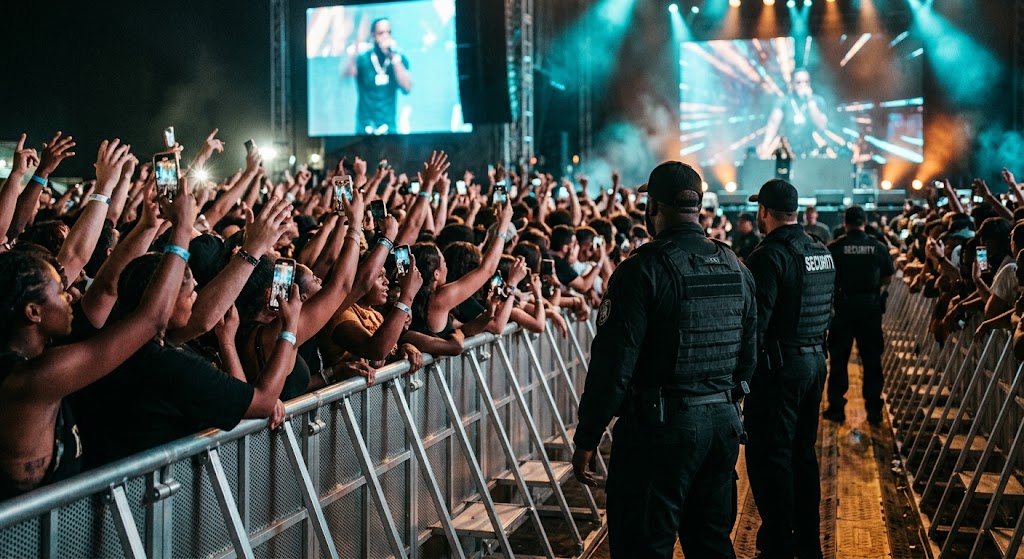
For this genre, that is not a remote scenario. Crowd energy is part of the experience, and crowd-related incidents are a leading source of serious claims at high-energy shows. The timeline below walks through how a single moment can become a multi-party claim — and where this coverage steps in.
THE EXCLUSION: base GL commonly excludes assault & battery by endorsement — it is not assumed, it is removed.
THE STAKES: without it, injuries from fights, altercations, and force can be uninsured.
THE COMPANION: it pairs with negligent security, the claim that the security plan fell short. The two are usually addressed together.
HOW ONE MOMENT BECOMES A CLAIM
Tap each stage to follow how a single altercation can escalate into a covered claim — and see where assault & battery coverage does the work that base general liability won't. This is a general illustration, not a coverage determination.
THE INCIDENTS THIS COVERAGE IS BUILT FOR
Assault & battery is shorthand for a specific family of crowd-conduct exposures. These are the situations it is designed to answer.
CROWD FIGHTS
An altercation between attendees that injures one of them, or an uninvolved bystander caught in the middle.
FRONT-OF-STAGE INCIDENTS
Pushing, crowd pressure, and confrontations in the high-energy zone closest to the performance.
USE-OF-FORCE CLAIMS
Injuries alleged to arise from how security or staff physically intervened during an incident.
EJECTION DISPUTES
Claims that arise when a patron is removed from the venue and alleges injury in the process.
PARKING LOT & PERIMETER
Incidents that begin or spill into the entry, exit, and lot areas connected to the event.
ESCALATED CONFRONTATIONS
A verbal dispute that turns physical, the most common path a real claim actually takes.
ASSAULT & BATTERY NEVER STANDS ALONE
This coverage works as part of a coordinated program. These are the lines it most often pairs with.
ASSAULT & BATTERY QUESTIONS & ANSWERS
What promoters and venues ask most about closing this gap for hip hop and rap events.
Assault and battery coverage responds to bodily injury claims arising from a physical altercation, fight, or use of force at an event. Because a standard general liability policy commonly excludes assault and battery, this coverage is usually added back by endorsement so injuries from crowd violence, fights, or security-related force are not left uninsured.
Many carriers treat assault and battery as a distinct, higher-severity exposure and remove it from the base general liability form using an exclusion endorsement. The exclusion does not mean the coverage is unavailable — it means it has to be deliberately added back, often as a separate insuring agreement with its own limit, rather than assumed to be part of the base policy.
In general terms, assault refers to the threat or attempt to cause harmful or offensive contact, while battery refers to the actual physical contact. In an insurance context the two are usually paired together as a single coverage because a real-world incident often involves both — a confrontation that becomes physical.
It can, and for live events this is often essential. Claims sometimes arise from how security personnel used force during an incident. Whether and how security-related actions are covered depends on the specific endorsement wording, which is why the structure of the coverage matters as much as having it at all.
It may not be named in the venue contract the way general liability is, but for this genre it is frequently the most important coverage to carry. Venues, underwriters, and promoters all recognize that crowd-related incidents are a leading source of serious claims at high-energy shows, so closing this gap is a core part of a responsible program.
Yes. When assault and battery is added back to a policy, it is common for it to carry its own limit or a sublimit that may be lower than the general liability limit. Understanding that limit — and whether it is adequate for your event — is an important part of reviewing the coverage rather than assuming it matches the rest of the policy.
They are closely related and often appear together. Assault and battery responds to the injury from the physical act itself, while negligent security responds to the allegation that the organizer or venue failed to provide reasonable security that could have prevented it. After a crowd incident, both theories are frequently raised, which is why they are usually addressed side by side.
Coverage generally responds to the claim brought against the insured regardless of who is alleged to have started an incident, subject to the policy terms. What matters for coverage is the claim of bodily injury and how the policy and its endorsements are written, not solely the question of who threw the first punch. The policy wording always controls.
Underwriters commonly look at the venue, the expected crowd size and profile, the security and staffing plan, the alcohol setup, the event history, and the controls in place such as screening and crowd management. A clear, well-documented security plan is one of the strongest things a promoter can present when seeking this coverage.
KIG works with specialty entertainment markets that evaluate hip hop and rap events on their real risk profile rather than declining on genre alone. We help structure assault and battery back into the program, review the limits and the security-related wording, and coordinate it with general liability and negligent security so the whole exposure is addressed. Start with the Special Event Insurance Quote Form or call or text (412) 212-2800.
MORE HIP HOP & RAP COVERAGE PAGES
Return to the main coverage hub, or jump to any page below.
RELATED KIG COVERAGE & RESOURCES
The availability of coverage and eligibility for coverage can depend on numerous factors. We cannot guarantee that all customers, individuals, and businesses looking for coverage will be successful in these efforts when contacting our team. All policy coverages and terms need to be fully reviewed by the respective consumer to ensure the coverage asked for is what is specifically being quoted or provided by any insurance policy. Insurance Policies, Coverage Changes, and their terms and conditions are not bound or altered until written confirmation is provided by one of our licensed team members or underwriters. This page does not offer legal advice, legal opinions, or policy interpretations. Rather, this page is meant as a resource to help provide customers and insurance consumers with additional considerations that may help in their insurance buying or pursuit of insurance information. Kelly Insurance Group does not employ or direct attorneys.