DECLINED HIP HOP
CONCERT INSURANCE
"We can't write that." If you've heard it, you're not stuck — you're just in the wrong market. Standard carriers decline live hip hop events for the very things that make them what they are: the crowd, the venue, the energy. Kelly Insurance Group was built for the hard-to-place. For us, a decline letter is usually where the work starts.
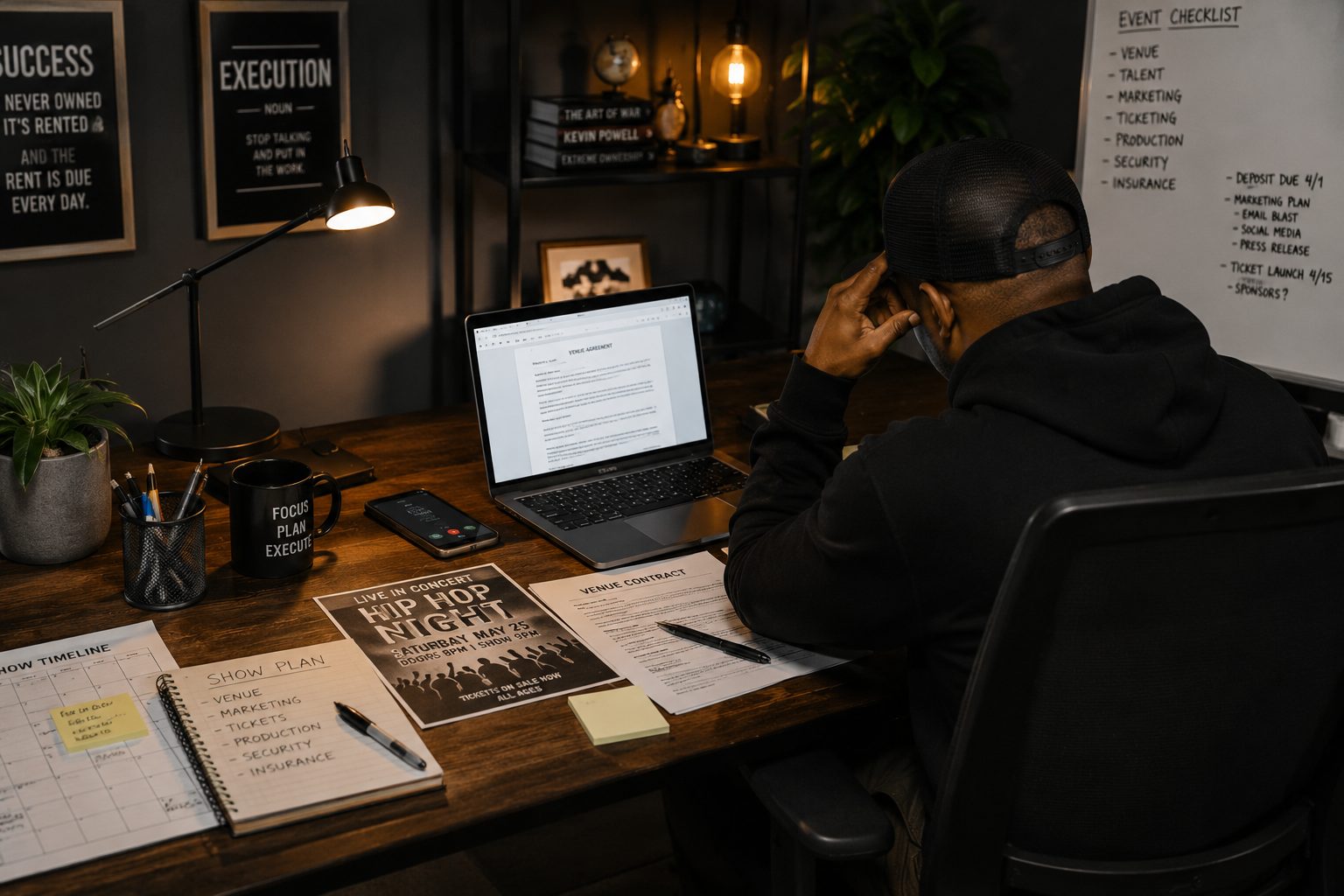
A NO FROM ONE CARRIER ISN'T THE LAST WORD
A decline says more about the carrier than the event. Standard markets are built for standard risks — and live hip hop is, by design, not one of them.
Getting declined feels like a verdict on your event. It isn't. It's a mismatch. Most standard carriers are built around predictable, lower-touch risks, and they get cautious about the things that define a live hip hop show — crowd-conduct exposure, large crowds, non-traditional venues, alcohol. Faced with those, many simply decline rather than work through them. That's a market mismatch, not a statement that the event can't be covered.
This is the exact space Kelly Insurance Group was built for. Since 1881, the agency has specialized in hard-to-place and non-standard risk — presenting events to specialty and surplus-lines markets that write the business standard carriers walk away from. The coverage itself is familiar: general liability with the genre's add-backs. What changes is who it's presented to and how.
Different declines call for different plays. Tell the tool below why you were turned away, and see how the event gets approached from there.
IT'S A MISMATCH: the wrong market declined — it doesn't mean the event is uninsurable.
SPECIALTY IS THE FIX: hard-to-place risk goes to markets that actually write it.
BUILT FOR THIS SINCE 1881: non-standard, hard-to-place coverage is core to what KIG does.
PICK THE REASON, SEE THE PLAY
Choose what got your event declined to see how it's typically approached from there. This is a general illustration of the approach, not a guarantee of coverage — every placement depends on the specific event and the markets.
WHAT TURNS A DECLINE INTO A PLACEMENT
The difference between a decline and a bound policy is often presentation. These are the things that let your event be put forward in its best light.
A DOCUMENTED PLAN
A written security and crowd-management plan that shows the event is run responsibly.
THE VENUE PICTURE
Clear details on the space, its capacity, and its approvals — especially for non-standard venues.
THE ALCOHOL SETUP
How alcohol is served and who holds the license, so the liquor exposure is understood.
A TRACK RECORD
Any history of well-run events that demonstrates you're a manageable risk to write.
DECLINED & HARD-TO-PLACE QUESTIONS & ANSWERS
What promoters ask most after a standard carrier turns their event down.
A decline from a standard carrier is often a starting point, not the end. Hard-to-place events are placed through specialty markets that understand the risk, and presenting the event well to the right markets is how coverage frequently gets secured after a standard decline. Sharing the details lets the event be taken to those markets.
Standard carriers are often built around lower-touch risks and get cautious about the things that define live hip hop events — crowd-conduct exposure, assault & battery, non-traditional venues, large crowds, or alcohol. Rather than work through those factors, many simply decline, which is different from the event being uninsurable.
Hard-to-place means a risk that standard markets are reluctant to write, so it needs specialty or surplus-lines markets that handle non-standard exposures. Many hip hop and rap events fall into this category not because they can't be covered, but because they need the right markets and a proper presentation.
Often, yes. A standard decline does not mean every market will decline. Specialty brokers work with carriers that specifically write harder risks, and presenting the event accurately — the venue, security, crowd, and alcohol details — gives those markets what they need to consider it.
A clear, complete picture of the event helps the most — a documented security and crowd-management plan, clarity on how alcohol is handled, the venue details, and a track record where available. These let the risk be presented favorably to markets that write this kind of business.
It can be. Because base general liability commonly excludes assault & battery, and crowd-conduct claims are a real exposure at live shows, some standard carriers shy away. Specialty markets that understand the genre can often write the coverage with assault & battery addressed deliberately.
They can be. Warehouses, lofts, and pop-up spaces raise occupancy and permitting questions standard carriers are cautious about. These underground and non-standard venues are a common hard-to-place scenario, and presenting the space and its plan clearly is part of how coverage gets placed.
A prior decline is something underwriters may ask about, but it does not make an event permanently uninsurable. Working with a broker who can present the event properly to specialty markets is how a past decline is moved past, rather than letting it define the risk.
KIG works across the full range — concerts, festivals, private and label events, block parties, battle rap and underground shows, tours, and venues — including the harder-to-place cases. Specialty, non-standard risk is a core part of what the agency does, which is why a decline elsewhere is often where the conversation with KIG begins.
KIG presents declined and hard-to-place events to specialty markets that understand hip hop and rap, frames the risk accurately, and works to place coverage standard carriers turned down. A decline letter is frequently a starting point for us, not the end of the road. Start with the Special Event Insurance Quote Form or call or text (412) 212-2800.
MORE HIP HOP & RAP COVERAGE PAGES
Return to the main coverage hub, or jump to any page below.
RELATED KIG COVERAGE & RESOURCES
The availability of coverage and eligibility for coverage can depend on numerous factors. We cannot guarantee that all customers, individuals, and businesses looking for coverage will be successful in these efforts when contacting our team. All policy coverages and terms need to be fully reviewed by the respective consumer to ensure the coverage asked for is what is specifically being quoted or provided by any insurance policy. Insurance Policies, Coverage Changes, and their terms and conditions are not bound or altered until written confirmation is provided by one of our licensed team members or underwriters. This page does not offer legal advice, legal opinions, or policy interpretations. Rather, this page is meant as a resource to help provide customers and insurance consumers with additional considerations that may help in their insurance buying or pursuit of insurance information. Kelly Insurance Group does not employ or direct attorneys.