
INSURANCE REVIEWS FOR VALUABLE COLLECTIONS
Kelly Insurance Group helps high-net-worth individuals and private clients review insurance for valuable collections — including jewelry, watches, fine art, sports memorabilia, trading cards, comic books, luxury personal items, musical instruments, wine, and specialty collectibles — addressing the homeowners sublimit gap, agreed value coverage, appraisal requirements, and the coordinated program structure appropriate for significant personal asset concentrations.
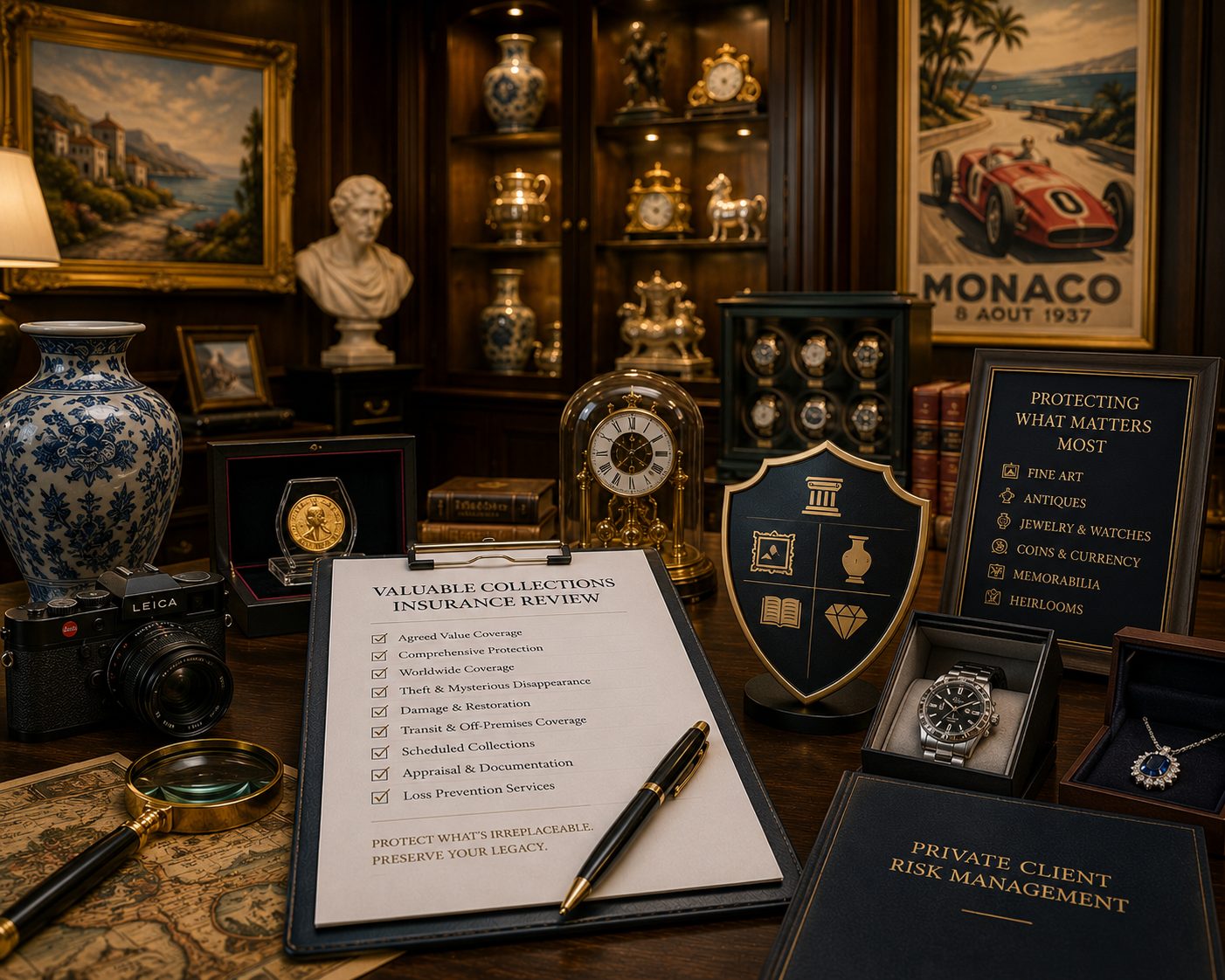
WHY EVERY SIGNIFICANT PERSONAL COLLECTION NEEDS COVERAGE BEYOND THE HOMEOWNERS POLICY.
Homeowners policies include theft sublimits that apply to each category of personal property — jewelry, watches, fine art, silverware, and collectibles each have their own sublimit, typically in the range of $1,500 to $5,000. These sublimits apply per occurrence and per category, meaning that even if a home is broken into and the entire jewelry collection is stolen, the homeowners policy pays the sublimit — not the collection's actual value.
Valuable articles and fine art policies typically cover mysterious disappearance — the loss of an item whose circumstances of loss are unknown. Homeowners policies generally do not cover mysterious disappearance. For jewelry, watches, and small high-value collectibles that can be misplaced, lost during travel, or simply not found, mysterious disappearance coverage is an important protection that standard homeowners policies lack.
Homeowners personal property coverage is typically a named peril policy — covering only the specific perils listed. Valuable articles and fine art policies are typically all-risk — covering any cause of loss except those specifically excluded. Accidental damage, breakage, and losses that don't fit neatly into a named peril category are covered under all-risk policies but not under standard homeowners coverage.
A valuable articles policy can be structured as a blanket policy — one limit covering the entire collection without listing individual items — or as a scheduled policy — listing each item with its individual agreed value. For collections with a few high-value individual pieces, scheduling those pieces ensures that the full agreed value is paid for each item. For large collections of lower-value items, a blanket approach may be more practical.
Insurance companies writing valuable articles coverage require appraisals to support agreed values — and appraisals have a shelf life. Most carriers require that jewelry and art appraisals be updated every three to five years; some require more frequent updates for rapidly appreciating categories like collectible trading cards and memorabilia. Maintaining current appraisals is both an insurance requirement and a practical protection for the collection owner.
VALUABLE COLLECTIONS COVERAGE ELEMENTS
PRIVATE CLIENTS WHO NEED A VALUABLE COLLECTIONS COVERAGE REVIEW.
Any individual whose personal collections — in any category — exceed homeowners policy sublimits is carrying a coverage gap. The review conversation identifies what is currently covered, what is not, and what the appropriate agreed value structure should be for each collection category.
- Jewelry and watch collectors with pieces exceeding the homeowners theft sublimit
- Fine art collectors with any piece individually valued above $5,000
- Trading card, comic book, memorabilia, and collectibles collectors whose holdings have appreciated significantly
- Wine collectors with cellars representing significant investment value
- Private clients who have inherited significant personal property and have never reviewed its insurance coverage
- Any collector in any category who has not completed a full collection inventory and coverage review in the past three years
SELECT YOUR PRIMARY COLLECTION TYPE TO SEE THE RELEVANT COVERAGE CONSIDERATIONS.
Valuable collections span a wide range of categories — each with distinct valuation methods, coverage structures, storage requirements, and appraisal needs.
Jewelry and watches are among the most commonly underinsured valuables in private client programs. Homeowners policies include theft sublimits that typically cap at $1,500 to $5,000 for all jewelry combined. Scheduled coverage at appraised value is the appropriate structure for any individual piece above the homeowners sublimit threshold.
- Homeowners theft sublimit — typically $1,500 to $5,000 for all jewelry combined
- Scheduled coverage at appraised value for individual significant pieces
- All-risk coverage — loss, theft, damage, and mysterious disappearance
- Coverage worldwide — jewelry travels with the owner and must be covered everywhere
- Appraisal requirements — insurance appraisals vs. retail appraisals differ
WHAT THE INSURANCE REVIEW COVERS.
VALUABLE ARTICLES POLICY PLACEMENT
Placement of a valuable articles policy covering jewelry, watches, fine art, and collectibles — with agreed value, all-risk coverage, mysterious disappearance, no deductible options, and worldwide coverage that follows each item wherever it travels.
COLLECTION INVENTORY AND SCHEDULING
Development of a complete collection inventory — identifying each item, its current appraised value, and the appropriate coverage structure — with high-value items scheduled individually and blanket coverage applied to supporting collection categories.
APPRAISAL COORDINATION AND VALUATION UPDATES
Coordination of appraisal requirements across all collection categories — scheduling appraisals at the frequency required by the carrier and the rate of value change in each category, with agreed value updates at each renewal.
TRANSIT AND AUCTION COVERAGE
Coverage review for collection items in transit — being sent to auction, consigned to dealers, loaned to exhibitions, or shipped for authentication or conservation — confirming that coverage applies at every stage of the item's journey outside the primary residence.
FOUR VALUABLE COLLECTIONS COVERAGE GAPS PRIVATE CLIENTS CARRY.
A collection of jewelry worth $300,000 insured only under the homeowners policy is covered for theft at a maximum of $1,500 to $5,000 — less than 2% of the collection's value. This is the most pervasive coverage gap in private client insurance, and it affects virtually every homeowner who has not specifically scheduled their jewelry under a valuable articles policy.
Fine art and collectibles in categories that have appreciated significantly may be insured at agreed values that are a fraction of their current market value. An annual valuation review process prevents this gap from widening every year.
A consignment to Heritage Auctions, Sotheby's, or eBay Vault involves the item traveling outside the insured premises — typically not covered under standard homeowners personal property coverage once the item leaves the home. Specific transit coverage for consigned items is needed for collections actively sold at auction.
Jewelry, watches, and small high-value collectibles are occasionally lost rather than stolen. Homeowners policies do not cover mysterious disappearance. A valuable articles policy that includes mysterious disappearance coverage addresses losses where the item simply cannot be located.
QUESTIONS THAT OFTEN COME UP.
Why isn't my homeowners policy sufficient for my jewelry and art?
Homeowners policies include theft sublimits — typically $1,500 to $5,000 per category — that apply regardless of the actual value of the items. They also cover personal property on a named peril or ACV basis, meaning accidental damage and mysterious disappearance are typically not covered. A valuable articles policy provides all-risk agreed value coverage specifically designed for high-value personal property.
What is mysterious disappearance coverage?
Mysterious disappearance coverage pays for the loss of an item when the circumstances of the loss are unknown — the item simply cannot be located. Standard homeowners policies do not cover this type of loss. Valuable articles policies typically include mysterious disappearance as part of the all-risk coverage.
How often should collection appraisals be updated?
Most insurance carriers require jewelry and fine art appraisals to be updated every three to five years. For rapidly appreciating categories — trading cards, comic books, contemporary art — more frequent updates are warranted.
Should every piece in my collection be scheduled individually?
High-value individual pieces — anything worth more than $5,000 to $10,000 — should generally be scheduled individually with a specific agreed value. Lower-value supporting items in a collection can often be covered under a blanket limit.
Does the collection need to be at home to be covered?
No. Valuable articles policies typically provide worldwide coverage — covering items wherever they are, including at second homes, in transit, at exhibitions, and when traveling internationally.
What documentation do I need to make a collection insurance claim?
Documentation that supports the agreed value of the item — the most recent appraisal, purchase receipt, auction sale record, or authentication certificate. Maintaining a current inventory with photographs, serial numbers, and appraisals significantly simplifies the claim process.
READY TO START?
Tell us about your situation and a member of the team will be in touch.
COVER EVERY COLLECTION AT WHAT IT IS ACTUALLY WORTH IN TODAY'S MARKET.
Kelly Insurance Group can help private clients review valuable articles coverage, collection inventories, appraisal requirements, and agreed value structures for jewelry, art, collectibles, and all categories of significant personal property.
The availability of coverage and eligibility for coverage can depend on numerous factors. We cannot guarantee that all customers, individuals, and businesses looking for coverage will be successful in these efforts when contacting our team. All policy coverages and terms need to be fully reviewed by the respective consumer to ensure the coverage asked for is what is specifically being quoted or provided by any insurance policy. Insurance Policies, Coverage Changes, and their terms and conditions are not bound or altered until written confirmation is provided by one of our licensed team members or underwriters. This page does not offer legal advice, legal opinions, or policy interpretations. Rather, this page is meant as a resource to help provide customers and insurance consumers with additional considerations that may help in their insurance buying or pursuit of insurance information. Kelly Insurance Group does not employ or direct attorneys.