COMIC BOOKS TRADING CARDS AND COLLECTIBLE CARD COVERAGE
Kelly Insurance Group helps high-net-worth collectors and private clients review insurance for comic book collections, trading card collections, and collectible card game holdings — addressing agreed value coverage based on professional grading, CGC and PSA grade-specific valuations, population report context, transit coverage for items at grading companies and auction houses, and the rapidly evolving values in the collectibles market.
HOW PROFESSIONAL GRADING AND MARKET DYNAMICS CREATE SPECIFIC INSURANCE REQUIREMENTS.
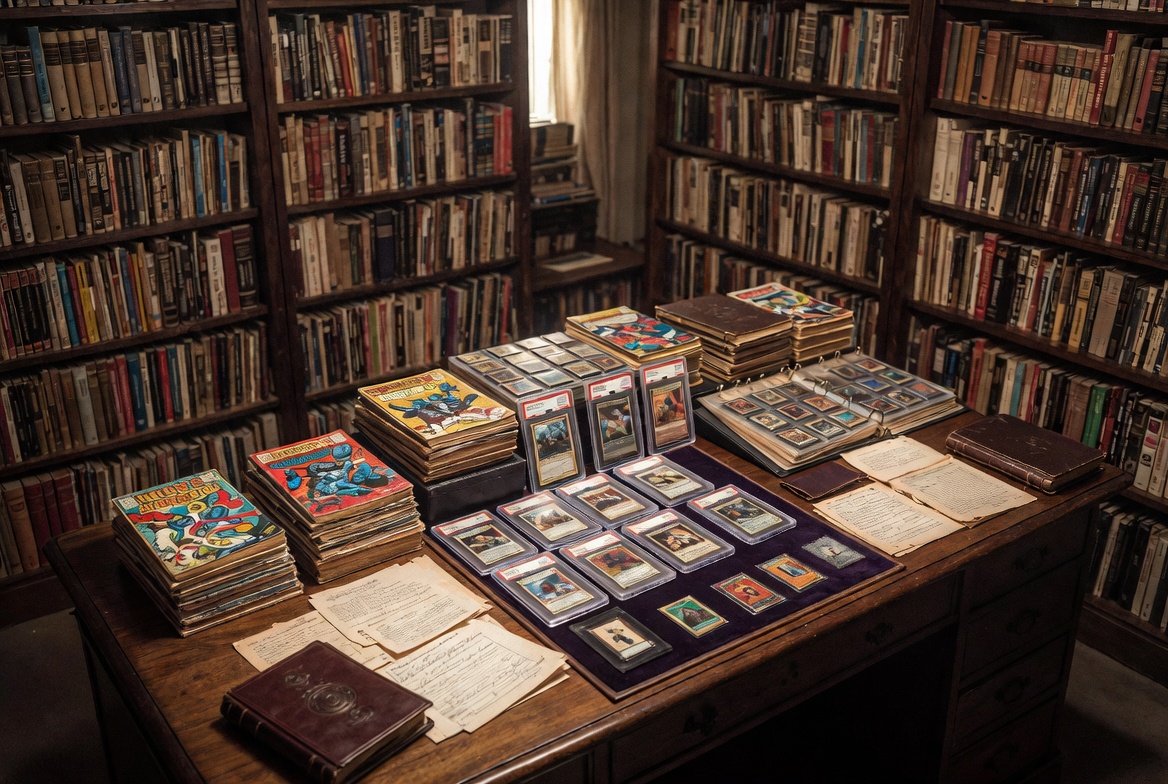
Professional grading companies authenticate and grade collectibles on a numeric scale — CGC for comics, PSA and BGS for cards — and encapsulate the item in a sealed, labeled slab with a unique serial number. The certified grade is the single most important determinant of value for most key issues and key cards. Insurance coverage for graded collectibles must be based on the certified grade, and the slab serial number is the definitive identifier for individual pieces.
Not all comics or cards in a collection are equally significant. Key issues — first appearances, origin stories, first team appearances — and key cards — rookie cards, autographed parallels, low-numbered variants — command the highest prices and drive the most significant insurance exposures. A collection review should identify the key issues and key cards, establish grade-specific agreed values for each, and ensure the total blanket coverage is adequate for the balance of the collection.
For any graded collectible, the population report — the number of items certified at a specific grade and above — provides context for its rarity. A CGC 9.8 of a major key issue with only 50 known copies commands a very different price than a common modern book with 5,000 copies in 9.8. Population context should be part of the documentation supporting agreed values for significant individual pieces.
Collections containing a significant number of ungraded comics or cards present an insurance challenge: value is harder to establish without a certified grade. For valuable raw items, submission to a grading company before establishing an insurance agreed value provides the most reliable documentation. For large raw collections, a blanket coverage approach with periodic inventory and appraisal is typical.
How comics and cards are stored directly affects their condition and value. Comics stored without acid-free bags and boards, in environments with heat or humidity fluctuations, deteriorate over time. Proper storage preserves the condition that makes graded copies valuable. Environmental controls — temperature, humidity, and UV — are the standard for professional storage of high-value collectibles.
COMIC AND CARD COVERAGE ELEMENTS
COMIC BOOK AND TRADING CARD COLLECTORS WHO NEED A COVERAGE REVIEW.
Any collector whose comic book or trading card holdings include certified high-grade key issues or key cards — or whose overall collection has grown in value faster than coverage has been updated — benefits from a specific coverage review.
- Comic book collectors with CGC-certified key issues or significant graded runs representing substantial value
- Trading card collectors with PSA or BGS certified key rookie cards, autographed parallels, or low-numbered variants
- Collectors who have seen their holdings appreciate significantly and whose coverage has not been updated
- Active collectors who regularly send items to grading companies or consign items to auction
- Collectors who have inherited or acquired significant comic or card collections that have never been properly appraised
- Any collector whose agreed values were established more than 12 to 18 months ago in rapidly appreciating categories
SELECT AN ISSUE TYPE OR GRADE TO UNDERSTAND THE INSURANCE IMPLICATIONS.
Comic book insurance values are directly tied to grading and issue significance. Understanding how CGC grades and key issue categories map to coverage requirements helps collectors structure accurate protection.
First appearance issues — Amazing Fantasy #15, Incredible Hulk #1, X-Men #1 — represent the most valuable segment of the comic book market. Values for these books in high grades can reach six and seven figures. Agreed values must be based on grade-specific auction comparables from Heritage, ComicConnect, and ComicLink.
- Grade-specific auction comparables required — Heritage, ComicConnect, ComicLink
- Population report context is critical — available census data on copies at each grade
- Agreed value must specifically identify the issue, grade, and grading company
- Annual review essential — first appearance values can move with media announcements
- Individual scheduling required for any first appearance book above $5,000
WHAT THE INSURANCE REVIEW COVERS.
GRADE-SPECIFIC AGREED VALUE COVERAGE
Agreed value coverage for graded comics and cards at the certified grade-specific market value — with slab serial numbers documented for significant pieces and population context considered in establishing values for rare high-grade copies.
KEY ISSUE AND KEY CARD SCHEDULING
Identification and individual scheduling of the collection's most significant pieces — key issues, key rookie cards, autographed variants, and low-numbered parallels — with agreed values based on current auction comparables at the specific certified grade.
TRANSIT AND GRADING COMPANY COVERAGE
Coverage for graded and raw items in transit to grading companies, auction houses, and private buyers — addressing the specific gap in homeowners coverage for items that leave the collection for commercial activity.
COLLECTION INVENTORY AND BLANKET COVERAGE
Blanket coverage for the balance of the collection — supporting key items that are individually scheduled with appropriate overall collection limits and periodic inventory review to keep coverage current.
FOUR COVERAGE GAPS IN COMIC BOOK AND TRADING CARD COLLECTIONS.
The comic and trading card market has experienced dramatic price appreciation for key issues. An Amazing Fantasy #15 CGC 9.2 insured two years ago at a price that was current then may be worth multiples of that agreed value today. Annual review is essential in rapidly appreciating categories.
Sending valuable cards to PSA for grading is one of the highest-risk moments in a collector's custody chain. Homeowners personal property coverage typically does not follow items to off-premises locations. Specific transit coverage closes this gap.
A large raw comic collection acquired at significant cost but never appraised for insurance may be covered under homeowners personal property general limits at values far below the actual collection worth.
An agreed value for a CGC 9.8 key issue established without considering whether it is a 1-of-3 or a 1-of-3,000 may significantly underrepresent the value of a truly rare high-grade copy.
QUESTIONS THAT OFTEN COME UP.
How is a CGC-graded comic book's insurance value established?
Agreed value for a CGC-graded comic is established through recent auction comparables at the specific certified grade from Heritage Auctions, ComicConnect, ComicLink, and eBay sales for the same issue in the same grade. The CGC slab serial number identifies the specific item. Population report data provides context for rarity at grade that affects value for low-population key issues.
Can I insure a comic book collection under my homeowners policy?
Standard homeowners personal property coverage applies to comics, but without specific agreed values, without all-risk coverage, and without mysterious disappearance protection. More significantly, homeowners coverage typically does not follow items to off-premises locations such as grading companies or auction houses.
What is a population report and why does it matter for insurance?
A population report shows how many copies of a specific item have been certified at each grade by a grading company. A key issue with only a handful of known copies in 9.8 is significantly more valuable than the same issue with thousands of high-grade copies. Population context supports the agreed value for high-rarity items.
Are items at a grading company covered under my existing insurance?
Not reliably under standard homeowners coverage. Items in transit to, at, or in transit from a grading company are outside the home. A valuable articles policy with transit coverage or a specific transit endorsement ensures continuous coverage throughout the grading cycle.
How should I store comics and cards to satisfy insurance requirements?
Comics in acid-free polypropylene bags with acid-free boards, stored in climate-controlled conditions away from UV light, heat, and humidity fluctuations. Cards in top loaders or sleeves in a similar controlled environment. Consistent climate control and protection from physical handling preserves both condition and insurability.
What is the right blanket coverage amount for a large raw collection?
The blanket amount should reflect the total current market value of the raw collection — which requires either a dealer appraisal or an internal inventory with per-item pricing from current completed sales. Annual review keeps the blanket limit current as the collection's composition and the market evolve.
READY TO START?
Tell us about your situation and a member of the team will be in touch.
COVER THE COLLECTION AT CERTIFIED GRADE VALUE — UPDATED FOR TODAY'S MARKET.
Kelly Insurance Group can help comic book and trading card collectors review grade-specific agreed values, key issue scheduling, transit coverage, and collection-level blanket coverage for holdings across all certified and raw categories.
The availability of coverage and eligibility for coverage can depend on numerous factors. We cannot guarantee that all customers, individuals, and businesses looking for coverage will be successful in these efforts when contacting our team. All policy coverages and terms need to be fully reviewed by the respective consumer to ensure the coverage asked for is what is specifically being quoted or provided by any insurance policy. Insurance Policies, Coverage Changes, and their terms and conditions are not bound or altered until written confirmation is provided by one of our licensed team members or underwriters. This page does not offer legal advice, legal opinions, or policy interpretations. Rather, this page is meant as a resource to help provide customers and insurance consumers with additional considerations that may help in their insurance buying or pursuit of insurance information. Kelly Insurance Group does not employ or direct attorneys.