
INSURANCE REVIEWS FOR JEWELRY WATCHES AND WEARABLES
Kelly Insurance Group helps high-net-worth individuals and private clients review insurance for jewelry collections, watch collections, and high-value wearables — addressing the homeowners theft sublimit gap, agreed value coverage, appraisal requirements, mysterious disappearance coverage, and the specific needs of collectors whose jewelry and watch holdings represent significant concentrated asset value.
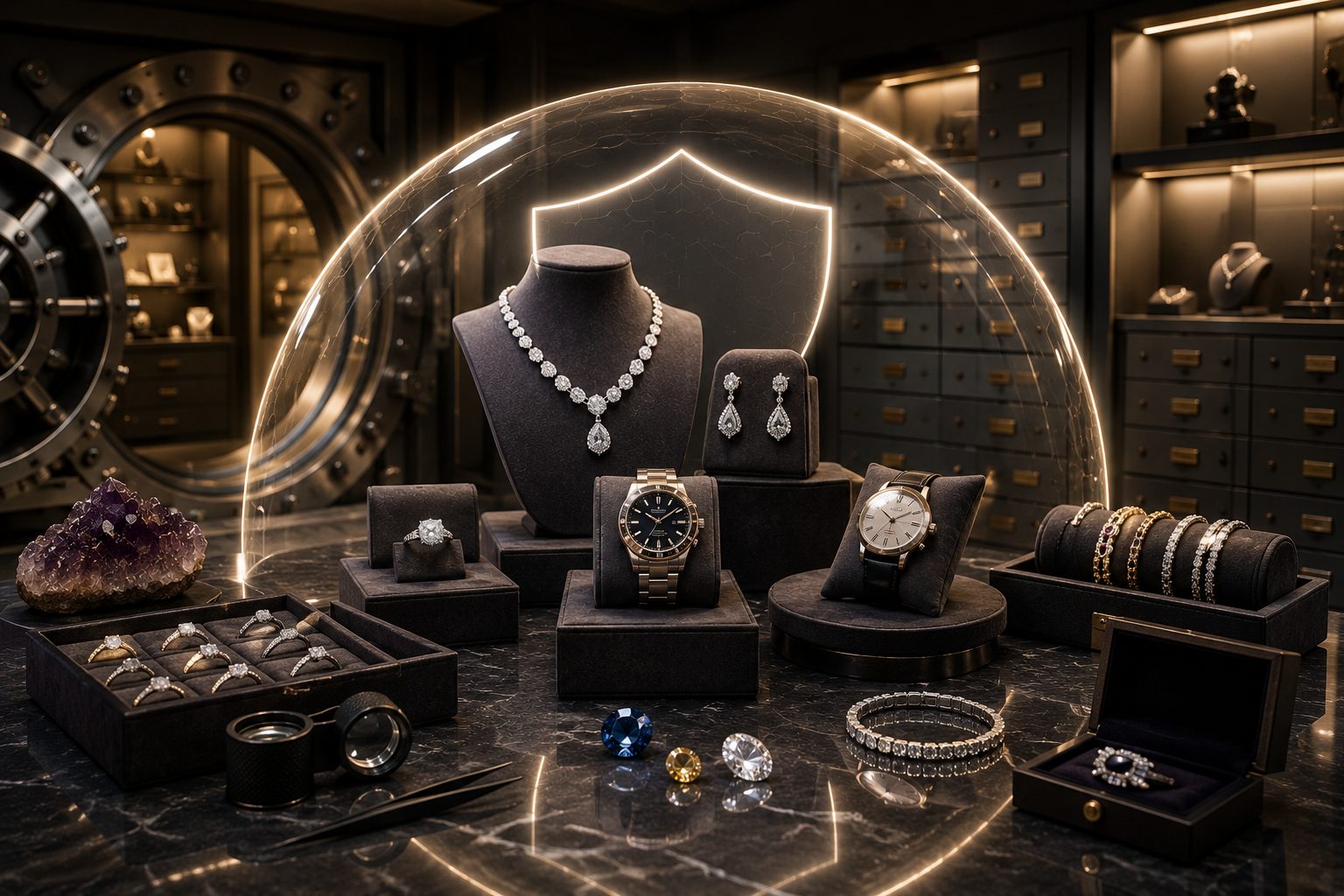
THE SPECIFIC COVERAGE REQUIREMENTS OF HIGH-VALUE JEWELRY AND WATCH COLLECTIONS.
The appraisal used for insurance purposes should reflect the replacement cost of the piece — what it would cost to purchase a comparable piece at current retail prices from a jeweler. A retail appraisal prepared for estate, resale, or charitable contribution purposes typically reflects a different value — often fair market value — that may be significantly below the insurance replacement cost. Insurance coverage should be based on insurance replacement value appraisals prepared by a GIA-credentialed gemologist.
Diamond jewelry with GIA-certified stones has documented characteristics — cut, color, clarity, and carat weight — that provide an objective basis for replacement value. A GIA report number linked to the specific stone is the most reliable documentation for both establishing agreed value and facilitating claim settlement. Copies of GIA reports for significant diamonds should be maintained in the insurance documentation file.
Vintage and estate jewelry from significant houses — Cartier, Van Cleef & Arpels, Bulgari, Harry Winston — can carry collector premiums that exceed the intrinsic value of the materials. A signed Art Deco Cartier bracelet may be worth far more than a modern piece with identical diamond weight because of its provenance, design, and maker. Insurance appraisals for vintage and estate pieces should specifically address collector value, not just material value.
The secondary market for watches from Patek Philippe, Rolex, Audemars Piguet, Richard Mille, and similar manufacturers has seen dramatic appreciation — with certain references trading at multiples of their retail prices. An agreed value for a watch collection should reflect current secondary market pricing, not original retail price. Annual review of watch values against current grey market and auction comparables is appropriate.
Coverage for jewelry and watches is not limited to burglary at home. The full risk profile includes: items worn to events and lost or damaged, items left in hotel rooms, items in checked luggage, items sent for service or authentication, and items consigned to auction. All-risk worldwide coverage with mysterious disappearance addresses all of these scenarios.
JEWELRY AND WATCH COVERAGE ELEMENTS
JEWELRY AND WATCH OWNERS WHO BENEFIT FROM A COVERAGE REVIEW.
Any individual whose jewelry and watch holdings exceed the homeowners theft sublimit — which includes virtually any serious collector or anyone who has accumulated meaningful fine jewelry over time — benefits from a dedicated valuable articles review.
- Jewelry collectors with individual pieces exceeding $5,000 in insurance replacement value
- Watch collectors with references from Patek Philippe, Rolex, AP, Richard Mille, or similar manufacturers
- Individuals who have inherited jewelry or watches and have never had the pieces appraised for insurance purposes
- Collectors who travel frequently with jewelry and watches and need confirmed worldwide coverage
- Anyone with vintage or estate jewelry from significant makers where collector value exceeds intrinsic material value
- Any jewelry or watch owner whose current appraisals are more than three years old
SELECT AN APPRAISAL TYPE TO UNDERSTAND HOW IT AFFECTS INSURANCE COVERAGE.
Understanding the difference between appraisal types is essential for structuring jewelry and watch insurance correctly. The wrong appraisal basis can result in a settlement far below what the owner expects.
An insurance appraisal establishes the replacement value of a piece of jewelry or a watch — what it would cost to replace the item with a comparable new piece at current retail prices. This is typically the highest appraisal value and forms the basis for the scheduled amount on an insurance policy. Insurance appraisals should be updated every three to five years to reflect changes in metal prices, stone prices, and labor costs.
- Replacement value — cost of a comparable new piece at current retail
- Typically the highest of the common appraisal types
- Should be updated every three to five years
- Provided by a GIA-credentialed gemologist or certified jewelry appraiser
- Forms the basis for the scheduled amount on a valuable articles policy
WHAT THE INSURANCE REVIEW COVERS.
VALUABLE ARTICLES POLICY FOR JEWELRY AND WATCHES
Agreed value valuable articles coverage for jewelry and watch collections — with all-risk coverage including mysterious disappearance, worldwide protection, no deductible options, and individual scheduling for pieces above the threshold for blanket coverage.
APPRAISAL COORDINATION AND GEMOLOGICAL DOCUMENTATION
Coordination of insurance appraisals by GIA-credentialed gemologists and certified watch specialists — maintaining current replacement cost appraisals, GIA report documentation for certified diamonds, and secondary market valuations for watch collections.
VINTAGE AND ESTATE JEWELRY VALUATION
Specialized appraisal support for vintage and estate jewelry from significant makers — ensuring that collector premiums, designer attribution, and historical significance are reflected in the agreed values, not just the intrinsic material value.
TRANSIT AND TRAVEL COVERAGE REVIEW
Review of coverage for jewelry and watches in transit — at service facilities, in hotel rooms, in airline luggage, and during international travel — confirming that the policy provides true worldwide all-risk coverage without location-based restrictions.
FOUR JEWELRY AND WATCH INSURANCE GAPS THAT SURFACE AT CLAIM TIME.
A jewelry collection worth $250,000 insured only under the homeowners policy's $5,000 theft sublimit is carrying a $245,000 uninsured gap. This gap is invisible until a theft claim is filed — at which point the carrier pays $5,000 and the owner absorbs the rest.
A diamond ring appraised at $12,000 ten years ago that would cost $28,000 to replace at today's prices is insured at the wrong number. Annual review is the appropriate practice.
A ring lost during travel, an earring lost at an event, a watch strap that failed — these are the most common types of jewelry and watch losses. Homeowners policies typically exclude mysterious disappearance. A valuable articles policy that includes it provides protection for these everyday losses.
A Rolex Daytona purchased at retail for $13,000 that trades on the secondary market for $35,000 is insured at the wrong value if the agreed value reflects the original purchase price. Watch values for significant references should be reviewed annually against current grey market and auction pricing.
QUESTIONS THAT OFTEN COME UP.
What is the difference between a homeowners jewelry sublimit and a valuable articles policy?
The homeowners jewelry sublimit — typically $1,500 to $5,000 — caps the total theft payment for all jewelry combined, applies only to named perils, and excludes mysterious disappearance. A valuable articles policy covers each scheduled piece at its full agreed value, provides all-risk coverage including mysterious disappearance, and applies worldwide without a premises limitation.
How often should jewelry and watches be appraised for insurance?
Most carriers require appraisals to be updated every three to five years. For watches from manufacturers like Rolex and Patek Philippe whose secondary market prices have appreciated significantly, annual valuation review is more appropriate.
Does a valuable articles policy cover jewelry lost during travel?
Yes — a proper valuable articles policy provides worldwide all-risk coverage, including coverage for items lost in hotel rooms, during travel, or in any other location.
What is an insurance appraisal and how is it different from other appraisals?
An insurance appraisal establishes the replacement value of a piece — what it would cost to purchase a comparable piece at current retail prices. Fair market value and liquidation value appraisals reflect different — typically lower — values appropriate for different purposes.
Should I schedule each piece of jewelry individually?
Pieces with significant individual value — typically above $5,000 to $10,000 — should be scheduled individually so that the full agreed value is documented and paid in the event of a loss.
Are watches insured at original retail price or current market value?
The agreed value should reflect current market value — not original retail price. For watches that have appreciated on the secondary market, the agreed value should be based on current grey market pricing or a specialist watch appraisal.
INSURE EVERY PIECE AT WHAT IT WOULD COST TO REPLACE IT TODAY.
Kelly Insurance Group can help clients review valuable articles coverage for jewelry and watch collections — agreed value, all-risk coverage, mysterious disappearance, worldwide protection, and appraisal coordination for every significant piece.
The availability of coverage and eligibility for coverage can depend on numerous factors. We cannot guarantee that all customers, individuals, and businesses looking for coverage will be successful in these efforts when contacting our team. All policy coverages and terms need to be fully reviewed by the respective consumer to ensure the coverage asked for is what is specifically being quoted or provided by any insurance policy. Insurance Policies, Coverage Changes, and their terms and conditions are not bound or altered until written confirmation is provided by one of our licensed team members or underwriters. This page does not offer legal advice, legal opinions, or policy interpretations. Rather, this page is meant as a resource to help provide customers and insurance consumers with additional considerations that may help in their insurance buying or pursuit of insurance information. Kelly Insurance Group does not employ or direct attorneys.