
MIXED-USE
CONDO INSURANCE
COMMERCIAL OPERATIONS CHANGE THE ENTIRE BUILDING'S RISK PROFILE.
Cooking operations, grease exhaust, and late-night hours raise the building's fire profile, affecting the master property premium for every unit.
Ground-floor retail draws public visitors beyond residents, increasing the premises liability the association carries.
Every commercial tenant needs its own GL, property, and specialty coverage with the association named as additional insured. Gaps in tenant insurance fall back on the association.
Too much commercial square footage can disqualify the project for conventional mortgage financing, affecting every unit owner's resale value.
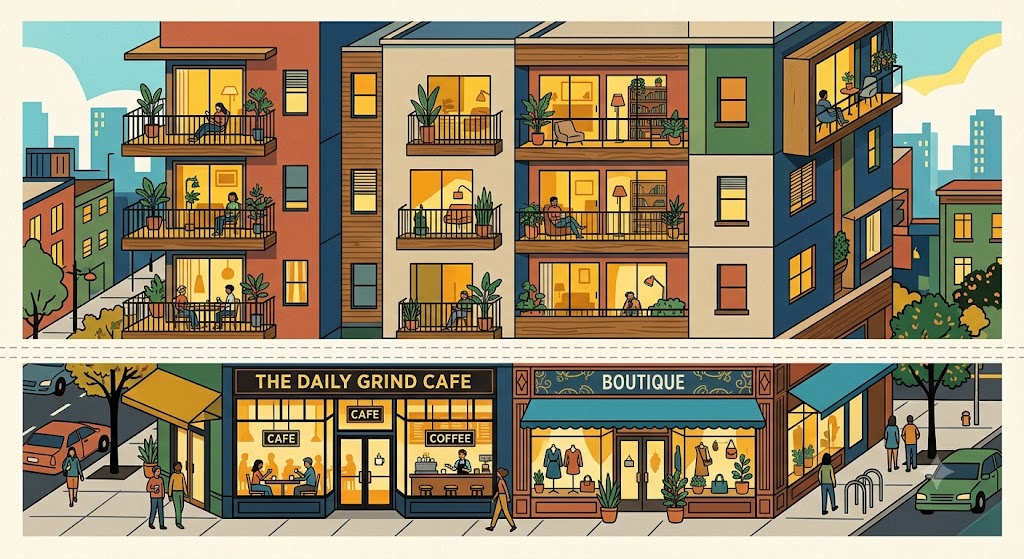
A mixed-use condominium building houses two fundamentally different risk profiles under one roof. The ground-floor commercial tenants — retailers, restaurants, cafes, salons, professional offices — generate exposures that a purely residential building never faces. Cooking operations increase fire risk for the entire structure. Public-facing retail draws visitors that multiply premises liability. Delivery trucks, waste hauling, and commercial signage create additional exposure at the building's base. All of it flows upward into the association's risk profile.
Kelly Insurance Group structures mixed-use condo programs that separate the commercial and residential exposures clearly, coordinate the association's master policy with each commercial tenant's required coverage, and address the warrantability implications that lenders care about. We work with the associations where the tenant mix makes standard carriers uncomfortable — buildings with restaurants, bars, or liquor-serving operations that other brokerages struggle to place.
TAP TO SEE EACH SIDE OF THE BUILDING'S RISK.
Mixed-use creates overlapping exposures. Tap each view to understand what the association covers vs what the tenant covers.
WHAT EVERY COMMERCIAL TENANT IN YOUR BUILDING SHOULD CARRY.
The association's CC&Rs or commercial lease agreement should require each tenant to carry commercial general liability with the association named as additional insured, property coverage for their build-out, fixtures, inventory, and business personal property, workers' compensation if they have employees, and any specialty coverage their business type requires. Restaurants need liquor liability if they serve alcohol. Salons need professional liability. Retailers need product liability. The association should collect certificates of insurance annually and track expiration dates so no tenant operates without active coverage.
When a tenant's insurance lapses or a tenant operates without the required coverage, the association absorbs the risk. A single uninsured restaurant fire can trigger claims against the association's master policy and GL that would have been handled by the tenant's own coverage had it been in force.
MORE CONDO ASSOCIATION COVERAGE
MIXED-USE CONDO COVERAGE — ANSWERED.
DOES THE MASTER POLICY COVER THE COMMERCIAL SPACES?
The master property covers the building structure including the commercial shell. The tenant's interior build-out, inventory, and business property are covered by the tenant's own commercial policy. The CC&Rs and lease define the boundary.
WHAT ADDITIONAL LIABILITY DOES GROUND-FLOOR RETAIL CREATE?
Commercial tenants generate higher foot traffic, delivery activity, and in the case of restaurants, grease, fire, and alcohol exposure. The association's GL must account for this, and tenants must carry their own GL with the association as additional insured.
DOES A RESTAURANT TENANT AFFECT THE ASSOCIATION'S COST?
Restaurants with cooking operations increase the building's fire risk profile and directly affect the master property premium. Some carriers decline mixed-use buildings with certain restaurant types. Associations with restaurants often pay higher premiums.
HOW SHOULD THE ASSOCIATION HANDLE TENANT INSURANCE REQUIREMENTS?
Require each tenant to carry GL, property, workers' comp, and specialty coverage. Name the association as additional insured. Collect certificates annually. Track expiration dates so no tenant operates uninsured.
WHAT IF A TENANT'S OPERATIONS DAMAGE THE RESIDENTIAL UNITS?
The master property responds for structural damage and common elements. Unit owners' HO-6 policies cover their interiors. The association and owners may pursue the tenant's insurance through subrogation if the tenant caused the loss.
DOES MIXED-USE AFFECT WARRANTABILITY?
Fannie Mae and Freddie Mac limit commercial space — generally no more than 35 percent for Fannie and 25 percent for Freddie. Exceeding these limits can make units ineligible for conventional financing, affecting every owner's resale value.
GET YOUR MIXED-USE BUILDING COVERED RIGHT.
Kelly Insurance Group separates commercial and residential exposures and builds mixed-use condo programs that hold together when the tenant mix gets complicated. Since 1881.
The availability of coverage and eligibility for coverage can depend on numerous factors. We cannot guarantee that all customers, individuals, and businesses looking for coverage will be successful in these efforts when contacting our team. All policy coverages and terms need to be fully reviewed by the respective consumer to ensure the coverage asked for is what is specifically being quoted or provided by any insurance policy. Insurance Policies, Coverage Changes, and their terms and conditions are not bound or altered until written confirmation is provided by one of our licensed team members or underwriters. This page does not offer legal advice, legal opinions, or policy interpretations. Rather, this page is meant as a resource to help provide customers and insurance consumers with additional considerations that may help in their insurance buying or pursuit of insurance information. Kelly Insurance Group does not employ or direct attorneys.
RELATED INSURANCE PROGRAMS
Other Kelly Insurance Group coverages matched to this page