ORDINANCEOR LAW COVERAGE
WHEN CURRENT CODE APPLIES AFTER A LOSS — AND THE PROPERTY POLICY DOESN'T PAY THE DIFFERENCE.
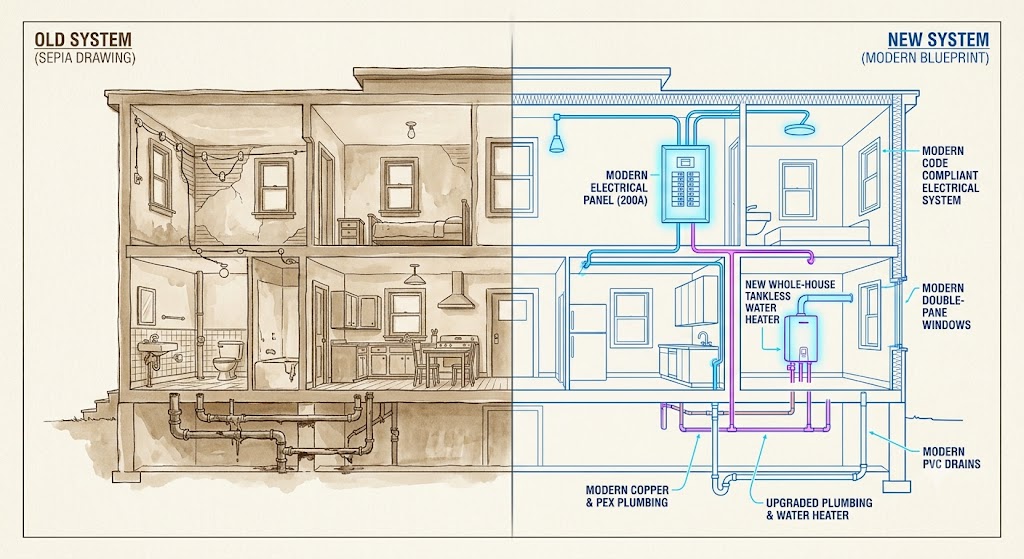
THE PROPERTY POLICY RESTORES TO PRE-LOSS CONDITION — NOT TO CURRENT CODE.
After a covered loss, the master property policy pays to rebuild to the original standard. But if the building was constructed under codes that have since been updated, current codes apply to the reconstruction. Fire suppression that wasn't required in 1985 is required now. ADA accessibility that wasn't mandated originally is mandated during reconstruction. Ordinance or law coverage pays the difference.
The value of the undamaged portion that code requires to be demolished — a total loss of functional structure.
The cost of tearing down the undamaged portion when code requires full demolition and rebuild.
The additional construction expense to rebuild to current code vs the original standard.
Older buildings operating under previous codes face the largest gap when a loss triggers current requirements.
TAP EACH UPGRADE TYPE TO SEE THE COST EXPOSURE.
After a loss, current code can require upgrades the original building never had. Tap each to see the impact.
THE WIDER THE CODE GAP, THE HIGHER THE ORDINANCE OR LAW COST.
A building constructed five years ago under recent codes faces a small gap. A building constructed forty years ago faces a massive one. Aging buildings and condo conversions carry the highest ordinance or law exposure because they were built or converted under codes that have been revised multiple times since. For high-rise buildings, the life-safety code upgrades alone — pressurized stairwells, fire suppression, emergency power, elevator recall — can add millions to the reconstruction cost that the property policy will not pay.
ORDINANCE OR LAW — ANSWERED.
WHAT DOES ORDINANCE OR LAW PAY FOR?
Three categories: the value of undamaged structure that code requires demolished, the demolition cost of that undamaged portion, and the increased cost to rebuild damaged and demolished portions to current code.
WHY DOESN'T THE PROPERTY POLICY COVER CODE UPGRADES?
Property pays to restore to pre-loss condition — not a higher standard. Code-required upgrades like fire suppression, ADA accessibility, and updated electrical are beyond the original standard.
WHICH BUILDINGS FACE THE MOST EXPOSURE?
Older buildings, condo conversions, and structures grandfathered under previous codes. The wider the gap between original code and current requirements, the higher the cost.
WHAT IS DEMOLITION COST COVERAGE?
When code requires demolition of undamaged structure — for example, if damage exceeds 50 percent and code requires full demo and rebuild — this coverage pays for tearing down the undamaged section.
DOES THIS APPLY TO PARTIAL LOSSES?
Yes. A partial loss triggering code requirements — rebuilt wing needs sprinklers, upgraded electrical in fire-damaged section, accessibility in rebuilt entrance — all involve ordinance or law costs.
HOW MUCH COVERAGE DOES AN ASSOCIATION NEED?
Depends on building age, gap between original code and current requirements, and scope of potential upgrades. Older buildings with outdated fire, electrical, and accessibility standards need higher limits.
CLOSE THE GAP BETWEEN ORIGINAL CODE AND CURRENT REQUIREMENTS.
Kelly Insurance Group reviews the code compliance gap alongside the property program so the ordinance or law limit matches the real exposure. Since 1881.
The availability of coverage and eligibility for coverage can depend on numerous factors. We cannot guarantee that all customers, individuals, and businesses looking for coverage will be successful in these efforts when contacting our team. All policy coverages and terms need to be fully reviewed by the respective consumer to ensure the coverage asked for is what is specifically being quoted or provided by any insurance policy. Insurance Policies, Coverage Changes, and their terms and conditions are not bound or altered until written confirmation is provided by one of our licensed team members or underwriters. This page does not offer legal advice, legal opinions, or policy interpretations. Rather, this page is meant as a resource to help provide customers and insurance consumers with additional considerations that may help in their insurance buying or pursuit of insurance information. Kelly Insurance Group does not employ or direct attorneys.
RELATED INSURANCE PROGRAMS
Other Kelly Insurance Group coverages matched to this page