MARINA INSURANCE APPLICATION QUESTIONS
A WORKING SUBMISSION GUIDE FOR MARINAS, BOATYARDS, AND WATERFRONT BUSINESSES
Underwriter Submission Guide

What Marina Underwriters Want to See in a Submission

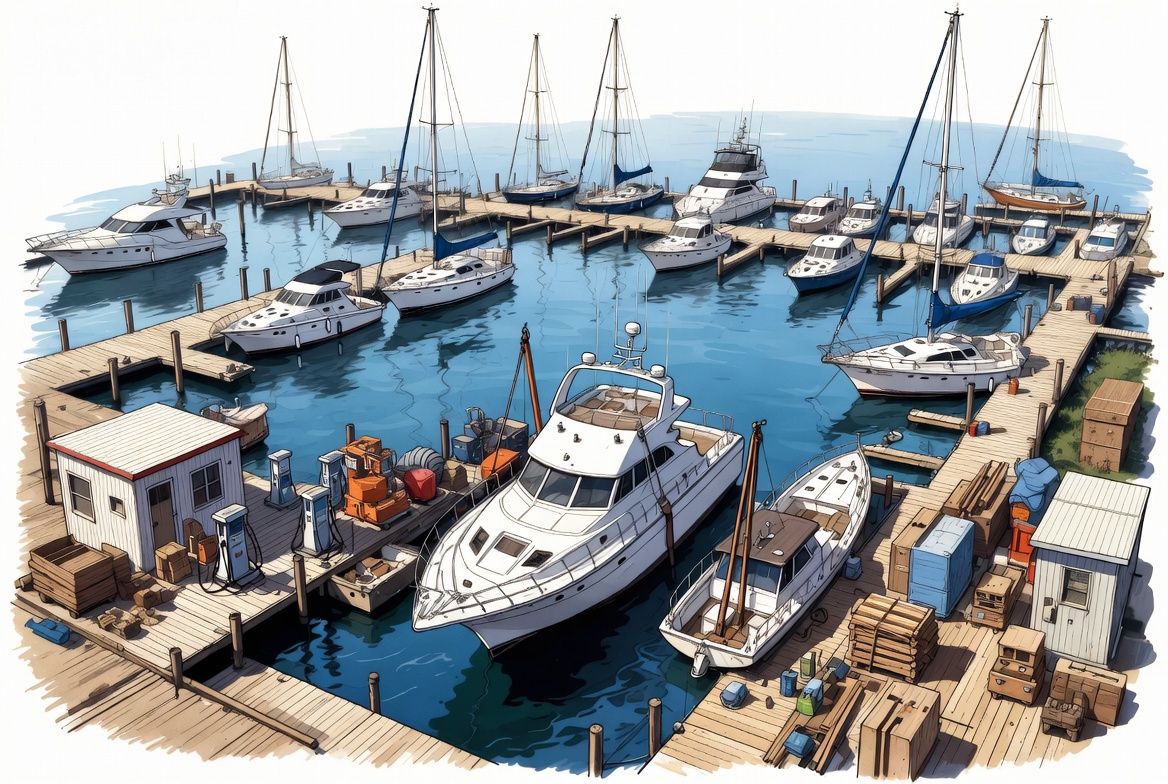
Marina insurance is one of the more demanding commercial classes to underwrite. The risk pool is small, severity can be enormous, and a single waterfront operation can blend slip rental, dry stack storage, fuel sales, repair work, vessel handling, and waterfront retail into one account. Carriers willing to write this business want the submission organized in a particular way before they will price it. The questions on this page are the ones that come up most often in real marina submissions, written out so the operator can pull the answers together once and have everything ready when the broker requests it.

Most rejected or delayed marina quotes share a pattern. The operator answered the easy questions, left the technical ones blank or vague, and the underwriter sent the submission back for clarification. By the time the file came back fully populated, two underwriters had already passed and the renewal was running tight. Treating the application like a financial statement — every line item supported, every number tied to a document — is the difference between a placement that lands cleanly and one that drifts through the market.

Use this page as a working checklist before you submit. Every section below is something a marina underwriter will eventually ask about. The prose under each heading explains why the question exists and what kind of answer carriers respond to. Kelly Insurance Group works through these submissions with marina operators directly, but even when an operator is shopping their own market, the same answers will need to be on the table.

Section 1

Operations & Business Profile

The opening pages of any marina submission. Underwriters read this section to size the account and decide whether it fits their appetite at all before they look at the technical exhibits.

The operations narrative tells the carrier what the marina actually does for revenue. A marina that mainly rents slips and sells some retail goods is a very different account from one that runs a fuel dock, hauls boats with a 50-ton travel lift, performs hull repair, and keeps a boatyard packed with stored vessels through the off-season. Both describe themselves as marinas. They get priced and placed differently.

What underwriters want to see

  • Full operations description. Every revenue-generating activity at the location, written out plainly. Don't summarize. If the marina runs a small boat rental fleet during summer weekends, that goes on the application. If a tenant runs an independent service shop on-site, that needs to be disclosed.
  • Revenue breakdown by activity. Approximate percentage split across slip rental, mooring, dry stack, fuel sales, retail, repair work, rentals, and any other income source. Underwriters use this to weight the rating between marina-class and boatyard-class exposure.
  • Years in business at the location. A long operating history with a clean loss record is a meaningful underwriting positive. New operators or recent ownership changes generate more questions and may require additional documentation about prior management.
  • Seasonal pattern. Year-round operation versus a summer-only marina with winterization and off-season storage. This affects everything from the property values held during the off-season to the workers compensation classification mix.
  • Ownership structure and recent changes. Sole proprietorship, LLC, partnership, or corporate ownership. Any acquisition, merger, or significant ownership change in the past three years should be flagged with dates.
  • Expansion or contraction plans. Planned dock additions, dry stack construction, fuel system replacement, or property acquisitions. Material changes to the operation can affect mid-term endorsements and renewal underwriting.
Section 2

Waterfront, Docks, & Property

Marina property is unusual. It sits in or over the water, takes weather damage on a different cycle than land-based property, and gets valued at numbers that surprise a lot of carriers.

The water type is the first thing an underwriter looks at. A marina on a calm freshwater lake faces different storm exposure than a tidal marina on the coast. Hurricane-zone marinas underwrite differently from inland river operations. Floating docks behave differently than fixed docks in flood, ice, and wind. The submission should make the waterfront environment unambiguous.

What underwriters want to see

  • Body of water classification. River, lake, tidal estuary, protected bay, open coast, or canal. Named body of water. Tidal range if applicable.
  • Slip and mooring counts. Total wet slips, total moorings, average occupancy by season. Underwriters use slip count as one of the primary rating bases.
  • Maximum vessel size accommodated. Length overall, beam, and draft of the largest vessel the marina can berth. This sets the upper bound on care, custody, and control exposure.
  • Dock construction. Fixed pilings versus floating docks. Wood, concrete, aluminum, or composite. Approximate age of each section. Recent reconstruction or major repair history.
  • Electrical service to docks. Voltage and amperage at pedestals, age of the wiring, ground-fault protection, recent inspections or upgrades. Marina electrical fires and electric shock drowning incidents have made this a priority underwriting question.
  • Bulkheads, seawalls, and breakwaters. Type of construction, condition, and approximate age. These are insurable property items separate from the docks themselves.
  • Land-side buildings. Office, retail, restroom and shower facilities, repair shops, indoor storage buildings, fuel-system structures. Square footage and construction class for each.
  • Property values. Replacement cost values for docks, buildings, and improvements. Marinas often carry blanket-style property programs because itemized scheduling becomes unmanageable, but the underwriter still needs the underlying numbers.
Section 3

Storage & Vessel Accumulation

Concentration of vessel values is the single biggest severity driver in marina underwriting. A single fire in a packed dry stack building can produce a loss in the tens of millions.

When underwriters ask about storage, they are really asking about how much value sits in any one place at any one time. A marina that keeps 200 boats in an indoor dry stack rack, with average vessel values of $80,000, has $16 million sitting under one roof — and an exposure profile closer to a warehouse with high-value inventory than a typical marina. Carriers with marina appetite still need to manage their own accumulation, which is why the storage section gets so much attention.

What underwriters want to see

  • Storage types in use. Wet slip storage, dry stack racking, indoor heated storage, indoor unheated storage, outdoor yard storage, on-trailer storage, and covered slip storage. Counts under each.
  • Maximum number of vessels stored at one time. The peak number, not the average. Off-season storage often pushes peak counts much higher than summer-season counts.
  • Average and maximum vessel values. Average insured value per stored vessel, and the highest-value individual vessel typically stored. These numbers anchor the care, custody, and control conversation later in the submission.
  • Dry stack rack details. Number of racks, stack height in tiers, building construction class, and whether the structure is fully enclosed, partially open, or covered with no walls.
  • Fire protection. Sprinkler systems in dry stack buildings, fire detection, hydrant access, fire department response time, and combustible material storage policies. Dry stack fire protection has become a hard underwriting requirement at most carriers writing the class.
  • Spacing between stored vessels. Outdoor yard spacing, fire breaks between rows, and aisle widths in indoor storage. Tight spacing accelerates fire spread and is a known loss driver.
  • Security. Perimeter fencing, gated access, lighting, monitored alarm systems, and camera coverage. Customer access procedures during off-hours.
  • Electrical and battery practices in storage. Whether stored vessels are connected to shore power, battery disconnect policies, and any restrictions on aftermarket electrical equipment. Lithium battery fires on stored vessels are an emerging concern.
Section 4

Equipment, Lifts, & Vessel Handling

Equipment used to move customer vessels is one of the most claim-active items on a marina policy. A travel lift accident can damage a single yacht for more than a year of slip revenue.

Vessel handling generates a different kind of exposure than static dockage. Every time a customer's $400,000 boat goes into a travel lift sling, gets hauled out, gets blocked in a yard, or gets pulled into a dry stack rack, the marina is briefly responsible for it. Equipment age, operator training, written procedures, and ground conditions all factor into how carriers price that exposure. For deeper coverage discussion of the equipment itself, the marina equipment insurance page goes into the property and inland marine side.

What underwriters want to see

  • Equipment inventory. Travel lifts, hydraulic boat trailers, forklifts (including dry stack forklifts with mast extensions), cranes, telehandlers, dollies, marine railways, hydraulic lifts, and any specialty handling equipment in use.
  • Capacity ratings and age. Working capacity in tons or pounds for each major piece. Year manufactured. Year placed in service at this marina if different.
  • Maintenance and inspection records. Annual third-party inspections, sling load tests, hydraulic system checks, and documentation of corrective work performed. Many carriers require copies of recent inspection reports as part of the submission.
  • Operator qualifications. Training programs, named operators, certification documentation, and minimum experience requirements before an operator runs equipment unsupervised.
  • Written handling procedures. Pre-lift inspection checklists, standard operating procedures for each piece of equipment, and documented procedures for handling vessels above stated values or sizes.
  • Ground conditions. Concrete pads under travel lift travel paths, drainage in the haul-out area, and condition of the yard surface where equipment operates loaded.
  • Equipment values. Replacement cost values for inland marine scheduling. Travel lifts and large forklifts often carry replacement values into seven figures.
  • Subcontractor handling. Whether outside transport companies or independent operators ever handle vessels at the marina, and whether the marina or the third party carries the primary coverage during those moves.
Section 5

Fueling & Environmental Exposure

A fuel dock fundamentally changes the underwriting profile. Pollution exposure at a marina is not a side issue — it can dwarf every other coverage on the program.

Marina fuel operations sit at the intersection of property, liability, and pollution coverage. A diesel spill from a fuel dock that reaches the waterway becomes a federal Clean Water Act issue under U.S. Coast Guard jurisdiction. A leaking underground storage tank discovered during a property transaction can generate cleanup obligations that run into the hundreds of thousands or more. The fueling section of the application is where pollution underwriters really earn their fees.

For broader context on the pollution side specifically, Kelly Insurance Group's environmental and pollution liability insurance page covers the dedicated forms, and underground storage tank pollution liability goes into the UST-specific coverage requirements.

What underwriters want to see

  • Fuel types sold. Gasoline, diesel, ethanol-blended fuel, or non-ethanol marine gasoline. Some carriers handle gasoline differently than diesel-only operations.
  • Annual gallons sold. By fuel type, for the most recent full year. Underwriters use throughput as a primary rating base for the pollution coverage.
  • Tank type, location, and age. Aboveground (AST) versus underground (UST) tanks, capacity in gallons, year installed, construction (single-wall, double-wall, fiberglass, steel), and most recent integrity testing date.
  • Spill prevention infrastructure. Containment under fuel dock fittings, automatic shutoff nozzles, overfill prevention, secondary containment under tank fields, and oil-water separators on stormwater systems.
  • Leak detection systems. Continuous monitoring versus monthly inventory reconciliation. Documented compliance with EPA UST regulations under 40 CFR Part 280 if applicable.
  • Emergency shutoff and response. Location and operability of emergency shutoff valves, written spill response plan, on-site spill containment supplies, and trained response personnel.
  • Spill history. Any reportable spills, releases, or environmental enforcement actions in the past 5 to 10 years. This is asked. It must be answered honestly. A non-disclosed prior incident discovered after binding is a coverage problem.
  • Stormwater and discharge permits. NPDES permit status for marina stormwater discharge if applicable, and any state-level marina discharge permits.
  • Pump-out and waste systems. Sewage pump-out station presence, holding tank capacity, and disposal arrangements.
Section 6

Care, Custody, & Control of Customer Vessels

When the marina takes possession of a customer's boat — even briefly — to move it, fuel it, store it, or work on it, the marina has temporarily assumed responsibility for property it doesn't own. This is the heart of marina operators legal liability.

General liability policies exclude damage to property in the insured's care, custody, and control. That exclusion is the reason Marina Operators Legal Liability (MOLL) exists as a separate coverage form. The MOLL policy responds when a customer vessel is damaged while the marina is responsible for it — during a haul-out, a launch, a service procedure, while moored at a fuel dock, while in dry stack storage, or any other moment of legal custody.

The questions in this section drive the MOLL limit, and they drive how comfortable the underwriter is offering that limit at all. Operators with documented procedures, signed customer contracts, and written value disclosures generally get better terms than operators who handle vessels on a handshake.

What underwriters want to see

  • Maximum value of any single vessel in custody. The largest customer vessel the marina will accept. This sets the per-vessel sublimit on MOLL coverage.
  • Maximum total value of all vessels in custody. The peak aggregate value of customer property the marina is responsible for at any one time. Off-season storage typically produces the highest aggregate.
  • Vessel handling activities. Whether marina staff move vessels, operate them, fuel them, sea-trial them, or perform any operational task on customer boats. Each of these is a separate exposure.
  • Key retention policies. Whether the marina retains keys to customer vessels, who has access to the key storage, and what procedures govern key handling during off-hours.
  • Written customer contracts. Slip leases, storage agreements, service authorization forms, and haul-out work orders. Underwriters want to see the standard contract language. Limitation-of-liability clauses, agreed value disclosures, and waiver-of-subrogation provisions all matter.
  • Value disclosure requirements. Whether customers must disclose vessel value and current insurance at intake. Many carriers prefer marinas that require customer-side hull insurance as a condition of storage above a stated value.
  • Sea trial and vessel operation. Whether marina employees ever operate customer vessels under power, where, for what purpose, and under what supervision. Sea trial exposure is a separate and important sub-question.
  • Subcontractor work. Independent service providers working on customer vessels at the marina, whether the marina holds them harmless via contract, and whether their certificates of insurance are on file. The marina's certificates of insurance procedures are a frequent submission topic.
Section 7

Loss History, Workers Compensation, & Auto

The supporting exhibits. Underwriters cross-check what the operator says about the operation against what the loss runs and the schedules of insurance actually show.

Five-year currently-valued loss runs are standard at marina submission. Carriers want to see open claims, closed claims, paid losses, and reserves across every coverage line in the program. The loss runs tell a story the application narrative cannot. A marina that describes a meticulous safety culture but presents loss runs full of equipment damage claims and slip-and-fall injuries triggers underwriting questions the broker has to be ready to answer.

For broader context on coverage line selection, Kelly Insurance Group's workers compensation insurance page covers the work comp side, and commercial umbrella and excess insurance covers the supplemental limits most marina programs eventually need.

What underwriters want to see

  • Five-year loss runs. Currently valued, on carrier letterhead or carrier portal output. Property, general liability, MOLL, inland marine, workers compensation, and commercial auto — each separately.
  • Workers compensation classifications. Marina employees rate under multiple class codes depending on duties. Repair workers, fuel dock attendants, dock hands, and office staff don't rate at the same code. Misclassification at audit produces premium-recovery surprises.
  • Payroll by class code. For workers compensation, the payroll split is the rating base. Annual payroll, projected payroll for the next term, and overtime exclusion practices.
  • Owner / officer election. Whether owners are included in or excluded from workers compensation coverage. Each state has its own rules; the application asks.
  • Commercial auto fleet. Pickup trucks, service vans, work boats with road trailers, fuel delivery vehicles if applicable. Vehicle list, drivers, and MVR review practices.
  • Claim narratives. For any claim above a stated threshold (often $25,000 or $50,000), a narrative explaining what happened, why it happened, and what corrective action followed.
  • Risk management documentation. Safety manual, incident reporting procedures, vendor management policy, and any written compliance programs.
Putting It Together

Building a Submission That Underwriters Actually Read

Marina submissions move through the underwriting market faster when they arrive complete. Carriers writing this class see plenty of incomplete files. The ones that get attention are organized into a clean package: ACORD applications fully populated, a supplemental marina application with the section-by-section answers above, current loss runs across every line, schedules of property and equipment, copies of customer contracts, and recent inspection records for major equipment.

A clean submission is also the lever for a better placement. Underwriters with discretion will use it on the accounts that look easy to underwrite. A marina that hands over a complete file with verified safety procedures and clean loss history will see better terms than the same marina sending in a half-filled application and waiting on the broker to chase the answers.

When you're ready to put the submission together, contact Kelly Insurance Group or book a meeting with the team. We work with marina operators across the country on this exact process.

Frequently Asked Questions

Marina Insurance Submission Questions

Questions marina operators ask most often when they are putting together their first specialty marina submission or shopping a renewal that didn't go the way they wanted.

For an established marina with organized records, a complete submission package typically takes one to two weeks of focused effort to assemble. The longest-pole items are usually the five-year currently-valued loss runs (which sometimes have to be requested from prior carriers and can take 7 to 14 days to arrive) and the equipment inspection records, especially if some inspections are overdue. New operators or marinas with disorganized records can take 30 days or more, particularly if property values have not been reviewed recently.

General liability covers third-party bodily injury and property damage but excludes damage to property in the insured's care, custody, or control. Marina Operators Legal Liability (MOLL) is the dedicated coverage that responds to damage to customer vessels while the marina is legally responsible for them — during haul-outs, launches, fueling, dry stack handling, and storage. Most marinas need both. The general liability covers the customer who slips on the dock; the MOLL covers the customer's boat that gets dropped during a haul-out.

Most carriers writing dry stack accumulation now require either fully sprinklered storage buildings or open-construction dry stacks with no enclosed walls. The dry stack fire history in the U.S. has driven this. A fire in a packed enclosed dry stack with no sprinkler system can produce a total loss of every vessel inside, and several have. Operators with older, unsprinklered enclosed dry stacks should expect a meaningful pricing penalty and may face appetite restrictions at certain carriers.

The first source is the marina's MOLL policy, because the vessel was in the marina's care, custody, and control during the haul-out. The customer's hull insurance may also respond and then pursue subrogation back against the marina. Whether subrogation actually moves forward depends on the marina's customer contract — specifically whether the contract contains a waiver-of-subrogation clause or a limitation-of-liability provision. This is one of the reasons underwriters ask to see the marina's standard customer contract during submission.

Almost always yes, especially with a fuel operation. Standard commercial general liability policies contain absolute or near-absolute pollution exclusions, with limited carve-backs that don't cover gradual or storage-related releases. A marina with fuel storage, pump-out systems, or any history of waterway proximity issues typically needs a dedicated pollution liability or environmental package policy. Kelly Insurance Group's environmental and pollution liability insurance page covers the structures available.

The most frequent decline reasons we see are unsprinklered enclosed dry stack storage above a certain vessel count, fuel dock operations with documented leak history or undocumented older underground tanks, and loss runs showing repeated MOLL claims tied to vessel handling. Hurricane-zone exposure can also drive declines or restricted appetite, especially in coastal Florida and the Gulf. None of these are automatic dealbreakers in every market — they shift which carriers will engage and at what terms.

Yes. Pollution underwriting questions about prior incidents typically run back 5 to 10 years and sometimes longer. A resolved spill that was fully remediated, with documentation showing closure from the regulatory authority, is a far better story than a non-disclosed incident the underwriter discovers later. Non-disclosure of a known prior incident can void coverage at claim time on the basis of material misrepresentation. Always disclose. Always document the resolution.

Marina insurance is a specialty class with a small group of carriers who actually want the business. Most generalist agencies will quote it through whatever standard carrier they have, often producing a partial program with serious gaps in MOLL, pollution, or property valuation. Kelly Insurance Group is an independent specialty brokerage focused on hard-to-place and high-exposure commercial accounts, with direct access to the carriers writing marina, boatyard, and waterfront business at the technical level the class requires. Get in touch or book a meeting to walk through your operation.

WHERE TO GO NEXT

Contact Kelly Insurance Group

QUESTIONS, SUBMISSIONS, OR GENERAL DISCUSSION