EMPLOYMENT PRACTICES LIABILITY FOR HOUSEHOLD STAFF
Kelly Insurance Group helps high-net-worth households review employment practices liability insurance for household employers — addressing wrongful termination claims, harassment and hostile work environment claims, discrimination claims, wage and hour violations, and the specific EPLI coverage needs of private individuals who employ nannies, housekeepers, personal assistants, estate managers, and other domestic workers.
WHY PRIVATE HOUSEHOLD EMPLOYERS NEED SPECIFIC EMPLOYMENT PRACTICES LIABILITY COVERAGE.
Federal employment anti-discrimination law applies to employers with one or more employees. Title VII of the Civil Rights Act prohibits discrimination based on race, color, national origin, sex, and religion. The Age Discrimination in Employment Act covers workers 40 and older. The Americans with Disabilities Act covers employers with 15 or more employees — but most state equivalents cover smaller employers, and many states extend coverage to one-employee businesses. A private household with a single domestic employee is potentially covered by both federal and state anti-discrimination law.
Wrongful termination claims arise when a terminated employee believes the termination was based on a protected characteristic — or when the employer failed to follow required processes in states with specific termination protections. Even in at-will employment states, termination based on a protected characteristic is unlawful. A household employer who terminates a long-term housekeeper, nanny, or personal assistant faces wrongful termination exposure regardless of the actual reason for the termination — the employee's perception drives the claim.
Workplace harassment claims arise in household employment when an employee claims they were subjected to unwelcome conduct based on a protected characteristic — sex, race, national origin, religion, age, or disability. The household employer is responsible for preventing harassment and for responding appropriately when it is reported. A household employer who is accused of personally harassing an employee, or whose family members' conduct creates a hostile work environment, faces the same harassment liability as a commercial employer.
The Fair Labor Standards Act requires overtime pay for non-exempt household employees who work more than 40 hours per week — at one and one-half times the regular rate. Live-in household employees have specific overtime rules that differ from day workers. Many household employers are unaware of these requirements, do not track hours with sufficient precision, or make payroll decisions based on convenience rather than legal requirement. Wage and hour claims can include back pay for all unpaid overtime — potentially for multiple years — plus an equal amount in liquidated damages, plus attorney's fees.
Household EPLI coverage provides two key protections: legal defense of employment practices claims — attorney fees and litigation costs — and settlement and judgment coverage if the claim is resolved in the employee's favor. Many employment practices claims are resolved through settlement; the legal defense costs alone can reach tens of thousands of dollars even in cases that never proceed to trial. EPLI coverage specifically designed for household employers addresses the unique characteristics of domestic employment claims.
HOUSEHOLD EPLI COVERAGE ELEMENTS
HOUSEHOLD EMPLOYERS WHO NEED EPLI COVERAGE.
Any private individual who employs household workers on a regular basis — regardless of the number of employees — benefits from household EPLI coverage, given the exposure created by employment law requirements that apply regardless of employer size.
- Households employing full-time domestic workers — nannies, housekeepers, personal assistants, estate managers
- Households that have terminated or disciplined a household employee within the past three years
- Employers whose household staff have raised any concerns, complaints, or disputes regarding their employment
- Households with live-in employees whose continuous employment relationship creates extended EPLI exposure
- High-net-worth households where the value of personal assets makes them attractive litigation targets
- Any household employer whose EPLI coverage has not been reviewed in the past 12 months
SELECT AN EMPLOYMENT PRACTICES CLAIM TYPE TO UNDERSTAND THE EXPOSURE AND COVERAGE.
Household employment practices liability mirrors commercial EPLI in its coverage categories — wrongful termination, harassment, discrimination, and wage and hour — with household-specific nuances that private employers should understand.
Wrongful termination is among the most common household employment practices claims. An employee who is terminated and believes the termination was based on a protected characteristic — age, race, sex, national origin, disability, pregnancy, or in many states sexual orientation — may file a complaint with the EEOC or state equivalent, or pursue a civil claim. The household employer is subject to the same anti-discrimination standards as a commercial employer.
- Federal anti-discrimination statutes apply to household employers with one or more employees
- State-specific protections — many states have broader protections than federal law
- At-will employment — what it means and its limitations for household employers
- Documentation practices — why employment records matter in wrongful termination claims
- EPLI defense coverage — legal representation and settlement coverage
WHAT THE REVIEW COVERS.
HOUSEHOLD EPLI PLACEMENT
Employment practices liability insurance specifically designed for household employers — covering wrongful termination, harassment, discrimination, and wage and hour claims by current and former household employees.
WAGE AND HOUR COMPLIANCE REVIEW
Review of household payroll practices against FLSA and applicable state wage and hour requirements — confirming overtime calculation, minimum wage compliance, record-keeping practices, and live-in employee-specific rules.
EMPLOYMENT DOCUMENTATION REVIEW
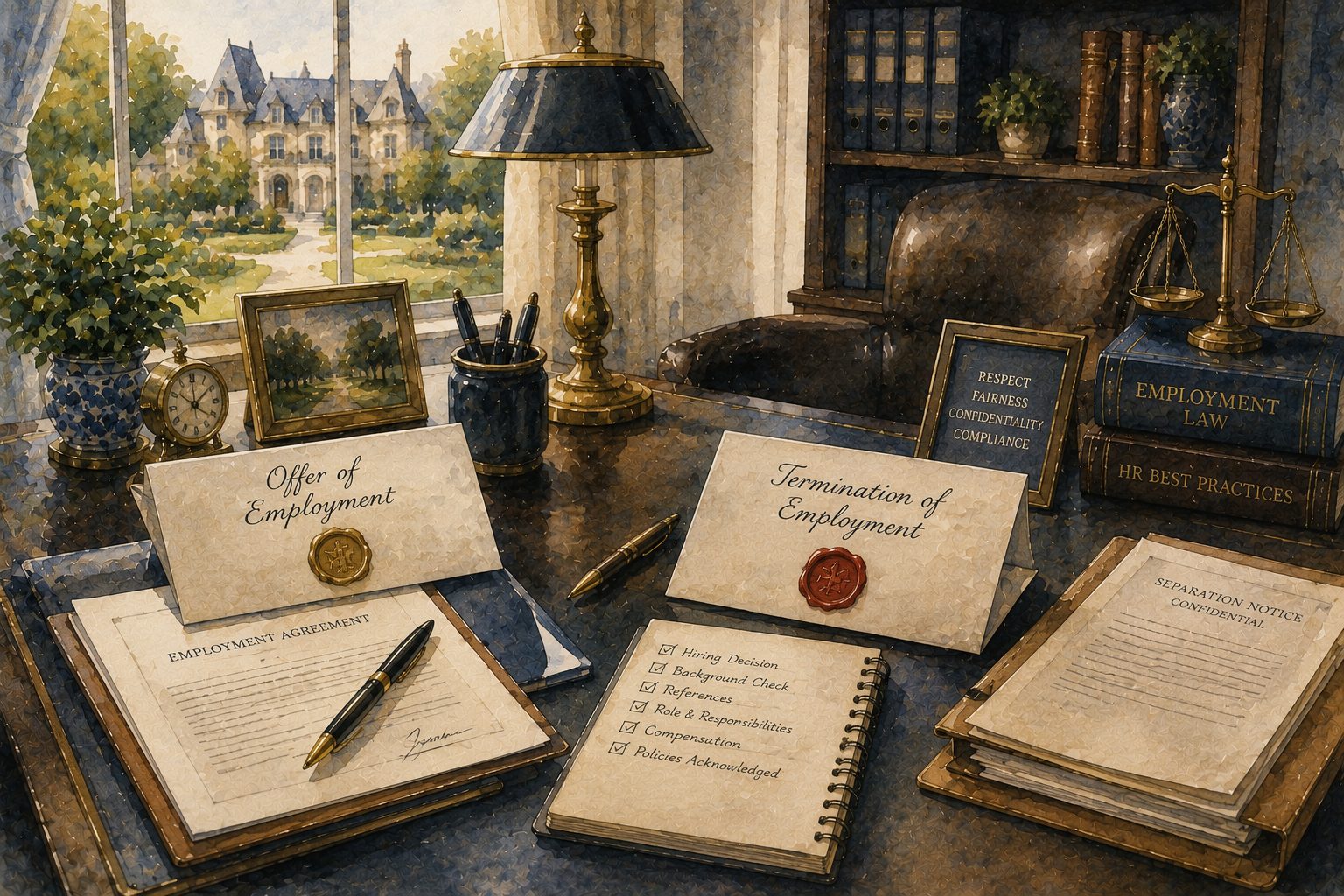
Review of employment documentation practices — employment agreements, offer letters, conduct standards, termination procedures — confirming that the household employer's documentation supports defensible employment decisions.
COORDINATION WITH WORKERS COMPENSATION AND HOUSEHOLD PROGRAM
Coordination of EPLI coverage with workers compensation, fidelity and crime, and the household liability program — confirming that the full range of household employer liability is addressed without gaps across the coordinated program.
FOUR HOUSEHOLD EPLI SITUATIONS THAT GENERATE CLAIMS.
A household employer who terminates a nanny or housekeeper who has worked in the household for several years, without documented performance issues or a clear non-discriminatory reason, faces significant wrongful termination exposure. The long tenure and the absence of documentation both work against the employer in a claim.
A housekeeper who works 45 to 50 hours per week and has not been paid overtime for the hours above 40 has a wage and hour claim under the FLSA. The back pay obligation covers all unpaid overtime — potentially for two to three years — plus an equal amount in liquidated damages. EPLI with a wage and hour endorsement covers the defense and, to the extent covered, the back pay obligation.
A household employee who claims that the employer's family members — spouse, adult children, or guests — subjected them to unwelcome conduct based on a protected characteristic has a harassment claim against the household employer. The employer is responsible for the household work environment, including conduct by family members and guests.
Household employers who employ workers with work authorization requirements face specific EPLI exposure related to immigration status — discriminating against workers based on national origin in the I-9 process, or taking adverse employment action based on immigration status. Immigration-related employment practices claims are a specific exposure for household employers with immigrant domestic workers.
QUESTIONS THAT OFTEN COME UP.
Do federal employment discrimination laws apply to my household employees?
Yes. Federal employment anti-discrimination law applies to employers with one or more employees, and most state equivalents cover similarly small employers. A private household with a single domestic employee is potentially covered by both federal and state anti-discrimination law.
Does my homeowners policy cover a wrongful termination claim by my nanny?
No. Standard homeowners personal liability coverage does not include employment practices liability. A claim by a household employee alleging wrongful termination or harassment requires specific EPLI coverage to have any insurance response.
Am I required to pay overtime to my housekeeper?
If your housekeeper is a non-exempt employee under the FLSA — which most domestic workers are — overtime is required for hours worked over 40 in a workweek. The overtime rate is one and one-half times the regular rate of pay. Live-in employees have specific overtime rules that differ from day workers. Failure to pay required overtime creates a wage and hour claim.
What is a wage and hour claim?
A wage and hour claim is filed by an employee who claims they were not paid what they were legally entitled to under the FLSA or applicable state wage and hour law — typically including unpaid overtime, minimum wage violations, or improper deductions. Successful wage and hour claims entitle the employee to back pay for the unpaid wages, an equal amount in liquidated damages, and attorney's fees.
Does EPLI cover both the legal defense and any settlement or judgment?
EPLI typically covers legal defense costs and, to the extent covered by the policy, settlement and judgment amounts. The specific coverage terms — whether defense costs are paid separately from or within limits, what the per-claim and aggregate limits are, and what types of claims are covered — vary by policy. Wage and hour coverage in particular is a variable — some EPLI policies include it, others require a specific endorsement.
Should I have a written employment agreement with my household employees?
A written employment agreement — covering job duties, compensation, overtime policies, termination procedures, and conduct standards — significantly strengthens the household employer's position in any employment practices dispute. It establishes clear expectations, documents the terms of employment, and provides a reference point if any aspect of the employment relationship is challenged.
PROTECT THE HOUSEHOLD EMPLOYER FROM THE FULL RANGE OF EMPLOYMENT PRACTICES CLAIMS.
Kelly Insurance Group can help private households review employment practices liability coverage, wage and hour compliance, employment documentation practices, and the complete household employer EPLI program.

The availability of coverage and eligibility for coverage can depend on numerous factors. We cannot guarantee that all customers, individuals, and businesses looking for coverage will be successful in these efforts when contacting our team. All policy coverages and terms need to be fully reviewed by the respective consumer to ensure the coverage asked for is what is specifically being quoted or provided by any insurance policy. Insurance Policies, Coverage Changes, and their terms and conditions are not bound or altered until written confirmation is provided by one of our licensed team members or underwriters. This page does not offer legal advice, legal opinions, or policy interpretations. Rather, this page is meant as a resource to help provide customers and insurance consumers with additional considerations that may help in their insurance buying or pursuit of insurance information. Kelly Insurance Group does not employ or direct attorneys.