PROTECTION PLANNING FOR BOATS YACHTS AND PERSONAL WATERCRAFT
Kelly Insurance Group helps high-net-worth individuals and private clients review insurance for boats, yachts, personal watercraft, and marina-based vessels — addressing hull and machinery coverage, protection and indemnity liability, crew coverage, navigation territory, and the full range of watercraft insurance considerations for vessels of all sizes and uses.
THE SPECIFIC COVERAGE COMPONENTS OF YACHT AND BOAT INSURANCE — AND WHY EACH MATTERS.
Hull and machinery coverage addresses physical damage to the vessel — including the hull, machinery, equipment, and in many cases the dinghy, tender, and outboard motors. Agreed value coverage — paying the full agreed amount in the event of a total loss — is the appropriate structure for any significant vessel. For yachts and high-value powerboats, the agreed value should be based on a current marine survey rather than a general market estimate.
Protection and indemnity (P&I) coverage is the marine equivalent of liability insurance. It covers bodily injury to third parties, property damage to other vessels and structures, and wreck removal liability. P&I limits for significant vessels should be reviewed against the potential liability exposure — a large vessel involved in a collision can create multi-million dollar property damage and injury claims.
The Jones Act is a federal law that provides significant rights to injured seamen working aboard vessels. A vessel owner with hired crew — even a part-time captain, a mate, or a deckhand — is potentially subject to Jones Act claims if a crew member is injured. Specific Jones Act crew coverage, or confirmation that the P&I policy addresses Jones Act liability, is an essential component of coverage for any vessel with paid crew.
A policy written for coastal cruising on the East Coast may not cover a vessel that heads to the Bahamas or the Caribbean. Navigation warranties in yacht policies define where the vessel may operate — and operating outside the territory may constitute a breach of warranty that voids coverage for a loss occurring in the unauthorized area.
A vessel that spills fuel or oil in navigable waters can trigger significant cleanup liability under the Oil Pollution Act of 1990. Pollution liability coverage addresses fuel spill cleanup costs and government penalties. Not all P&I policies automatically include pollution coverage, and this should be specifically confirmed for larger power vessels with significant fuel capacity.
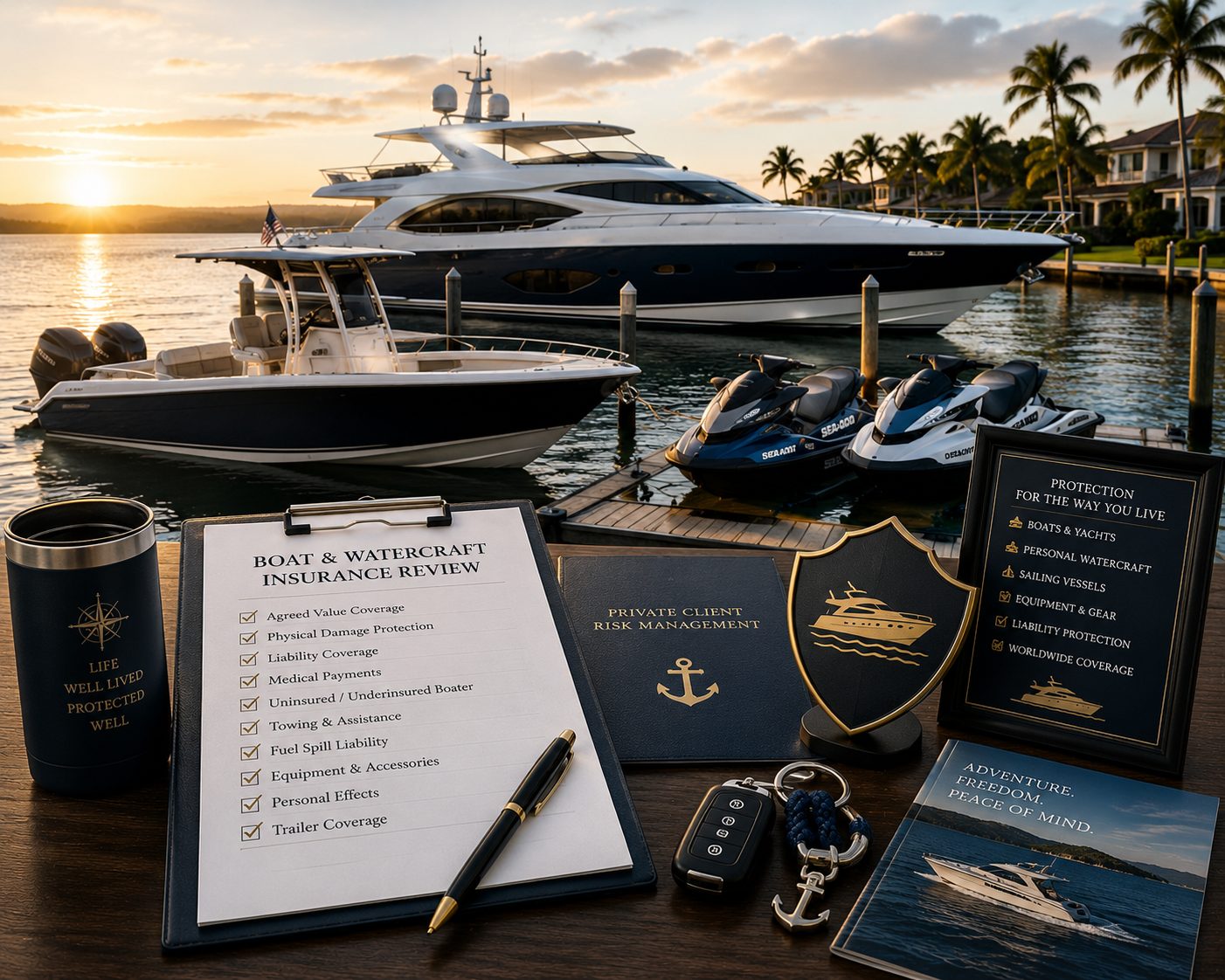
WATERCRAFT INSURANCE COVERAGE ELEMENTS
PRIVATE CLIENTS WHO NEED A WATERCRAFT INSURANCE REVIEW.
Any private client who owns a vessel — from a high-end center console to a full-displacement yacht — benefits from a watercraft insurance review that confirms hull value, P&I limits, navigation territory, and crew coverage are all appropriate for the vessel and its use.
- Yacht owners with vessels above the value threshold of standard boat owner policies
- Private clients with offshore powerboats, sport fishing vessels, or center consoles representing significant value
- Vessel owners with paid crew — captains, mates, or deckhands — who need Jones Act coverage review
- Sailors and powerboaters who cruise extensively and need navigation territory that matches their cruising range
- PWC owners who want dedicated watercraft coverage beyond what homeowners policies provide
- Any vessel owner whose current watercraft coverage has not been reviewed with a current marine survey
SELECT YOUR WATERCRAFT TYPE TO SEE THE RELEVANT COVERAGE CONSIDERATIONS.
Boat, yacht, and personal watercraft insurance requirements vary based on vessel type, size, value, how it is used, and where it operates.
Yachts and large vessels — typically 30 feet and above — require a specific yacht policy rather than a standard boat owner policy. Hull coverage, protection and indemnity liability, crew coverage, and navigation territory are all specific policy components that must be addressed for larger vessels.
- Hull and machinery — agreed value at current market or survey value
- Protection and indemnity liability — bodily injury and property damage to third parties
- Crew coverage — injury to paid crew members aboard the vessel
- Medical payments for passengers
- Navigation territory — the geographic area where the vessel is permitted to operate
WHAT THE INSURANCE REVIEW COVERS.
HULL AND MACHINERY COVERAGE
Agreed value hull coverage for vessels of all sizes — based on current marine survey — with coverage for the vessel, its machinery, equipment, tenders, and outboards at the agreed value with no depreciation in the event of a total loss.
PROTECTION AND INDEMNITY LIABILITY
P&I liability coverage at limits appropriate for the vessel size and use — covering bodily injury to third parties, property damage to other vessels and structures, wreck removal, and pollution liability for fuel spill cleanup.
CREW AND PASSENGER COVERAGE
Coverage for paid crew — Jones Act liability, crew medical payments, and employer liability — alongside passenger liability coverage for injuries to guests aboard the vessel during recreational use.
NAVIGATION TERRITORY AND CRUISING PROGRAM
Review of navigation territory against the vessel's actual cruising range — expanding coverage territory for vessels used in offshore, foreign, or extended coastal passages to ensure coverage applies where the vessel actually operates.
FOUR WATERCRAFT INSURANCE GAPS PRIVATE CLIENTS FREQUENTLY CARRY.
A marine survey is the basis for an agreed hull value. A vessel whose agreed value reflects a survey from five or more years ago may be significantly under- or over-insured relative to the current market. Annual review of the agreed value against current market conditions is appropriate for significant vessels.
A larger vessel operating in busy coastal waters has far greater liability exposure potential than P&I limits set for a smaller vessel might address. A collision involving a large vessel can generate property damage and bodily injury claims well into the millions. P&I limits should be reviewed against the vessel's actual exposure profile.
A vessel owner who hires a captain for occasional use, a mate for longer passages, or a deckhand for racing season is potentially subject to Jones Act claims. Specific Jones Act coverage or P&I coverage that addresses this exposure is essential for any vessel with paid crew.
A vessel that ventures into the Bahamas, the Caribbean, or other areas outside the policy's defined navigation territory may find that a loss in those waters is not covered. Navigation territory should be reviewed before any extended passage outside the normal cruising area.
QUESTIONS THAT OFTEN COME UP.
What is protection and indemnity coverage?
Protection and indemnity (P&I) is the marine insurance term for liability coverage. It covers bodily injury to third parties, property damage to other vessels and property, and wreck removal costs. For vessels with paid crew, it may also address Jones Act liability. P&I is a distinct component from hull coverage and both are needed for a complete vessel insurance program.
What is the Jones Act and why does it matter for boat owners?
The Jones Act is a federal statute that provides injured seamen — including paid crew on recreational vessels — the right to sue their employer for negligence under a more plaintiff-favorable standard than standard negligence law. A vessel owner with any paid crew is potentially subject to Jones Act claims.
Does homeowners insurance cover my boat?
Standard homeowners policies include limited coverage for small, low-powered boats. Any significant vessel requires a dedicated boat or yacht policy. The homeowners coverage for larger vessels is typically inadequate in both hull value and liability limits.
What is a navigation warranty and why does it matter?
A navigation warranty in a yacht policy defines the geographic area where the vessel is covered. Operating outside this territory may constitute a breach of warranty that voids coverage for a loss in the unauthorized area. The navigation territory should be reviewed and expanded before any passage outside the normal cruising range.
How is a yacht's agreed value established?
A marine survey by a qualified marine surveyor is the standard basis for establishing agreed hull value. The survey assesses the vessel's condition, equipment, and current market value. Surveys are typically required by carriers for new policies and recommended at regular intervals for existing policies.
Does a yacht policy cover the tender and outboard?
Typically yes — most yacht policies include coverage for tenders, dinghies, and their outboard motors as part of the vessel's equipment. The tender's value should be confirmed in the policy schedule.
COVER THE VESSEL COMPLETELY — HULL, LIABILITY, CREW, AND TERRITORY.
Kelly Insurance Group can help private clients review yacht and boat insurance programs — including hull and machinery, protection and indemnity, crew coverage, navigation territory, and coordination with the personal umbrella.
The availability of coverage and eligibility for coverage can depend on numerous factors. We cannot guarantee that all customers, individuals, and businesses looking for coverage will be successful in these efforts when contacting our team. All policy coverages and terms need to be fully reviewed by the respective consumer to ensure the coverage asked for is what is specifically being quoted or provided by any insurance policy. Insurance Policies, Coverage Changes, and their terms and conditions are not bound or altered until written confirmation is provided by one of our licensed team members or underwriters. This page does not offer legal advice, legal opinions, or policy interpretations. Rather, this page is meant as a resource to help provide customers and insurance consumers with additional considerations that may help in their insurance buying or pursuit of insurance information. Kelly Insurance Group does not employ or direct attorneys.